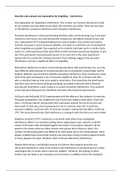
Describe and evaluate one explanation for forgetting – interference
One explanation for forgetting is interference. This is when one memory disrupts the recall
of one another and most likely occurs when the memories are similar. There are two types
of interference: proactive interference and retroactive interference.
Proactive interference is when past learning interferes with current learning. E.g. if you have
moved to a new house, you may find yourself writing your old address instead of your new
one. Underwood (1957) analysed findings from several studies. One of which was where
students were given a set of nonsense syllables and asked to recall them. He concluded that
when forgetting was greater than expected as the students had taken part in a similar study
earlier on. Underwood found that about 80% of what had been learned was forgotten in one
day if the participants had previously learned 15 or more lists in the same experiment,
against 20% if no earlier lists had been learned. These findings suggests that proactive
interference can have a significant effect on forgetting.
Retroactive interference is when current learning interferes with past learning. E.g. you may
have difficulty skiing because of recently learning how to snowboard. Georg Muller and his
student, Pilzecker, were the first to identify retroactive interference. They carried out a study
where they gave participants a set of nonsense syllables to learn for 6 minutes and then,
after a retention interval, they were asked to recall them. They found that the interference
task (they were shown three landscape paintings and asked to describe them) between
learning and recall led to a poor recalls as it caused retroactive interference. This caused RI
as the task (describing pictures) interfered with what they had previously learned.
McGeoch and McDonald (1931) experimented with the effects of the similarity of materials.
They gave participants a list of adjectives (List A) and were asked to learn them. There was
then a 10 minute interval, during which they were given another list (List B) to learn and
then recall. If List B was a list of synonyms for List A, recall was only 12%. If List B was
nonsense syllables, recall was 26%. If List B was numbers, having the least effect, recall was
37%. This study demonstrates that interference is strongest when the items are more similar.
Baddeley and Hitch (1977) conducted a real-world study where they investigated
interference effects in an everyday setting where rugby players were asked to recall the
names of the teams they had played against last season. Some players played in all the
games in the season whereas others missed some games due to illness or injury. The
number of intervening games was different for each player due to the missed games. Some
players recalled teams inaccurately as they may have been relying on teams played recently
or those played in the past, therefore, their recall was affected by interference.
Despite there being a considerable amount of evidence that supports proactive and
retroactive interference, most of the research into interference is lab-based and use mostly
meaningless lists of words and/or nonsense syllables. Therefore, the findings of these
studies may not relate to our everyday uses of memory. In addition to this, the ecological
One explanation for forgetting is interference. This is when one memory disrupts the recall
of one another and most likely occurs when the memories are similar. There are two types
of interference: proactive interference and retroactive interference.
Proactive interference is when past learning interferes with current learning. E.g. if you have
moved to a new house, you may find yourself writing your old address instead of your new
one. Underwood (1957) analysed findings from several studies. One of which was where
students were given a set of nonsense syllables and asked to recall them. He concluded that
when forgetting was greater than expected as the students had taken part in a similar study
earlier on. Underwood found that about 80% of what had been learned was forgotten in one
day if the participants had previously learned 15 or more lists in the same experiment,
against 20% if no earlier lists had been learned. These findings suggests that proactive
interference can have a significant effect on forgetting.
Retroactive interference is when current learning interferes with past learning. E.g. you may
have difficulty skiing because of recently learning how to snowboard. Georg Muller and his
student, Pilzecker, were the first to identify retroactive interference. They carried out a study
where they gave participants a set of nonsense syllables to learn for 6 minutes and then,
after a retention interval, they were asked to recall them. They found that the interference
task (they were shown three landscape paintings and asked to describe them) between
learning and recall led to a poor recalls as it caused retroactive interference. This caused RI
as the task (describing pictures) interfered with what they had previously learned.
McGeoch and McDonald (1931) experimented with the effects of the similarity of materials.
They gave participants a list of adjectives (List A) and were asked to learn them. There was
then a 10 minute interval, during which they were given another list (List B) to learn and
then recall. If List B was a list of synonyms for List A, recall was only 12%. If List B was
nonsense syllables, recall was 26%. If List B was numbers, having the least effect, recall was
37%. This study demonstrates that interference is strongest when the items are more similar.
Baddeley and Hitch (1977) conducted a real-world study where they investigated
interference effects in an everyday setting where rugby players were asked to recall the
names of the teams they had played against last season. Some players played in all the
games in the season whereas others missed some games due to illness or injury. The
number of intervening games was different for each player due to the missed games. Some
players recalled teams inaccurately as they may have been relying on teams played recently
or those played in the past, therefore, their recall was affected by interference.
Despite there being a considerable amount of evidence that supports proactive and
retroactive interference, most of the research into interference is lab-based and use mostly
meaningless lists of words and/or nonsense syllables. Therefore, the findings of these
studies may not relate to our everyday uses of memory. In addition to this, the ecological