ZSO1 BIOCOMPATIBILITY
Biomaterial science
Focus of materials science in general on:
1. Composition: the chemical make-up of materials
2. Properties: the functional characteristics of materials and analytical methods to measure these characteristics
3. Structure: a description of the arrangements of atoms or ions in materials
Biomaterials science focuses on:
Materials of a biological origin
Materials with an application in the biomedical sciences
Classification of materials
Main classes
o Metals and alloys
o Ceramics and glasses
o Organic materials (Polymers and plastics)
Subclasses
o Semiconductors
o Composites
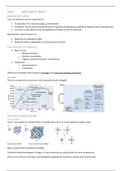
Differences amongst others based on strength and solid state bonding properties
Strength
There is an elastic limit and stress limit (maximal tensile strength)
Solid state bonding properties
Ionic bonding
One or more electrons transfer from a metallic donor atom to a non-metallic acceptor atom
Simple cubic lattice Face centered cubic lattice
Many crystal structures/lattices possible.
Coulomb interaction between charges Ionic materials are usually solids at room temperature
Purely ionic solids do not have many biomedical applications (However, glasses and ceramics do!)
,Covalent bonding
Characteristics of covalent bonding
Octet rule (atoms in molecules strive to noble gas configurations)
Emphasizes sharing of electrons
Large variety in the arrangement of atoms is possible: unlimited number of molecules can exist
No long range bonding: gasses, liquids and solids
Electronegativity
Polar covalent bonds are not fully symmetrical
Bond polarities are due to differences in electronegativity
Inductive effect: the shift in electrons in a covalent bond due to the electronegativity of nearby atoms
Small difference in electronegativity: non-polar covalent bond
Difference of ~2 or less in electronegativity: polar covalent bond
Difference of more than ~2 in electronegativity: ionic bond
Electronegativity is given on a relative scale developed by Linus Pauling.
Metallic bonding
Free electron model: electrons are shared with all neighbours!
Characteristics of metal bonding
Long range bonding: usually solids at room temperature (sometimes liquids)
Delocalized character of bonding gives strength to material
Delocalized character of bonding allows deformations
Weak bonding
London forces (dispersion interactions)
Dipole-induced dipole interaction
Dipole-dipole interaction
Hydrogen bonding
,Classification of Materials (based on chemical bonding): metal, covalent, ionic
Classes of Materials: metals, polymers, ceramics and glasses composites etc.
Classes of Materials
Metals
Usually FCC, HCP or BCC crystal lattice
Good thermal and electrical conductors
Produced from ores
Often used in alloys
Need surface treatment
Two Classes:
o Ferrous metals and alloys
o Nonferrous metals and alloys
First step involves mostly chemistry and is often laborious
Example: Extraction of magnesium
Stainless steel
(very relevant for biomedical applications such as implants)
A group of ferrous alloys that contain at least 11% Cr, providing extraordinary corrosion resistance.
Categories of stainless steels:
Ferritic Mostly BCC (body-centered cubic) structure, poor alloy, only moderate improvements
Martensitic Complex structure, very strong, poor corrosi resistance
Austenitic FCC (face centered cubic) structure, most common, usually employed in biomedical sciences
, Often also used: 316L (L = low carbon)
ASTM 316L (American Society of Testing and Materials): alloy optimized for surface and bulk microstructure
Fe Bulk metal
Cr Gives corrosion resistant Cr2O3 surface
Ni Stabilizes stronger austenitic FCC phase
Low C Reduces formation of grain boundaries, improves corrosion resistance
Many other (non-ferrous) alloys have also been developed for improved surface characteristics or mechanical
properties.
Cobalt based alloys
(for example hip implants).
Often made using casting
Disadvantages:
o Formation of interdendritic regions during melting
o Large grain size
o Casting defects
Solution: Hot isostatic pressing
Titanium-based alloys
(for example dental implants)
Excellent corrosion resistance provides applications in chemical processing equipment, marine components and
biomedical implants.
Titanium alloys are considered biocompatible (i.e., they are not rejected by the
body). By developing porous coatings of bone-like ceramic compositions known as
hydroxyapatite, it may be possible to make titanium implants bioactive (i.e., the
natural bone can grow into the hydroxyapatite coating).
← α = HCP and β = BCC
Alpha-beta = ASTM F136
Biomaterial science
Focus of materials science in general on:
1. Composition: the chemical make-up of materials
2. Properties: the functional characteristics of materials and analytical methods to measure these characteristics
3. Structure: a description of the arrangements of atoms or ions in materials
Biomaterials science focuses on:
Materials of a biological origin
Materials with an application in the biomedical sciences
Classification of materials
Main classes
o Metals and alloys
o Ceramics and glasses
o Organic materials (Polymers and plastics)
Subclasses
o Semiconductors
o Composites
Differences amongst others based on strength and solid state bonding properties
Strength
There is an elastic limit and stress limit (maximal tensile strength)
Solid state bonding properties
Ionic bonding
One or more electrons transfer from a metallic donor atom to a non-metallic acceptor atom
Simple cubic lattice Face centered cubic lattice
Many crystal structures/lattices possible.
Coulomb interaction between charges Ionic materials are usually solids at room temperature
Purely ionic solids do not have many biomedical applications (However, glasses and ceramics do!)
,Covalent bonding
Characteristics of covalent bonding
Octet rule (atoms in molecules strive to noble gas configurations)
Emphasizes sharing of electrons
Large variety in the arrangement of atoms is possible: unlimited number of molecules can exist
No long range bonding: gasses, liquids and solids
Electronegativity
Polar covalent bonds are not fully symmetrical
Bond polarities are due to differences in electronegativity
Inductive effect: the shift in electrons in a covalent bond due to the electronegativity of nearby atoms
Small difference in electronegativity: non-polar covalent bond
Difference of ~2 or less in electronegativity: polar covalent bond
Difference of more than ~2 in electronegativity: ionic bond
Electronegativity is given on a relative scale developed by Linus Pauling.
Metallic bonding
Free electron model: electrons are shared with all neighbours!
Characteristics of metal bonding
Long range bonding: usually solids at room temperature (sometimes liquids)
Delocalized character of bonding gives strength to material
Delocalized character of bonding allows deformations
Weak bonding
London forces (dispersion interactions)
Dipole-induced dipole interaction
Dipole-dipole interaction
Hydrogen bonding
,Classification of Materials (based on chemical bonding): metal, covalent, ionic
Classes of Materials: metals, polymers, ceramics and glasses composites etc.
Classes of Materials
Metals
Usually FCC, HCP or BCC crystal lattice
Good thermal and electrical conductors
Produced from ores
Often used in alloys
Need surface treatment
Two Classes:
o Ferrous metals and alloys
o Nonferrous metals and alloys
First step involves mostly chemistry and is often laborious
Example: Extraction of magnesium
Stainless steel
(very relevant for biomedical applications such as implants)
A group of ferrous alloys that contain at least 11% Cr, providing extraordinary corrosion resistance.
Categories of stainless steels:
Ferritic Mostly BCC (body-centered cubic) structure, poor alloy, only moderate improvements
Martensitic Complex structure, very strong, poor corrosi resistance
Austenitic FCC (face centered cubic) structure, most common, usually employed in biomedical sciences
, Often also used: 316L (L = low carbon)
ASTM 316L (American Society of Testing and Materials): alloy optimized for surface and bulk microstructure
Fe Bulk metal
Cr Gives corrosion resistant Cr2O3 surface
Ni Stabilizes stronger austenitic FCC phase
Low C Reduces formation of grain boundaries, improves corrosion resistance
Many other (non-ferrous) alloys have also been developed for improved surface characteristics or mechanical
properties.
Cobalt based alloys
(for example hip implants).
Often made using casting
Disadvantages:
o Formation of interdendritic regions during melting
o Large grain size
o Casting defects
Solution: Hot isostatic pressing
Titanium-based alloys
(for example dental implants)
Excellent corrosion resistance provides applications in chemical processing equipment, marine components and
biomedical implants.
Titanium alloys are considered biocompatible (i.e., they are not rejected by the
body). By developing porous coatings of bone-like ceramic compositions known as
hydroxyapatite, it may be possible to make titanium implants bioactive (i.e., the
natural bone can grow into the hydroxyapatite coating).
← α = HCP and β = BCC
Alpha-beta = ASTM F136