SOCIAL INFLUENCE
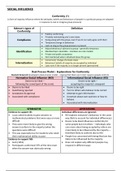
Conformity (1)
(a form of majority influence where the attitudes, beliefs and behaviours of people in a particular group are adopted
in response to real or imagine group pressure)
Kelman’s types of Definition
Conformity
• Publicly conforming
• Privately maintaining one’s own views
Compliance • Going along with the group, even if we do no really agree with them
• Temporary change in behaviour
• Lasts as long as the group pressure is present
• Adjust behaviour/ opinions to group – generally temporary
Identification • Membership is desirable – members are role models
• Private and public acceptance
• Not maintained when individuals leave the group
• Conversion/ change of private views
Internalisation • Behaviour/ beliefs of majority are accepted by individual
• Lasts even if the majority is no longer present (permanent)
Dual Process Model – Explanations for Conformity
Deutsch & Gerard developed a dual process model – arguing that there are 2 main reasons people conform.
Normative Social Influence (NSI) Informational Social Influence (ISI)
Desire to be liked – Desire to be right –
following the crowd (part of the norm) accepting the majority’s viewpoint
• Desire to be liked • Desire to be right
• Avoid being rejected • Turn to others who believe to be correct
• Acceptance & approval • Attempt to gain information
• Associated with compliance • Uncertain about own opinions or how to
behave
• Associated with internalisation
STRENGTHS LIMITATIONS
Evidence to support ISI: Individual differences are ignored:
• Lucas asked students to give answers to • NSI explains everyone’s behaviour in the same
mathematical problems that were easy or more way (fails to account for individual differences)
difficult • Desire to be liked influences conformity for
• They were more likely to give the wrong some people but not others – individuals who
answer (conform to the majority) when the care more about being accepted by others are
questions were difficult more likely to be influenced by the majority –
• This was especially true for students who rated therefore likely to conform due to NSI
their mathematical ability as poor • People less concerned with being liked are less
Evidence to support NSI: likely to be influenced by the majority
• Asch (1951) • Does not explain why different people may
• Participants conformed 37% of the time even respond in different ways
when the answer was obviously wrong
Conformity (1)
(a form of majority influence where the attitudes, beliefs and behaviours of people in a particular group are adopted
in response to real or imagine group pressure)
Kelman’s types of Definition
Conformity
• Publicly conforming
• Privately maintaining one’s own views
Compliance • Going along with the group, even if we do no really agree with them
• Temporary change in behaviour
• Lasts as long as the group pressure is present
• Adjust behaviour/ opinions to group – generally temporary
Identification • Membership is desirable – members are role models
• Private and public acceptance
• Not maintained when individuals leave the group
• Conversion/ change of private views
Internalisation • Behaviour/ beliefs of majority are accepted by individual
• Lasts even if the majority is no longer present (permanent)
Dual Process Model – Explanations for Conformity
Deutsch & Gerard developed a dual process model – arguing that there are 2 main reasons people conform.
Normative Social Influence (NSI) Informational Social Influence (ISI)
Desire to be liked – Desire to be right –
following the crowd (part of the norm) accepting the majority’s viewpoint
• Desire to be liked • Desire to be right
• Avoid being rejected • Turn to others who believe to be correct
• Acceptance & approval • Attempt to gain information
• Associated with compliance • Uncertain about own opinions or how to
behave
• Associated with internalisation
STRENGTHS LIMITATIONS
Evidence to support ISI: Individual differences are ignored:
• Lucas asked students to give answers to • NSI explains everyone’s behaviour in the same
mathematical problems that were easy or more way (fails to account for individual differences)
difficult • Desire to be liked influences conformity for
• They were more likely to give the wrong some people but not others – individuals who
answer (conform to the majority) when the care more about being accepted by others are
questions were difficult more likely to be influenced by the majority –
• This was especially true for students who rated therefore likely to conform due to NSI
their mathematical ability as poor • People less concerned with being liked are less
Evidence to support NSI: likely to be influenced by the majority
• Asch (1951) • Does not explain why different people may
• Participants conformed 37% of the time even respond in different ways
when the answer was obviously wrong