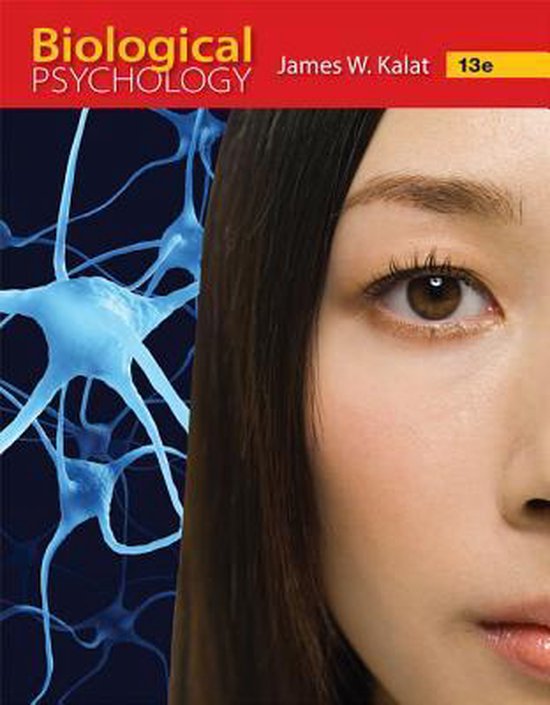
TEST BANK FOR BIOLOGICAL PSYCHOLOGY,
13TH EDITION, JAMES W. KALAT.
,Name: Class: Date:
Chapter 01
1. Dendrites contain the nuclei, ribosomes, mitochondria, and other structures found in most cells.
a. True
b. False
ANSWER: False
2. Neurons receive information and transmit it to other cells.
a. True
b. False
ANSWER: True
3. Santiago Ramón y Cajal used special staining techniques to reveal that the brain is composed of individual cells.
a. True
b. False
ANSWER: True
4. An efferent axon carries information away from a structure.
a. True
b. False
ANSWER: True
5. The greater the surface area of a dendrite, the more information it can receive from other neurons.
a. True
b. False
ANSWER: True
6. Neurons are distinguished from other cells by their shape.
a. True
b. False
ANSWER: True
7. The role of glial cells is to act like “glue” or scaffolding to support the neurons.
a. True
b. False
ANSWER: False
8. Glial cells transmit information across long distances.
a. True
b. False
ANSWER: False
9. There are two types of glial cells that produce myelin sheath. In the central nervous system, Schwann cells fulfill this
role and, in the periphery, oligodendrocytes produce it.
Copyright Cengage Learning. Powered by Cognero. Page 1
, Stuvia.com Stuvia.com - The .
The MarketplaceMarketplace to
to BuyBuy
and
andSellSell youryour StudyStudy MaterialMaterial
Name: Class: Date:
Chapter 01
a. True
b. False
ANSWER: False
10. The blood-brain barrier is made up of closely packed glial cells.
a. True
b. False
ANSWER: False
11. The difference in voltage in a resting neuron is called the resting potential.
a. True
b. False
ANSWER: True
12. Increasing the electrical gradient for potassium will reduce the tendency for potassium ions to exit the neuron.
a. True
b. False
ANSWER: True
13. At the resting potential, the potassium channels are completely closed and the sodium channels are almost closed.
a. True
b. False
ANSWER: False
14. Dr. Skinner is working in the lab measuring the voltage of neurons, and during one condition, she tried to
depolarizethe neurons from -70 mV to -80 mV.
a. True
b. False
ANSWER: False
15. Action potentials can be produced in the dendrites of some neurons.
a. True
b. False
ANSWER: False
16. The two basic kinds of cells in the nervous system are .
a. neurons and glia
b. dendrites and axons
c. ribosomes and lysosomes
d. neurons and axons
ANSWER: a
Copyright Cengage Learning. Powered by Cognero. Page 2
, Stuvia.com Stuvia.com - The .
The MarketplaceMarketplace to
to BuyBuy
and
andSellSell youryour StudyStudy MaterialMaterial
Name: Class: Date:
Chapter 01
17. Santiago Ramon y Cajal demonstrated that .
a. at rest, the neuron has a negative charge inside its membrane
b. neurons are separate from one another
c. neurons communicate at specialized junctions called synapses
d. action potentials follow the all-or-none law
ANSWER: b
18. Both and shared the Nobel Prize for Physiology or Medicine in 1906.
a. Golgi and Cajal
b. Cajal and Sherrington
c. Sherrington and Golgi
d. Cajal and Kalat
ANSWER: a
19. Dr. Kimi studies the plasma membrane of neurons. He specifically researches the specialized that allow
inimportant things like water, oxygen, sodium, and so on.
a. lipid channels
b. protein channels
c. lipid receptors
d. protein receptors
ANSWER: b
20. Neurons differ most strongly from other body cells in their .
a. temperature
b. shape
c. osmotic pressure
d. mitochondria
ANSWER: b
21. What do neurons have that other cells do not?
a. A plasma membrane
b. Large, branching extensions
c. Protein channels
d. An endoplasmic reticulum
ANSWER: b
22. Dr. McLaughlin’s lab studies how newly formed proteins are folded inside neurons. They would be most interested in
studying the .
a. endoplasmic reticulum
b. mitochondria
c. ribosomes
Copyright Cengage Learning. Powered by Cognero. Page 3
, Stuvia.com Stuvia.com - The .
The MarketplaceMarketplace to
to BuyBuy
and
andSellSell youryour StudyStudy MaterialMaterial
Name: Class: Date:
Chapter 01
d. nucleus
ANSWER: c
23. Water, oxygen, and freely flow across a cell membrane.
a. calcium
b. positively charged ions
c. magnesium
d. carbon dioxide
ANSWER: d
24. The structure that contains a cell’s chromosomes is called the .
a. endoplasmic reticulum
b. nucleus
c. mitochondrion
d. ribosome
ANSWER: b
25. Small, charged molecules can cross the cell membrane through .
a. diffusion
b. ribosomes
c. mitochondria
d. protein channels
ANSWER: d
26. Professor Lopez studies the specialized in the eye that detect light.
a. motor neurons
b. sensory neurons
c. glial cells
d. interneurons
ANSWER: b
27. Ribosomes are the part of a cell that .
a. performs metabolic activities
b. breaks down harmful chemicals
c. transports proteins
d. synthesizes new proteins
ANSWER: d
28. The endoplasmic reticulum is a .
a. network of thin tubes that transport newly synthesized proteins
b. site where the cell synthesizes new protein molecules
Copyright Cengage Learning. Powered by Cognero. Page 4
, Stuvia.com Stuvia.com - The .
The MarketplaceMarketplace to
to BuyBuy
and
andSellSell youryour StudyStudy MaterialMaterial
Name: Class: Date:
Chapter 01
c. structure that separates the inside of the cell from the outside
d. structure that contains the chromosomes
ANSWER: a
29. Dendrites .
a. contain the nucleus, ribosomes, and other structures found in most cells
b. are branching fibers that get narrower near their ends
c. are thin fibers of constant diameter
d. are an insulating material that cover an axon
ANSWER: b
30. The branching fibers that form the information-receiving pole of the nerve cells are called .
a. motor neurons
b. dendrites
c. sensory neurons
d. axons
ANSWER: b
31. Professor Xi studies the located on the of neurons in order to better understand how messages
arereceived by the neuron.
a. synaptic receptors; dendrites
b. axons; somas
c. synaptic hillocks; dendrites
d. synaptic receptors; somas
ANSWER: a
32. The tree-like branches of a neuron that receive information from other neurons are called .
a. axons
b. dendrites
c. soma
d. myelin
ANSWER: b
33. Many dendrites contain short outgrowths called spines that .
a. increase the surface area available for synapses
b. increase the speed of transmission
c. eliminate cell waste products
d. increase the symmetry of the soma
ANSWER: a
34. As compared to dendrites, axons usually .
Copyright Cengage Learning. Powered by Cognero. Page 5
, Stuvia.com Stuvia.com - The .
The MarketplaceMarketplace to
to BuyBuy
and
andSellSell youryour StudyStudy MaterialMaterial
Name: Class: Date:
Chapter 01
a. form the information-receiving pole of the neuron
b. are shorter in length
c. are covered with myelin
d. taper in diameter toward their periphery
ANSWER: c
35. The insulating material that covers many vertebrate axons is called the .
a. dendrite
b. myelin sheath
c. cell body or soma
d. presynaptic terminal
ANSWER: b
36. Jasmine is in her physiology lab practicing labeling a neuron. When she gets to the nodes of Ranvier, she will
belabeling .
a. the spiny outgrowths on dendrites
b. the myelin sheath
c. the swelling at the end of the axon
d. the gaps in the myelin sheath along the axon
ANSWER: d
37. Gaps in the insulating material that surrounds axons are known as .
a. interpeduncular nuclei
b. nodes of Ranvier
c. myelin synapses
d. presynaptic terminals
ANSWER: b
38. A presynaptic terminal is also known as .
a. an end bulb
b. a node of Ranvier
c. myelin
d. a spine
ANSWER: a
39. An axon has many branches, each of which swells at its tip. These are known as .
a. presynaptic terminals
b. efferent axons
c. afferent axons
d. intrinsic neurons
ANSWER: a
Copyright Cengage Learning. Powered by Cognero. Page 6
, Stuvia.com Stuvia.com - The .
The MarketplaceMarketplace to
to BuyBuy
and
andSellSell youryour StudyStudy MaterialMaterial
Name: Class: Date:
Chapter 01
40. Professor Case studies how drugs of abuse change the amount of chemical that neurons release from the
presynapticterminal into the .
a. dendritic terminal
b. junction between neurons
c. afferent space
d. nucleus
ANSWER: b
41. Neurons typically have one , but many .
a. dendrite; axons
b. axon; dendrites
c. cell body; axons
d. dendrite; cell bodies
ANSWER: b
42. As a general rule, axons convey information .
a. toward dendrites of their own cell
b. toward their own cell body
c. away from their own cell body
d. to surrounding glia
ANSWER: c
43. If you were to accidentally touch a hot stove with your hand, you would quickly pull your hand away. The
information carried to the muscles in your arm to make them contract was carried by .
a. efferent neurons
b. afferent neurons
c. intrinsic neurons
d. sensory neurons
ANSWER: a
44. If all of a neuron’s dendrites or axons were contained within the spinal cord, it would be considered a(n) neuron.
a. efferent
b. afferent
c. intrinsic
d. Purkinje
ANSWER: c
45. What type of neuron in the pons receives information only from other cells in the pons and sends information only to
other cells in the pons?
a. Afferent
b. Efferent
Copyright Cengage Learning. Powered by Cognero. Page 7
, Stuvia.com Stuvia.com - The .
The MarketplaceMarketplace to
to BuyBuy
and
andSellSell youryour StudyStudy MaterialMaterial
Name: Class: Date:
Chapter 01
c. Intrinsic
d. Inter-synaptic
ANSWER: c
46. Professor Peach is lecturing in her class about glial cells. She will tell her class that glial cells .
a. are less common than neurons in the human nervous system.
b. are responsible for transmitting information within the peripheral nervous system.
c. are the “glue” that holds all of the neurons together in the brain.
d. are not as well studied as neurons but have been shown to perform many important functions in the
nervoussystem.
ANSWER: d
47. What type of glia helps to synchronize the activity of axons?
a. Oligodendrocytes
b. Astrocytes
c. Radial glia
d. Schwann cells
ANSWER: b
48. Which type of glia remove waste material in the nervous system?
a. Astrocytes
b. Schwann cells
c. Oligodendrocytes
d. Radial glia
ANSWER: a
49. What type of glial cells myelinate axons in the brain and spinal cord?
a. oligodendrocytes
b. Schwann cells
c. radial glia
d. astrocytes
ANSWER: a
50. Which type of glia release chemicals that modify the activity of neighboring neurons?
a. Astrocytes
b. Schwann cells
c. Oligodendrocytes
d. Radial glia
ANSWER: a
51. Which type of glia builds myelin sheaths around axons in the periphery of the body?
Copyright Cengage Learning. Powered by Cognero. Page 8
13TH EDITION, JAMES W. KALAT.
,Name: Class: Date:
Chapter 01
1. Dendrites contain the nuclei, ribosomes, mitochondria, and other structures found in most cells.
a. True
b. False
ANSWER: False
2. Neurons receive information and transmit it to other cells.
a. True
b. False
ANSWER: True
3. Santiago Ramón y Cajal used special staining techniques to reveal that the brain is composed of individual cells.
a. True
b. False
ANSWER: True
4. An efferent axon carries information away from a structure.
a. True
b. False
ANSWER: True
5. The greater the surface area of a dendrite, the more information it can receive from other neurons.
a. True
b. False
ANSWER: True
6. Neurons are distinguished from other cells by their shape.
a. True
b. False
ANSWER: True
7. The role of glial cells is to act like “glue” or scaffolding to support the neurons.
a. True
b. False
ANSWER: False
8. Glial cells transmit information across long distances.
a. True
b. False
ANSWER: False
9. There are two types of glial cells that produce myelin sheath. In the central nervous system, Schwann cells fulfill this
role and, in the periphery, oligodendrocytes produce it.
Copyright Cengage Learning. Powered by Cognero. Page 1
, Stuvia.com Stuvia.com - The .
The MarketplaceMarketplace to
to BuyBuy
and
andSellSell youryour StudyStudy MaterialMaterial
Name: Class: Date:
Chapter 01
a. True
b. False
ANSWER: False
10. The blood-brain barrier is made up of closely packed glial cells.
a. True
b. False
ANSWER: False
11. The difference in voltage in a resting neuron is called the resting potential.
a. True
b. False
ANSWER: True
12. Increasing the electrical gradient for potassium will reduce the tendency for potassium ions to exit the neuron.
a. True
b. False
ANSWER: True
13. At the resting potential, the potassium channels are completely closed and the sodium channels are almost closed.
a. True
b. False
ANSWER: False
14. Dr. Skinner is working in the lab measuring the voltage of neurons, and during one condition, she tried to
depolarizethe neurons from -70 mV to -80 mV.
a. True
b. False
ANSWER: False
15. Action potentials can be produced in the dendrites of some neurons.
a. True
b. False
ANSWER: False
16. The two basic kinds of cells in the nervous system are .
a. neurons and glia
b. dendrites and axons
c. ribosomes and lysosomes
d. neurons and axons
ANSWER: a
Copyright Cengage Learning. Powered by Cognero. Page 2
, Stuvia.com Stuvia.com - The .
The MarketplaceMarketplace to
to BuyBuy
and
andSellSell youryour StudyStudy MaterialMaterial
Name: Class: Date:
Chapter 01
17. Santiago Ramon y Cajal demonstrated that .
a. at rest, the neuron has a negative charge inside its membrane
b. neurons are separate from one another
c. neurons communicate at specialized junctions called synapses
d. action potentials follow the all-or-none law
ANSWER: b
18. Both and shared the Nobel Prize for Physiology or Medicine in 1906.
a. Golgi and Cajal
b. Cajal and Sherrington
c. Sherrington and Golgi
d. Cajal and Kalat
ANSWER: a
19. Dr. Kimi studies the plasma membrane of neurons. He specifically researches the specialized that allow
inimportant things like water, oxygen, sodium, and so on.
a. lipid channels
b. protein channels
c. lipid receptors
d. protein receptors
ANSWER: b
20. Neurons differ most strongly from other body cells in their .
a. temperature
b. shape
c. osmotic pressure
d. mitochondria
ANSWER: b
21. What do neurons have that other cells do not?
a. A plasma membrane
b. Large, branching extensions
c. Protein channels
d. An endoplasmic reticulum
ANSWER: b
22. Dr. McLaughlin’s lab studies how newly formed proteins are folded inside neurons. They would be most interested in
studying the .
a. endoplasmic reticulum
b. mitochondria
c. ribosomes
Copyright Cengage Learning. Powered by Cognero. Page 3
, Stuvia.com Stuvia.com - The .
The MarketplaceMarketplace to
to BuyBuy
and
andSellSell youryour StudyStudy MaterialMaterial
Name: Class: Date:
Chapter 01
d. nucleus
ANSWER: c
23. Water, oxygen, and freely flow across a cell membrane.
a. calcium
b. positively charged ions
c. magnesium
d. carbon dioxide
ANSWER: d
24. The structure that contains a cell’s chromosomes is called the .
a. endoplasmic reticulum
b. nucleus
c. mitochondrion
d. ribosome
ANSWER: b
25. Small, charged molecules can cross the cell membrane through .
a. diffusion
b. ribosomes
c. mitochondria
d. protein channels
ANSWER: d
26. Professor Lopez studies the specialized in the eye that detect light.
a. motor neurons
b. sensory neurons
c. glial cells
d. interneurons
ANSWER: b
27. Ribosomes are the part of a cell that .
a. performs metabolic activities
b. breaks down harmful chemicals
c. transports proteins
d. synthesizes new proteins
ANSWER: d
28. The endoplasmic reticulum is a .
a. network of thin tubes that transport newly synthesized proteins
b. site where the cell synthesizes new protein molecules
Copyright Cengage Learning. Powered by Cognero. Page 4
, Stuvia.com Stuvia.com - The .
The MarketplaceMarketplace to
to BuyBuy
and
andSellSell youryour StudyStudy MaterialMaterial
Name: Class: Date:
Chapter 01
c. structure that separates the inside of the cell from the outside
d. structure that contains the chromosomes
ANSWER: a
29. Dendrites .
a. contain the nucleus, ribosomes, and other structures found in most cells
b. are branching fibers that get narrower near their ends
c. are thin fibers of constant diameter
d. are an insulating material that cover an axon
ANSWER: b
30. The branching fibers that form the information-receiving pole of the nerve cells are called .
a. motor neurons
b. dendrites
c. sensory neurons
d. axons
ANSWER: b
31. Professor Xi studies the located on the of neurons in order to better understand how messages
arereceived by the neuron.
a. synaptic receptors; dendrites
b. axons; somas
c. synaptic hillocks; dendrites
d. synaptic receptors; somas
ANSWER: a
32. The tree-like branches of a neuron that receive information from other neurons are called .
a. axons
b. dendrites
c. soma
d. myelin
ANSWER: b
33. Many dendrites contain short outgrowths called spines that .
a. increase the surface area available for synapses
b. increase the speed of transmission
c. eliminate cell waste products
d. increase the symmetry of the soma
ANSWER: a
34. As compared to dendrites, axons usually .
Copyright Cengage Learning. Powered by Cognero. Page 5
, Stuvia.com Stuvia.com - The .
The MarketplaceMarketplace to
to BuyBuy
and
andSellSell youryour StudyStudy MaterialMaterial
Name: Class: Date:
Chapter 01
a. form the information-receiving pole of the neuron
b. are shorter in length
c. are covered with myelin
d. taper in diameter toward their periphery
ANSWER: c
35. The insulating material that covers many vertebrate axons is called the .
a. dendrite
b. myelin sheath
c. cell body or soma
d. presynaptic terminal
ANSWER: b
36. Jasmine is in her physiology lab practicing labeling a neuron. When she gets to the nodes of Ranvier, she will
belabeling .
a. the spiny outgrowths on dendrites
b. the myelin sheath
c. the swelling at the end of the axon
d. the gaps in the myelin sheath along the axon
ANSWER: d
37. Gaps in the insulating material that surrounds axons are known as .
a. interpeduncular nuclei
b. nodes of Ranvier
c. myelin synapses
d. presynaptic terminals
ANSWER: b
38. A presynaptic terminal is also known as .
a. an end bulb
b. a node of Ranvier
c. myelin
d. a spine
ANSWER: a
39. An axon has many branches, each of which swells at its tip. These are known as .
a. presynaptic terminals
b. efferent axons
c. afferent axons
d. intrinsic neurons
ANSWER: a
Copyright Cengage Learning. Powered by Cognero. Page 6
, Stuvia.com Stuvia.com - The .
The MarketplaceMarketplace to
to BuyBuy
and
andSellSell youryour StudyStudy MaterialMaterial
Name: Class: Date:
Chapter 01
40. Professor Case studies how drugs of abuse change the amount of chemical that neurons release from the
presynapticterminal into the .
a. dendritic terminal
b. junction between neurons
c. afferent space
d. nucleus
ANSWER: b
41. Neurons typically have one , but many .
a. dendrite; axons
b. axon; dendrites
c. cell body; axons
d. dendrite; cell bodies
ANSWER: b
42. As a general rule, axons convey information .
a. toward dendrites of their own cell
b. toward their own cell body
c. away from their own cell body
d. to surrounding glia
ANSWER: c
43. If you were to accidentally touch a hot stove with your hand, you would quickly pull your hand away. The
information carried to the muscles in your arm to make them contract was carried by .
a. efferent neurons
b. afferent neurons
c. intrinsic neurons
d. sensory neurons
ANSWER: a
44. If all of a neuron’s dendrites or axons were contained within the spinal cord, it would be considered a(n) neuron.
a. efferent
b. afferent
c. intrinsic
d. Purkinje
ANSWER: c
45. What type of neuron in the pons receives information only from other cells in the pons and sends information only to
other cells in the pons?
a. Afferent
b. Efferent
Copyright Cengage Learning. Powered by Cognero. Page 7
, Stuvia.com Stuvia.com - The .
The MarketplaceMarketplace to
to BuyBuy
and
andSellSell youryour StudyStudy MaterialMaterial
Name: Class: Date:
Chapter 01
c. Intrinsic
d. Inter-synaptic
ANSWER: c
46. Professor Peach is lecturing in her class about glial cells. She will tell her class that glial cells .
a. are less common than neurons in the human nervous system.
b. are responsible for transmitting information within the peripheral nervous system.
c. are the “glue” that holds all of the neurons together in the brain.
d. are not as well studied as neurons but have been shown to perform many important functions in the
nervoussystem.
ANSWER: d
47. What type of glia helps to synchronize the activity of axons?
a. Oligodendrocytes
b. Astrocytes
c. Radial glia
d. Schwann cells
ANSWER: b
48. Which type of glia remove waste material in the nervous system?
a. Astrocytes
b. Schwann cells
c. Oligodendrocytes
d. Radial glia
ANSWER: a
49. What type of glial cells myelinate axons in the brain and spinal cord?
a. oligodendrocytes
b. Schwann cells
c. radial glia
d. astrocytes
ANSWER: a
50. Which type of glia release chemicals that modify the activity of neighboring neurons?
a. Astrocytes
b. Schwann cells
c. Oligodendrocytes
d. Radial glia
ANSWER: a
51. Which type of glia builds myelin sheaths around axons in the periphery of the body?
Copyright Cengage Learning. Powered by Cognero. Page 8