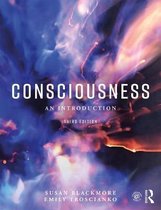
Summary of: Consciousness,
An Introduction
By Susan Blackmore, Emily T. Troscianko
All the chapters have been included in this exhaustive summary.
• ISBN 9781138801318
• 636 Pages 3rd Edition
• Published April 27, 2018 by Routledge
Table of Contents:
• Section One: The problem
• Chapter 1 What’s the problem?
• Chapter 2 What’s it like to be…?
• Chapter 3 The grand illusion
• Section Two: The brain
• Chapter 4 Neuroscience and the correlates of consciousness
• Chapter 5 The theatre of the mind
• Chapter 6 The unity of consciousness
• Section Three: Body and world
• Chapter 7 Attention
• Chapter 8 Conscious and unconscious
• Chapter 9 Agency and free will
• Section Four: Evolution
• Chapter 10 Evolution and animal minds
• Chapter 11 The function of consciousness
• Chapter 12 The evolution of machines
• Section Five: Borderlands
• Chapter 13 Altered states of consciousness
• Chapter 14 Reality and imagination
• Chapter 15 Dreaming and beyond
• Section Six: Self and other
• Chapter 16 Egos, bundles, and theories of self
• Chapter 17 The view from within?
• Chapter 18 Waking up
, Section One: The problem
Chapter 1 What’s the problem?
What is known about consciousness?
About the topic of consciousness, a lot is still unknown. The more that is known about the human brain and behavior, the
less there is known about consciousness and the more questions we have. The way we perceive consciousness has to do
with the own perspective. Everyone sees things differently and has their own perspective. With the issue of consciousness,
one must look at the objective and subjective world. It idepends on your own knowledge of some common bottlenecks that
ensures that you can get answers to certain questions about this matter.
What is the relationship between consciousness and philosophy?
The definition of consciousness can be divided into two types of theories. First, there are the monist theories that state that
there is only one matter. Second, there are the dualist theories that state that there are two matters. Descartes was a
supporter of dualism. He is best known for the statement 'I think, so I exist'. He said that even when you doubt everything,
there is always something that still exists and he therefore mainly looked at things that persisted after doubt. According to
him, there is a difference between extensive material, such as our body (physical), and undivided material, such as
our thinking (mental). according to him, here must be a relationship between the physical and mental aspects and these
interact with each other; they influence each other. This theory is also known as substance dualism.
This theory is however not supported by everyone. From the ordinary-language philosophy perspective, it is thought that
many problems arise because the language used to describe mental processes is not clear or is used incorrectly. This idea is
mainly supported by Ryle. This researcher tried to bring behaviorism and dualism together in one theory. He supports the
idea that the mind is what the brain does which we call functionalism. There is less proof for the existence of awareness. It
appears that there is a lot of overlap between how people think about consciousness, reason and the self.
In 1977, Popper and Eccles proposed the dualistic interaction theory. They thought that the processes in the brain could be
influenced by the feeling of having a self. This would also lead to the feeling of having a free will and subjective experience.
This idea was also supported by Chalmers in 2007. He believes that experience comes from physical processes without the
physical world playing a major role. This involves obtaining physical and unimaginable information.
Dennett adheres to the same ideas as Ryle does by stating that you should not accept the theories of dualism. Yet it is
difficult to avoid doing this. He saw consciousness as a theater which he called the Cartesian Theater. As soon as you say that
something is present in your consciousness, it is as if you are the audience of your own show. You are watching what is
happening on stage.
Another approach is the materialistic approach. This approach states that the interaction between all factors already have
been established and consciousness can no longer play a role. This includes the identity theory (stating that mental status
equals brain status) and functionalism (stating that mental status equals functional status). There is no room for a subjective
approach in this theory.
In addition, there is the idea of epiphenomenalism. This is the idea that a mental status is caused by events, the mental
status has no effect on these events. This does not seem to exist in reality because it would mean that we can never talk
about an event.
With the extreme theories, it is difficult not to fall back on theories of dualism. One way to do this is by believing
in panpsychism: This theory states that all mental operations are conscious in a certain way. The extreme version of
panpsychism even believes that all elements are conscious, even clouds and rivers, which would mean that anything has a
certain level of consciousness.
What is the relationship between consciousness and psychology?
An Introduction
By Susan Blackmore, Emily T. Troscianko
All the chapters have been included in this exhaustive summary.
• ISBN 9781138801318
• 636 Pages 3rd Edition
• Published April 27, 2018 by Routledge
Table of Contents:
• Section One: The problem
• Chapter 1 What’s the problem?
• Chapter 2 What’s it like to be…?
• Chapter 3 The grand illusion
• Section Two: The brain
• Chapter 4 Neuroscience and the correlates of consciousness
• Chapter 5 The theatre of the mind
• Chapter 6 The unity of consciousness
• Section Three: Body and world
• Chapter 7 Attention
• Chapter 8 Conscious and unconscious
• Chapter 9 Agency and free will
• Section Four: Evolution
• Chapter 10 Evolution and animal minds
• Chapter 11 The function of consciousness
• Chapter 12 The evolution of machines
• Section Five: Borderlands
• Chapter 13 Altered states of consciousness
• Chapter 14 Reality and imagination
• Chapter 15 Dreaming and beyond
• Section Six: Self and other
• Chapter 16 Egos, bundles, and theories of self
• Chapter 17 The view from within?
• Chapter 18 Waking up
, Section One: The problem
Chapter 1 What’s the problem?
What is known about consciousness?
About the topic of consciousness, a lot is still unknown. The more that is known about the human brain and behavior, the
less there is known about consciousness and the more questions we have. The way we perceive consciousness has to do
with the own perspective. Everyone sees things differently and has their own perspective. With the issue of consciousness,
one must look at the objective and subjective world. It idepends on your own knowledge of some common bottlenecks that
ensures that you can get answers to certain questions about this matter.
What is the relationship between consciousness and philosophy?
The definition of consciousness can be divided into two types of theories. First, there are the monist theories that state that
there is only one matter. Second, there are the dualist theories that state that there are two matters. Descartes was a
supporter of dualism. He is best known for the statement 'I think, so I exist'. He said that even when you doubt everything,
there is always something that still exists and he therefore mainly looked at things that persisted after doubt. According to
him, there is a difference between extensive material, such as our body (physical), and undivided material, such as
our thinking (mental). according to him, here must be a relationship between the physical and mental aspects and these
interact with each other; they influence each other. This theory is also known as substance dualism.
This theory is however not supported by everyone. From the ordinary-language philosophy perspective, it is thought that
many problems arise because the language used to describe mental processes is not clear or is used incorrectly. This idea is
mainly supported by Ryle. This researcher tried to bring behaviorism and dualism together in one theory. He supports the
idea that the mind is what the brain does which we call functionalism. There is less proof for the existence of awareness. It
appears that there is a lot of overlap between how people think about consciousness, reason and the self.
In 1977, Popper and Eccles proposed the dualistic interaction theory. They thought that the processes in the brain could be
influenced by the feeling of having a self. This would also lead to the feeling of having a free will and subjective experience.
This idea was also supported by Chalmers in 2007. He believes that experience comes from physical processes without the
physical world playing a major role. This involves obtaining physical and unimaginable information.
Dennett adheres to the same ideas as Ryle does by stating that you should not accept the theories of dualism. Yet it is
difficult to avoid doing this. He saw consciousness as a theater which he called the Cartesian Theater. As soon as you say that
something is present in your consciousness, it is as if you are the audience of your own show. You are watching what is
happening on stage.
Another approach is the materialistic approach. This approach states that the interaction between all factors already have
been established and consciousness can no longer play a role. This includes the identity theory (stating that mental status
equals brain status) and functionalism (stating that mental status equals functional status). There is no room for a subjective
approach in this theory.
In addition, there is the idea of epiphenomenalism. This is the idea that a mental status is caused by events, the mental
status has no effect on these events. This does not seem to exist in reality because it would mean that we can never talk
about an event.
With the extreme theories, it is difficult not to fall back on theories of dualism. One way to do this is by believing
in panpsychism: This theory states that all mental operations are conscious in a certain way. The extreme version of
panpsychism even believes that all elements are conscious, even clouds and rivers, which would mean that anything has a
certain level of consciousness.
What is the relationship between consciousness and psychology?