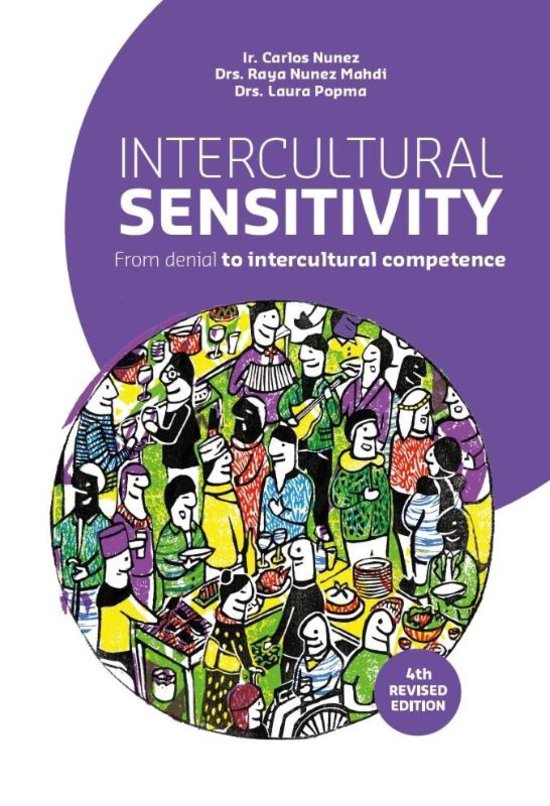
Intercultural sensitivity
Chapter 1 Cultural Awareness
Culture is learned, it influences the way we think, feel and behave. It even shapes our perception and judgment
of others.
1. What is culture? Visible and invisible culture
According to Edgar Schein culture consist of layers, like an onion.
1. Artefacts of culture: this is the outer layer/ material culture. It are the first things you notice when you
enter a new country (ex, Netherlands the bicycles). If you would only define culture through artefacts,
than you will get ‘stereotypes’.
2. Norms and values: norms are the (un)written standards of correct, desired behaviour (be on time in
class). Values express what we think is good or right (is it good to stand up for elderly in the bus?).
Norms and values are not as visible as artefacts. It takes some time to notice and even more to learn
them.
3. Basic assumptions: these are abstract and invisible, we learn them when we’re very young and
unaware of their influences. Yet the perception of the world around us, and the judgements we make
about others, are very much shaped/ distorted by the basic assumptions of our culture. Intercultural
communication is about bringing basic assumptions of our own culture to our awareness and to
recognise them of other cultures.
2. Definition of culture
Defition of Geert Hofstede: ‘’Culture is the collective programming of the mind, which distinguishes the
members of one group.. of people from another.’’
3. Cultural programming
Culture is learned, Hofstede calls it programming. We are ‘programmed’ through upbringing, socialisation,
norms and values and perception. Regardless of culture, each person is an unique individual and makes choices.
Three levels of programming
1. Individual (eats with his hands, because he doesn’t like to eat with knife and fork)
2. Cultural (eat with knife and fork)
3. Human nature (eat when you are hungry)
4. Culture and Subculture
‘culture is the collective mental programming of the human mind’, collective indicates here a group or
subgroups were we belong to. This can be different kinds of group; company culture, regional culture etc, each
with their own different programming.
5. intercultural Communication
Communication is the exchange of meaning. If you want to give information to another person, you’re the
source. Your information is encoded by using the appropriate language or expressions.
/The message can be distort by noise, this can be external (the sound of an airplane that causes that you can
hear the message) or internal (you are worried about something, so your attention is somewhere else). You can
also have cultural noise (the volume of Dutch people can be too loud for Indonesians for speaking
professionally).
Chapter 2 Working with Hall’s model of cultural differences
, 2.1 Communication : High and Low Context
All communication takes place within a certain context. But how much of little the meaning is communicated
through this context differs from culture to culture.
2.1.1 Low Context
In low context cultures information is communicated with words (written or spoken). People prefer to structure
their information into segments/ compartments. This is called compartmentalising. Personal relations, work and
everything else you deal with are also compartmentalised. Information has a clear structure, but is doesn’t flow
fast, because it remains within the compartments. A low context culture has a preference for starting with the
main point and ending with details. Most people in the Netherlands communicate in low context.
North-Western Europe, North America, Australia and New Zealand
Medium context:
Central and Eastern Europe
2.1.2 High Context
In high context cultures most of the message is in the persons themselves and in the context of the message. Its
implicitly and often nonverbally. People in high context cultures live in large communities and have excess to
wide networks. A high context culture has a preference for starting with context and get to the main point later.
Main point are not separated from details, but they form one holistic picture.
Latin Europe, Asia, Latin America, Africa, Mediterranean, Oceania.
2.1.3 Misunderstanding caused by too little or too much Context
Intercultural sensitivity means to be able to provide the right amount of context and explicitness. It’s the ability
to understand and communicate high and low context.
2.1.5 High and Low Context Subcultures
You can be high context with friends and low context at work, there may be an overlap. Within one country
there is a whole range of differences in the need for context, depending on the regional, urban, rural, ethic,
social class, professional, gender and generational subcultures.
2.1.6 Can we communicate High as well as Low Context? Yes
2.2 Monochronic and Polychronic Time (Edward+Mildred Hall)
Monochromic :
You prefer doing one thing at a time
You concentrate on your task and try not to disturb others
Time linear + tangible (the clock), you can gain it, save or waste it (deadlines and time schedules)
Your communicate in low context
Need for explicit information
Your task oriented
Work swiftly and promptly
German speaking countries, north-western Europe, North America, Australia New Zealand
Polychromic:
Chapter 1 Cultural Awareness
Culture is learned, it influences the way we think, feel and behave. It even shapes our perception and judgment
of others.
1. What is culture? Visible and invisible culture
According to Edgar Schein culture consist of layers, like an onion.
1. Artefacts of culture: this is the outer layer/ material culture. It are the first things you notice when you
enter a new country (ex, Netherlands the bicycles). If you would only define culture through artefacts,
than you will get ‘stereotypes’.
2. Norms and values: norms are the (un)written standards of correct, desired behaviour (be on time in
class). Values express what we think is good or right (is it good to stand up for elderly in the bus?).
Norms and values are not as visible as artefacts. It takes some time to notice and even more to learn
them.
3. Basic assumptions: these are abstract and invisible, we learn them when we’re very young and
unaware of their influences. Yet the perception of the world around us, and the judgements we make
about others, are very much shaped/ distorted by the basic assumptions of our culture. Intercultural
communication is about bringing basic assumptions of our own culture to our awareness and to
recognise them of other cultures.
2. Definition of culture
Defition of Geert Hofstede: ‘’Culture is the collective programming of the mind, which distinguishes the
members of one group.. of people from another.’’
3. Cultural programming
Culture is learned, Hofstede calls it programming. We are ‘programmed’ through upbringing, socialisation,
norms and values and perception. Regardless of culture, each person is an unique individual and makes choices.
Three levels of programming
1. Individual (eats with his hands, because he doesn’t like to eat with knife and fork)
2. Cultural (eat with knife and fork)
3. Human nature (eat when you are hungry)
4. Culture and Subculture
‘culture is the collective mental programming of the human mind’, collective indicates here a group or
subgroups were we belong to. This can be different kinds of group; company culture, regional culture etc, each
with their own different programming.
5. intercultural Communication
Communication is the exchange of meaning. If you want to give information to another person, you’re the
source. Your information is encoded by using the appropriate language or expressions.
/The message can be distort by noise, this can be external (the sound of an airplane that causes that you can
hear the message) or internal (you are worried about something, so your attention is somewhere else). You can
also have cultural noise (the volume of Dutch people can be too loud for Indonesians for speaking
professionally).
Chapter 2 Working with Hall’s model of cultural differences
, 2.1 Communication : High and Low Context
All communication takes place within a certain context. But how much of little the meaning is communicated
through this context differs from culture to culture.
2.1.1 Low Context
In low context cultures information is communicated with words (written or spoken). People prefer to structure
their information into segments/ compartments. This is called compartmentalising. Personal relations, work and
everything else you deal with are also compartmentalised. Information has a clear structure, but is doesn’t flow
fast, because it remains within the compartments. A low context culture has a preference for starting with the
main point and ending with details. Most people in the Netherlands communicate in low context.
North-Western Europe, North America, Australia and New Zealand
Medium context:
Central and Eastern Europe
2.1.2 High Context
In high context cultures most of the message is in the persons themselves and in the context of the message. Its
implicitly and often nonverbally. People in high context cultures live in large communities and have excess to
wide networks. A high context culture has a preference for starting with context and get to the main point later.
Main point are not separated from details, but they form one holistic picture.
Latin Europe, Asia, Latin America, Africa, Mediterranean, Oceania.
2.1.3 Misunderstanding caused by too little or too much Context
Intercultural sensitivity means to be able to provide the right amount of context and explicitness. It’s the ability
to understand and communicate high and low context.
2.1.5 High and Low Context Subcultures
You can be high context with friends and low context at work, there may be an overlap. Within one country
there is a whole range of differences in the need for context, depending on the regional, urban, rural, ethic,
social class, professional, gender and generational subcultures.
2.1.6 Can we communicate High as well as Low Context? Yes
2.2 Monochronic and Polychronic Time (Edward+Mildred Hall)
Monochromic :
You prefer doing one thing at a time
You concentrate on your task and try not to disturb others
Time linear + tangible (the clock), you can gain it, save or waste it (deadlines and time schedules)
Your communicate in low context
Need for explicit information
Your task oriented
Work swiftly and promptly
German speaking countries, north-western Europe, North America, Australia New Zealand
Polychromic: