Alternative investments
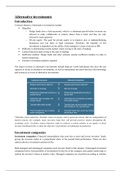
Introduction
Common features of alternative investments include:
Illiquidity
Hedge funds have a lock-up period, which is a minimum period before investors are
allowed to make withdrawals or redeem shares from a fund, and they are only
allowed to trade quarterly.
Private equity: The goal for private equity is to improve new or underperforming
businesses and exit them at high valuations. Therefore, the liquidity of this
investment is dependent on the ability of the manager to create a buyout or IPO.
Difficulty in determining current market values (owing to the lack of trading)
Limited historical data (owing to the lack of trading)
Inefficient markets: Hedge funds and other schemes assume inefficient markets in order to
exploit mispricing.
Extensive investment analysis required
The major investors in alternative investments include high-net worth individuals who have the risk
capacity to invest in alternative investments, as well as institutional investors that have the knowledge
and resources to invest in alternative investments.
*Absolute return objective: Absolute return strategies seek to generate returns that are independent of
market returns, for example, many investors hope they will provide positive returns throughout the
economic cycle. A relative return objective seeks to achieve a return relative to an equity or fixed
income benchmark (this is often the objective of portfolios of traditional investments).
Investment companies
Investment companies: Financial intermediaries that earn fees to pool and invest investors’ funds,
giving the investors rights to a proportional share of the pooled fund performance. These are also
called collective investment schemes (CIS).
Both managed and unmanaged companies pool investor funds in this manner. Unmanaged investment
companies hold a fixed portfolio of investments for the life of the company and usually stand ready to
redeem the investor’s shares at market value. Managed companies are classified according to whether
,or not they stand ready to redeem investor shares. Open-end funds operated by investment companies
(mutual funds or unit trusts) offer this redemption share, but closed-end funds do not. Closed-end
investment companies (such as investment trusts) issue shares that are then traded in the secondary
markets.
Unit trusts (or
mutual funds in
the US)
Open-end funds
Managed
ETFs
Closed-end
Investment funds
companies
Unmanaged Unit investment
trusts
Unit trust versus investment trust
Unit Trust Investment Trust
Business Entity Registered as business trust. Registered as a company.
Consists of a certain number of issued
Capital Consists of units.
shares.
Varies. If new investor invests the total
Changes in Capital Remains constant.
capital increases.
Participation in Shareholders have voting power.
Trustee is responsible.
Management Management by appointed directors.
Buying or Selling Required by law to repurchase its units
Trade shares in secondary market.
Shares/Units from investors.
Listing on Stock
Not possible. Possible.
Exchange
Income Interest and/or dividends. Dividends
Valuing investment company shares
The basis for valuing a unit trust’s units is net asset value (NAV) which is the per-share value of the
investment company’s assets minus its liabilities. Share value equals NAV in this case for unmanaged
and open-end investment companies because they stand ready to redeem their shares at NAV.
Fund assets−Fund liabilities
NAV =
Total number of units outstanding
The basis for valuing an investment trust is the share price that is determined in the secondary market.
Therefore, the share price can be at a premium or discount to NAV.
The difference between NAV and the share price:
Share price NAV
When the value of the Stock price changes throughout the NAV is determined at the end of
share/unit is determined day. the day.
Specification of Specify the number of shares you Specify the investment (in Rand)
investment want to buy. that you want to make.
Number of units/shares Fixed number of shares available. Unit trusts have unlimited
available number of units.
Ability to profit from Can determine whether the share is The NAV is the value of the unit.
share/unit a bargain.
,Unit trust strategies
First Level: Geographic region
Domestic
Foreign (Global)
Worldwide
Second Level: Type of investment
Variable interest
Equity
Real estate
Multi-class
Fund management fees
Investment companies charge fees, some as one-time charges and some as annual charges. By setting
an initial selling price above the NAV, the unmanaged company charges a fee for the effort of setting
up the fund. For managed funds, loads are simply sales commissions charged at purchase (front-end
load) as a percentage of the investment. A redemption fee (back-end load) is a charge to exit the
fund. Redemption fees discourage quick trading turnover and are often set up so that the fees decline
the longer shares are held (in this case, the fees are sometimes called contingent deferred sales
charges). Loads and redemption fees provide sales incentives but not portfolio management
performance incentives.
Annual charges are composed of operating expenses including management fees, administrative
expenses, and continuing distribution fees. The ratio of operating expenses to average assets is often
referred to as the fund’s ‘expense ratio’. Distribution fees are fees paid back to the party that arranged
the initial sale of the shares and are thus another type of sales incentive fee. Only management fees
can be considered a portfolio management incentive fee.
Example 1 of fees charged to the client:
Class A Class B Class C
Sales charge (load) on
3% None None
purchases
Deferred sales charge 5% for first year, declining 1% for initial two
None
(load) on redemptions by 1% each year thereafter years
Annual expenses
Distribution fee 0.25% 0.50% 0.50%
Management fee 0.75% 0.75% 0.75%
Other expenses 0.25% 0.25% 0.25%
1.25% 1.50% 1.50%
*Use an initial investment of $1. Note that a front-end load will reduce your initial investment. The
formula used is as follows:
Growth of initial investment =Growth for n years – Annual expenses
Scenario 1: Which fund is the best for a holding period of 6 years? Assume an annual return of 8%.
Class A=$ 0.97 ×1.086 × ( 1−0.0125 )6=$ 1.4274
Class B=$ 1.00 ×1.086 × (1−0.015 )6=$ 1.4493
Class C=$ 1.00 ×1.086 × ( 1−0.015 )6=$ 1.4493
Therefore, invest in Class B or C.
,Scenario 2: Which fund is the best for a holding period of 1 year? Assume an annual return of 8%.
C lass A=$ 0.97 × 1.08×(1−0.0125)=$ 1.0345
Class B=$ 1.00 ×1.08 ×(1−0.015) ×(1−0.05)=$ 1.0106
Class C=$ 1.00 ×1.08 ×(1−0.015)×(1−0.01)=$ 1.0532
Therefore, invest in Class C.
Example 2 of fees charged to the client:
Class A Class B Class C
Sales charge (load) on
3% None 3%
purchases
Deferred sales charge 5% for first year, declining 1% for initial two
None
(load) on redemptions by 1% each year thereafter years
Annual expenses 1.25% 1.25% 1.25%
Scenario 1: Which fund is the best for a holding period of 6 years? Assume an annual return of 8%.
Scenario 2: Which fund is the best for a holding period of 1 year? Assume an annual return of 8%.
Investment strategies
Investment companies primarily invest in equity. Investment strategies can be characterised as style,
sector, index, global, or stable value strategies.
Style: These focus on the underlying characteristics common to certain investments.
Growth: This may focus on high P/E stocks, and value may focus on low P/E stocks.
Sector: This focuses on a particular industry or sector.
Index: This tracks an index. In the simplest application, the fund owns the securities in the
index in the exact same proportion as the market value weights of the securities in the index.
Global: This includes securities from around the world and might keep portfolio weights
similar to world market capitalisation weights.
International: One that does not include the home country’s securities, whereas a global fund
would include the securities from the home country.
Stable value: This invests in securities such as short-term fixed income instruments and
guaranteed investment contracts which are guaranteed by the issuing insurance company.
Exchange-traded funds (ETFs)
Exchange-traded fund (ETF): An index-based investment product which provides exposure to an
index by means of a single financial instrument.
ETFs are funds that trade on a stock market like shares of any individual companies. They can be
traded at any time and can be sold short or margined. But they are shares of a portfolio, not of an
individual company. They represent shares of ownership in either open-end funds or unit investment
trusts that hold portfolios of stocks or bonds in custody, which are designed to track the price and
yield performance of their underlying indexes – broad market, sector/industry, single country/region
(multiple countries), or fixed income.
Recent developments of ETFs
Canada (1989): TIP 35 (Toronto Index Participation Fund) introduced.
US (1993): S&P 500 Depository Receipts introduced.
Asia (1999): The Hong Kong Tracker Fund was launched.
Europe (2000): Euro STOXX 50 appeared.
, Japan (2001): Did not trade stocks until 2001, and then 8 were listed.
European ETFs are generally structured according to the European commission’s 2001 Undertakings
for Collective Investment in Transferable Securities (UCITS) III directive, which is considered by
many managers to be more flexible than the fund guidelines of the US Investment Company Act of
1940. As a result, a number of new strategies in ETF investments have been introduced in Europe
within the past several years.
ETF structure
ETFs are open-ended funds that are regarded as collective investment schemes (CIS) in South Africa.
They are passive tracking instruments. Furthermore, there is no securities transfer tax (0.25%) on
ETFs which is one of the benefits.
Advantages of ETFs
1. Diversification can be easily obtained with a single ETF transaction, therefore ETFs provide a
convenient way to diversify. With equity-orientated ETFs, investors can gain instant exposure
to different market capitalisations, style (value or growth), sector or industries, or countries or
geographic regions. With fixed-income ETFs, they can gain exposure to different maturity
segments and bond market sectors.
2. Although ETFs represent interests in a portfolio of securities, they trade similarly to a stock
on an organised exchange. For example, ETFs can be sold short and also bought on margin.
3. ETFs trade throughout the whole trading day at market prices that are updated continuously,
rather than only trading once a day at closing market prices, as do the traditional open-end
mutual funds.
4. For many ETFs, there exist futures and options contracts on the same index, which is
convenient for risk management.
5. Portfolio holdings of ETFs are transparent. The ETF sponsor publishes the constituents of the
fund on a daily basis. This could closely resemble the constituents of the underlying index.
This is in contrast to other funds, for which the manager publishes only the list of assets in the
fund from time to time.
6. ETFs are cost effective. There are no load fees. Moreover, because the ETFs are passively
managed, the expense ratio can be kept relatively low compared to actively managed funds.
The expense ratio is comparable to that of an index mutual fund.
7. ETFs have an advantage over closed-end index funds because their structure can prevent a
significant premium/discount. Although supply and demand determine the market price of an
ETF just like any other security, arbitrage helps keep the traded price of an ETF much more in
line with its underlying value. Thus, due to arbitrage, unit investment trusts and open-end
ETFs have the capability to avoid trading at large premiums and discounts to the NAVs. This
is in contrast to closed-end index funds, which offer a fixed supply of shares and as demand
changes, they frequently trade at appreciable discounts from (and sometimes premiums to)
their NAVs.
8. The exposure to capital gains tax is lower than for traditional funds, to the consequences of
other shareholders’ redemptions are limited. Therefore, capital gains tax liability is expected
to be lower for ETF shareholders than for mutual fund shareholders.
9. Dividends are reinvested immediately for open-end ETFs, whereas for index mutual funds,
timing of dividend reinvestment varies.
Introduction
Common features of alternative investments include:
Illiquidity
Hedge funds have a lock-up period, which is a minimum period before investors are
allowed to make withdrawals or redeem shares from a fund, and they are only
allowed to trade quarterly.
Private equity: The goal for private equity is to improve new or underperforming
businesses and exit them at high valuations. Therefore, the liquidity of this
investment is dependent on the ability of the manager to create a buyout or IPO.
Difficulty in determining current market values (owing to the lack of trading)
Limited historical data (owing to the lack of trading)
Inefficient markets: Hedge funds and other schemes assume inefficient markets in order to
exploit mispricing.
Extensive investment analysis required
The major investors in alternative investments include high-net worth individuals who have the risk
capacity to invest in alternative investments, as well as institutional investors that have the knowledge
and resources to invest in alternative investments.
*Absolute return objective: Absolute return strategies seek to generate returns that are independent of
market returns, for example, many investors hope they will provide positive returns throughout the
economic cycle. A relative return objective seeks to achieve a return relative to an equity or fixed
income benchmark (this is often the objective of portfolios of traditional investments).
Investment companies
Investment companies: Financial intermediaries that earn fees to pool and invest investors’ funds,
giving the investors rights to a proportional share of the pooled fund performance. These are also
called collective investment schemes (CIS).
Both managed and unmanaged companies pool investor funds in this manner. Unmanaged investment
companies hold a fixed portfolio of investments for the life of the company and usually stand ready to
redeem the investor’s shares at market value. Managed companies are classified according to whether
,or not they stand ready to redeem investor shares. Open-end funds operated by investment companies
(mutual funds or unit trusts) offer this redemption share, but closed-end funds do not. Closed-end
investment companies (such as investment trusts) issue shares that are then traded in the secondary
markets.
Unit trusts (or
mutual funds in
the US)
Open-end funds
Managed
ETFs
Closed-end
Investment funds
companies
Unmanaged Unit investment
trusts
Unit trust versus investment trust
Unit Trust Investment Trust
Business Entity Registered as business trust. Registered as a company.
Consists of a certain number of issued
Capital Consists of units.
shares.
Varies. If new investor invests the total
Changes in Capital Remains constant.
capital increases.
Participation in Shareholders have voting power.
Trustee is responsible.
Management Management by appointed directors.
Buying or Selling Required by law to repurchase its units
Trade shares in secondary market.
Shares/Units from investors.
Listing on Stock
Not possible. Possible.
Exchange
Income Interest and/or dividends. Dividends
Valuing investment company shares
The basis for valuing a unit trust’s units is net asset value (NAV) which is the per-share value of the
investment company’s assets minus its liabilities. Share value equals NAV in this case for unmanaged
and open-end investment companies because they stand ready to redeem their shares at NAV.
Fund assets−Fund liabilities
NAV =
Total number of units outstanding
The basis for valuing an investment trust is the share price that is determined in the secondary market.
Therefore, the share price can be at a premium or discount to NAV.
The difference between NAV and the share price:
Share price NAV
When the value of the Stock price changes throughout the NAV is determined at the end of
share/unit is determined day. the day.
Specification of Specify the number of shares you Specify the investment (in Rand)
investment want to buy. that you want to make.
Number of units/shares Fixed number of shares available. Unit trusts have unlimited
available number of units.
Ability to profit from Can determine whether the share is The NAV is the value of the unit.
share/unit a bargain.
,Unit trust strategies
First Level: Geographic region
Domestic
Foreign (Global)
Worldwide
Second Level: Type of investment
Variable interest
Equity
Real estate
Multi-class
Fund management fees
Investment companies charge fees, some as one-time charges and some as annual charges. By setting
an initial selling price above the NAV, the unmanaged company charges a fee for the effort of setting
up the fund. For managed funds, loads are simply sales commissions charged at purchase (front-end
load) as a percentage of the investment. A redemption fee (back-end load) is a charge to exit the
fund. Redemption fees discourage quick trading turnover and are often set up so that the fees decline
the longer shares are held (in this case, the fees are sometimes called contingent deferred sales
charges). Loads and redemption fees provide sales incentives but not portfolio management
performance incentives.
Annual charges are composed of operating expenses including management fees, administrative
expenses, and continuing distribution fees. The ratio of operating expenses to average assets is often
referred to as the fund’s ‘expense ratio’. Distribution fees are fees paid back to the party that arranged
the initial sale of the shares and are thus another type of sales incentive fee. Only management fees
can be considered a portfolio management incentive fee.
Example 1 of fees charged to the client:
Class A Class B Class C
Sales charge (load) on
3% None None
purchases
Deferred sales charge 5% for first year, declining 1% for initial two
None
(load) on redemptions by 1% each year thereafter years
Annual expenses
Distribution fee 0.25% 0.50% 0.50%
Management fee 0.75% 0.75% 0.75%
Other expenses 0.25% 0.25% 0.25%
1.25% 1.50% 1.50%
*Use an initial investment of $1. Note that a front-end load will reduce your initial investment. The
formula used is as follows:
Growth of initial investment =Growth for n years – Annual expenses
Scenario 1: Which fund is the best for a holding period of 6 years? Assume an annual return of 8%.
Class A=$ 0.97 ×1.086 × ( 1−0.0125 )6=$ 1.4274
Class B=$ 1.00 ×1.086 × (1−0.015 )6=$ 1.4493
Class C=$ 1.00 ×1.086 × ( 1−0.015 )6=$ 1.4493
Therefore, invest in Class B or C.
,Scenario 2: Which fund is the best for a holding period of 1 year? Assume an annual return of 8%.
C lass A=$ 0.97 × 1.08×(1−0.0125)=$ 1.0345
Class B=$ 1.00 ×1.08 ×(1−0.015) ×(1−0.05)=$ 1.0106
Class C=$ 1.00 ×1.08 ×(1−0.015)×(1−0.01)=$ 1.0532
Therefore, invest in Class C.
Example 2 of fees charged to the client:
Class A Class B Class C
Sales charge (load) on
3% None 3%
purchases
Deferred sales charge 5% for first year, declining 1% for initial two
None
(load) on redemptions by 1% each year thereafter years
Annual expenses 1.25% 1.25% 1.25%
Scenario 1: Which fund is the best for a holding period of 6 years? Assume an annual return of 8%.
Scenario 2: Which fund is the best for a holding period of 1 year? Assume an annual return of 8%.
Investment strategies
Investment companies primarily invest in equity. Investment strategies can be characterised as style,
sector, index, global, or stable value strategies.
Style: These focus on the underlying characteristics common to certain investments.
Growth: This may focus on high P/E stocks, and value may focus on low P/E stocks.
Sector: This focuses on a particular industry or sector.
Index: This tracks an index. In the simplest application, the fund owns the securities in the
index in the exact same proportion as the market value weights of the securities in the index.
Global: This includes securities from around the world and might keep portfolio weights
similar to world market capitalisation weights.
International: One that does not include the home country’s securities, whereas a global fund
would include the securities from the home country.
Stable value: This invests in securities such as short-term fixed income instruments and
guaranteed investment contracts which are guaranteed by the issuing insurance company.
Exchange-traded funds (ETFs)
Exchange-traded fund (ETF): An index-based investment product which provides exposure to an
index by means of a single financial instrument.
ETFs are funds that trade on a stock market like shares of any individual companies. They can be
traded at any time and can be sold short or margined. But they are shares of a portfolio, not of an
individual company. They represent shares of ownership in either open-end funds or unit investment
trusts that hold portfolios of stocks or bonds in custody, which are designed to track the price and
yield performance of their underlying indexes – broad market, sector/industry, single country/region
(multiple countries), or fixed income.
Recent developments of ETFs
Canada (1989): TIP 35 (Toronto Index Participation Fund) introduced.
US (1993): S&P 500 Depository Receipts introduced.
Asia (1999): The Hong Kong Tracker Fund was launched.
Europe (2000): Euro STOXX 50 appeared.
, Japan (2001): Did not trade stocks until 2001, and then 8 were listed.
European ETFs are generally structured according to the European commission’s 2001 Undertakings
for Collective Investment in Transferable Securities (UCITS) III directive, which is considered by
many managers to be more flexible than the fund guidelines of the US Investment Company Act of
1940. As a result, a number of new strategies in ETF investments have been introduced in Europe
within the past several years.
ETF structure
ETFs are open-ended funds that are regarded as collective investment schemes (CIS) in South Africa.
They are passive tracking instruments. Furthermore, there is no securities transfer tax (0.25%) on
ETFs which is one of the benefits.
Advantages of ETFs
1. Diversification can be easily obtained with a single ETF transaction, therefore ETFs provide a
convenient way to diversify. With equity-orientated ETFs, investors can gain instant exposure
to different market capitalisations, style (value or growth), sector or industries, or countries or
geographic regions. With fixed-income ETFs, they can gain exposure to different maturity
segments and bond market sectors.
2. Although ETFs represent interests in a portfolio of securities, they trade similarly to a stock
on an organised exchange. For example, ETFs can be sold short and also bought on margin.
3. ETFs trade throughout the whole trading day at market prices that are updated continuously,
rather than only trading once a day at closing market prices, as do the traditional open-end
mutual funds.
4. For many ETFs, there exist futures and options contracts on the same index, which is
convenient for risk management.
5. Portfolio holdings of ETFs are transparent. The ETF sponsor publishes the constituents of the
fund on a daily basis. This could closely resemble the constituents of the underlying index.
This is in contrast to other funds, for which the manager publishes only the list of assets in the
fund from time to time.
6. ETFs are cost effective. There are no load fees. Moreover, because the ETFs are passively
managed, the expense ratio can be kept relatively low compared to actively managed funds.
The expense ratio is comparable to that of an index mutual fund.
7. ETFs have an advantage over closed-end index funds because their structure can prevent a
significant premium/discount. Although supply and demand determine the market price of an
ETF just like any other security, arbitrage helps keep the traded price of an ETF much more in
line with its underlying value. Thus, due to arbitrage, unit investment trusts and open-end
ETFs have the capability to avoid trading at large premiums and discounts to the NAVs. This
is in contrast to closed-end index funds, which offer a fixed supply of shares and as demand
changes, they frequently trade at appreciable discounts from (and sometimes premiums to)
their NAVs.
8. The exposure to capital gains tax is lower than for traditional funds, to the consequences of
other shareholders’ redemptions are limited. Therefore, capital gains tax liability is expected
to be lower for ETF shareholders than for mutual fund shareholders.
9. Dividends are reinvested immediately for open-end ETFs, whereas for index mutual funds,
timing of dividend reinvestment varies.