DNA Replication
• Before a nucleus divides ,
its DNA must be
replicated .
This is to ensure that all the
daughter cells have the
genetic
information to
produce the enzymes
and other
proteins that they need .
Requirements
The four
types of nucleotide ( with bases AGCT ) must be
present
•
.
•
The
enzymes
DNA
polymerase is
required .
A source of chemical to drive the
energy process
.
.
•
Both strands of the DNA molecule act as a template for the attachment of these nucleotides
Process
=
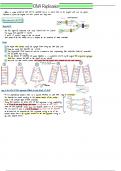
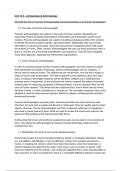
⑦ The enzyme DNA helicase breaks the hydrogen bonds
linking the DNA base pairs .
② Hence the ,
double helix separates and unwinds .
③ Each poly nucleotide
strand ( opened up) acts as a template to which
complementary free nucleotides ( bases not connected)
bind by specific base
pairing .
④ The new strands of nucleotides are
joined together in a condensation reaction
by the
enzyme
DNA
polymerase .
Hydrogen
bonds form between the bases on the
original and new strands .
⑤ Now , each new DNA molecule contains one strand from the original DNA molecule and one new strand .
I ④ ⑤
① ② ③
native "
8¥
-0 00
go
000000
00
00
00
%
0
-0 00 00 Do
00 0 I 0 0
00 00
&
00 00
00 0 00000 00 00 00 00
go
& 0 ,
0
Off 0
ieoeiaes
whyistheactionofDN-erasedifferenttrandotDNA.tl
The
opposite directions each other antiparallel
two
poly nucleotide strands in DNA in to
they
•
run -
are
.
'
'
of the 5
5%-0
The directions named the number carbon 3
I
are
according to
position
•
/
°
34
sugar of each nucleotide
→
the
atoms in
pentose .
"
31 2
5
÷ :* :÷: ÷:c:÷:÷: : :* :
5¥10
' '
Hence DNA 5
the
polymerase down the template strand in 3 to direction
•
moves a .
The opposite ) 3
'
•
new strand is made in a 5
'
to 3
'
direction ( as 3 end is at the 2
,
.
s ° 0
As the double helix antiparallel DNA of the
the
polymerase working
'
are on one '
z
,
template strands moves in the
opposite direction to the DNA
polymerase working on
5Y
strand
the other template .
• Before a nucleus divides ,
its DNA must be
replicated .
This is to ensure that all the
daughter cells have the
genetic
information to
produce the enzymes
and other
proteins that they need .
Requirements
The four
types of nucleotide ( with bases AGCT ) must be
present
•
.
•
The
enzymes
DNA
polymerase is
required .
A source of chemical to drive the
energy process
.
.
•
Both strands of the DNA molecule act as a template for the attachment of these nucleotides
Process
=
⑦ The enzyme DNA helicase breaks the hydrogen bonds
linking the DNA base pairs .
② Hence the ,
double helix separates and unwinds .
③ Each poly nucleotide
strand ( opened up) acts as a template to which
complementary free nucleotides ( bases not connected)
bind by specific base
pairing .
④ The new strands of nucleotides are
joined together in a condensation reaction
by the
enzyme
DNA
polymerase .
Hydrogen
bonds form between the bases on the
original and new strands .
⑤ Now , each new DNA molecule contains one strand from the original DNA molecule and one new strand .
I ④ ⑤
① ② ③
native "
8¥
-0 00
go
000000
00
00
00
%
0
-0 00 00 Do
00 0 I 0 0
00 00
&
00 00
00 0 00000 00 00 00 00
go
& 0 ,
0
Off 0
ieoeiaes
whyistheactionofDN-erasedifferenttrandotDNA.tl
The
opposite directions each other antiparallel
two
poly nucleotide strands in DNA in to
they
•
run -
are
.
'
'
of the 5
5%-0
The directions named the number carbon 3
I
are
according to
position
•
/
°
34
sugar of each nucleotide
→
the
atoms in
pentose .
"
31 2
5
÷ :* :÷: ÷:c:÷:÷: : :* :
5¥10
' '
Hence DNA 5
the
polymerase down the template strand in 3 to direction
•
moves a .
The opposite ) 3
'
•
new strand is made in a 5
'
to 3
'
direction ( as 3 end is at the 2
,
.
s ° 0
As the double helix antiparallel DNA of the
the
polymerase working
'
are on one '
z
,
template strands moves in the
opposite direction to the DNA
polymerase working on
5Y
strand
the other template .