1. Psychological Core:
Bornstein, Robert F., and Paul R. D'agostino. (1992) "Stimulus recognition and the mere
exposure effect." Journal of Personality and Social Psychology, 63 (4), 545.
Atalay, A. Selin, H. Onur Bodur, and Dina Rasolofoarison. Shining in the center Central gaze
cascade effect on product choice. Journal of Consumer Research 39, no. 4 (2012) 848-866.pdf
Dimofte, Claudiu V., and Richard F. Yalch. (2011), "The mere association effect and brand
evaluations." Journal of Consumer Psychology, 21 (1), 24-37.
Assigned reading to class: Krishna, A. (2012). An integrative review of sensory marketing:
Engaging the senses to affect perception, judgment and behavior. Journal of Consumer
Psychology, 22(3), 332-351.
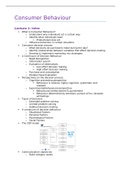
Consumer behavior reflects the totality of consumer’s decisions with respect to the
acquisition, consumption, and disposition of goods, services, activities, experiences,
people, and ideas by human decision-making units over time.
(Hoyer et al. 2018)
Stimulus – Senses – Perception – Memory – Intention – Action – Response
Perception: the awareness or understanding of sensory
information/awareness and interpretation of reality.
- Differences with sensation: a sensation occurs when we are exposed to a stimulus
(we devote our attention to something in the environment); a perception occurs
when we are aware of that stimulus (a sense is stimulated).
- There is no understanding in perception, only in sensation.
- Whenever an indirect measure of responding is more strongly influenced by
stimulus exposure than is a comparable direct measure of responding, perception
without awareness can be inferred.
(Reingold and Merikle 1988)
, Mere Exposure Effect: unreinforced exposure is sufficient to enhance
attitude toward the stimulus.
- Subliminal stimuli produce significantly stronger mere exposure effects than do
stimuli that are clearly recognized.
Attention: the act of devoting cognitive resources to the stimuli.
Visual properties draw attention:
- Design: visual properties of the product. (Color, composition, images)
- Display: visual properties of the surrounding environment. (Location, placement,
orientation)
Rule of Visual properties draw attention:
- Continuity: elements that are close together tend to be viewed as part of the same
object: those farther apart tend to be viewed as part of different objects
- Similarity: elements that physically resemble each other tend to be view as part of
the same object; those that are physically dissimilar tend to be viewed as different
objects
- Proximity: Incomplete or partially hidden objects tend to be viewed as whole or
completed patterns.
The unexpected draw attention:
- Violations of visual expectations
- Violations of previous knowledge
, - Violations of conventions or norms
Biological visual responses:
- Sex/ Face/ Eyes
Location:
- Symmetry: individuals have a propensity to look longer at the axis of symmetry
when exposed to a symmetric picture.
(Locher and Nodine 1973,1989)
- Center-stage effect: consumers hold the lay belief that in retail contexts the products
placed in central positions are more popular, reflecting the overall quality of the
product, which leads consumers to systematically prefer items in the center.
(Valenzuela and Raghubir 2009)
- Central fixation bias: the natural initial response is to look at the center of it.
Memory:
- Psychological process by which knowledge is stored and recorded.
- Retrieval is the process of remembering or accessing what was previously stored
in memory.
- Memory knowledge consists of connation between the to-be-learned material
and the concept already known.
- Information is encoded in all-or-none manner into cognitive.
- Memory is the neural network of associated nodes.
Types of memory:
- Sensory memory/ Working memory/ Long-term memory.
Memory associations:
- When presented with ambiguous information in the form of concepts that share
some associations, individuals may initially think about (i.e., retrieve) many
possible references and rely on contextual cues to narrow their thoughts to the
intended one.
- Mere association effect: Individual’s inability to ignore activated but irrelevant
associations.
Bornstein 1989:
The mere exposure effect produced by stimuli that are not clearly recognized
are substantially larger than mere exposure effect produced by clearly
recognized stimuli.
Karishna 2011:
Sensation: haptics/olfaction/audition/taste/vision
Bornstein, Robert F., and Paul R. D'agostino. (1992) "Stimulus recognition and the mere
exposure effect." Journal of Personality and Social Psychology, 63 (4), 545.
Atalay, A. Selin, H. Onur Bodur, and Dina Rasolofoarison. Shining in the center Central gaze
cascade effect on product choice. Journal of Consumer Research 39, no. 4 (2012) 848-866.pdf
Dimofte, Claudiu V., and Richard F. Yalch. (2011), "The mere association effect and brand
evaluations." Journal of Consumer Psychology, 21 (1), 24-37.
Assigned reading to class: Krishna, A. (2012). An integrative review of sensory marketing:
Engaging the senses to affect perception, judgment and behavior. Journal of Consumer
Psychology, 22(3), 332-351.
Consumer behavior reflects the totality of consumer’s decisions with respect to the
acquisition, consumption, and disposition of goods, services, activities, experiences,
people, and ideas by human decision-making units over time.
(Hoyer et al. 2018)
Stimulus – Senses – Perception – Memory – Intention – Action – Response
Perception: the awareness or understanding of sensory
information/awareness and interpretation of reality.
- Differences with sensation: a sensation occurs when we are exposed to a stimulus
(we devote our attention to something in the environment); a perception occurs
when we are aware of that stimulus (a sense is stimulated).
- There is no understanding in perception, only in sensation.
- Whenever an indirect measure of responding is more strongly influenced by
stimulus exposure than is a comparable direct measure of responding, perception
without awareness can be inferred.
(Reingold and Merikle 1988)
, Mere Exposure Effect: unreinforced exposure is sufficient to enhance
attitude toward the stimulus.
- Subliminal stimuli produce significantly stronger mere exposure effects than do
stimuli that are clearly recognized.
Attention: the act of devoting cognitive resources to the stimuli.
Visual properties draw attention:
- Design: visual properties of the product. (Color, composition, images)
- Display: visual properties of the surrounding environment. (Location, placement,
orientation)
Rule of Visual properties draw attention:
- Continuity: elements that are close together tend to be viewed as part of the same
object: those farther apart tend to be viewed as part of different objects
- Similarity: elements that physically resemble each other tend to be view as part of
the same object; those that are physically dissimilar tend to be viewed as different
objects
- Proximity: Incomplete or partially hidden objects tend to be viewed as whole or
completed patterns.
The unexpected draw attention:
- Violations of visual expectations
- Violations of previous knowledge
, - Violations of conventions or norms
Biological visual responses:
- Sex/ Face/ Eyes
Location:
- Symmetry: individuals have a propensity to look longer at the axis of symmetry
when exposed to a symmetric picture.
(Locher and Nodine 1973,1989)
- Center-stage effect: consumers hold the lay belief that in retail contexts the products
placed in central positions are more popular, reflecting the overall quality of the
product, which leads consumers to systematically prefer items in the center.
(Valenzuela and Raghubir 2009)
- Central fixation bias: the natural initial response is to look at the center of it.
Memory:
- Psychological process by which knowledge is stored and recorded.
- Retrieval is the process of remembering or accessing what was previously stored
in memory.
- Memory knowledge consists of connation between the to-be-learned material
and the concept already known.
- Information is encoded in all-or-none manner into cognitive.
- Memory is the neural network of associated nodes.
Types of memory:
- Sensory memory/ Working memory/ Long-term memory.
Memory associations:
- When presented with ambiguous information in the form of concepts that share
some associations, individuals may initially think about (i.e., retrieve) many
possible references and rely on contextual cues to narrow their thoughts to the
intended one.
- Mere association effect: Individual’s inability to ignore activated but irrelevant
associations.
Bornstein 1989:
The mere exposure effect produced by stimuli that are not clearly recognized
are substantially larger than mere exposure effect produced by clearly
recognized stimuli.
Karishna 2011:
Sensation: haptics/olfaction/audition/taste/vision