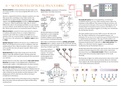
Laboratory animal
science
Summary
Laura Van den End
2022-2023
, Laura van den End
Historical overview
Use of laboratory animals parallel with the - Until the end of the 19th century: mostly dogs, cats,
development of medical science. rabbits and pigs → late more rodents (esp rats and
mice) = shift in type of species used.
Hippocrates - Legal obligation to test compounds in animals
- Accent on anatomy, mostly descriptive character before use in clinical studies.
- Vivisection - no anesthesia: everything was done - 1976: first legislation concerning the use of animals
on alive and awake animals in research - Cruelty of Animals Act
Galenus Counter movements
- Physiology: pigs, dogs, monkeys - Movement against experiments with animals, first
- Better understanding of circulatory system in England, later in France
- Animal was completely accepted as a model for - Peter Singer (1975): Animal Liberation Movement
men. - Tom Regan (1983): Animal Rights Movement
After the rising of Christianity: nearly no research
waas done and very little animals were used.
Renaissance
- From the 15th century on
- New urge to increase knowledge
- Lot of experiments on non-anesthetized animals
- Descartes: “The animal is like a mechanic object that
lives because of physical and chemical laws, without
conscience and not capable of feeling pain”
- Vesalius: anatomy of humans; relation between
spine and paralysis by cutting the spine of animals
- Harvey: animal is important source of information
→ knowledge of blood circulation and valves
Second half of the 19th century
- Discovery of anesthetics
- Darwin: similarities animals and humans →
scientific base for the use of animals als model for
humans
- Bernard: importance of organs (liver and
pancreas) → defends the use of animals in
experimental work
Emergence of microbiology
- Koch: pathgenocity of microorganisms is only
driven after infection experiment with healthy
laboratory animals
- Pasteur: development of vaccines and antisera
After WO I
- production of pharmaca
- Development of new disciplines (E.g. toxicology
and immunology)
- Strong increase in the number of laboratory
animals used.
Laboratory animal science
, Laura van den End
Legislation
Numbers of animals used Degrees of pain and suffering
- World wide: appr. 100 million MILD
- VS: appr. 20 million; EG: appr. 12 million - Administration of anesthesia, except for the sole
- Belgium (2013): 626.742 purpose of killing
- 77% rodents and 8% rabbits - Non-invasive imaging of animals (MRI) with
- 11% fish, amphibians and reptiles appropriate sedation to anesthesia
- 4% birds, 0,6% farm animals - Superficial procedures, e.g. ear and tail biopsies,
- 0,09 % dogs, 0,05% cats and 0,002% primates non surgical subcutaneous implantation of mini-
pumps and transponders
Numbers are fluctuating:
- Development of alternatives, ethics, legislation, MODERATE
more responsible use and high costs = decrease - Surgery under general anesthesia and appropriate
- Development of transgenic animals = increase analgesia, associated with post-surgical pain,
suffering or impairment of general condition
Recent changes in law - Models of induction of tumors, or spontaneous
- April 2010: new Belgian Royal Decree: stricter tumors, that are expected to cause moderate pain
rules concerning housing of laboratory animals. to distress of moderate interference with normal
- September 2010: new European Directive on behavior
protection of animals used for scientific purposes. - Irradiation or chemotherapy with sublethal dose
- May 2013: transposition of the EU Directive into or with an otherwise lethal dose but with
national legislation reconstruction of the immune system
SEVERE
What does the law say - Toxicity testing where dead is the end-point
- Pain, suffering and discomfort were not defined in
- Irradiation or chemotherapy with a lethal dose
legislation → now in the new EU Directive.
- An animal should not be used more than once in without reconstruction of the immune system
- Vaccine potency testing characterized by per-
experiments that inflict serious pain and suffering
sistent impairment of the animal’s condition,
progressive disease leading to death, associated
Laboratory animal - de nition with long-lating moderate pain, distress or
- Every living vertebrate animal suffering.
- Including free living and/or reproducing
larval forms
- Used or intended for laboratory experiments Purpose of animal use
- Excluding other foetal or embryonic forms - Production and control of sera, vaccines or
- Changes: diagnostics
- Include some invertebrae, like Cephalopoda - Toxicological and pharmacological research
- Include mammalian embryonic forms from - Diagnose of diseases
- Education
the last third of term
- Answer scientific questions
Animal experiment - de nition
- Every use of a living vertebrate animal for Housing and taking care
- Housing conditions, environment, space to move,
experimental and other scientific purposes
- Can inflict pain, suffering, discomfort or perm- feed, water and care → meet the animals’ need
- Daily control of animals and environment
anent injury
- Including every treatment that has the purpose or - Regular control by the veterinarian (large animals)
or expert (rodents, rabbits)
the consequence of the birth of an animal
- Exception of the least painful, in modern practice - 1991: detailed overview of caretaking and housing
of animals per species (recently reviewed in EU
accepted methods to kill or mark the animal
- Excluding non-experimental treatments in agricul- Directive and defined in the Royal Decree)
ture and in veterinary practice
Laboratory animal science
fifi
science
Summary
Laura Van den End
2022-2023
, Laura van den End
Historical overview
Use of laboratory animals parallel with the - Until the end of the 19th century: mostly dogs, cats,
development of medical science. rabbits and pigs → late more rodents (esp rats and
mice) = shift in type of species used.
Hippocrates - Legal obligation to test compounds in animals
- Accent on anatomy, mostly descriptive character before use in clinical studies.
- Vivisection - no anesthesia: everything was done - 1976: first legislation concerning the use of animals
on alive and awake animals in research - Cruelty of Animals Act
Galenus Counter movements
- Physiology: pigs, dogs, monkeys - Movement against experiments with animals, first
- Better understanding of circulatory system in England, later in France
- Animal was completely accepted as a model for - Peter Singer (1975): Animal Liberation Movement
men. - Tom Regan (1983): Animal Rights Movement
After the rising of Christianity: nearly no research
waas done and very little animals were used.
Renaissance
- From the 15th century on
- New urge to increase knowledge
- Lot of experiments on non-anesthetized animals
- Descartes: “The animal is like a mechanic object that
lives because of physical and chemical laws, without
conscience and not capable of feeling pain”
- Vesalius: anatomy of humans; relation between
spine and paralysis by cutting the spine of animals
- Harvey: animal is important source of information
→ knowledge of blood circulation and valves
Second half of the 19th century
- Discovery of anesthetics
- Darwin: similarities animals and humans →
scientific base for the use of animals als model for
humans
- Bernard: importance of organs (liver and
pancreas) → defends the use of animals in
experimental work
Emergence of microbiology
- Koch: pathgenocity of microorganisms is only
driven after infection experiment with healthy
laboratory animals
- Pasteur: development of vaccines and antisera
After WO I
- production of pharmaca
- Development of new disciplines (E.g. toxicology
and immunology)
- Strong increase in the number of laboratory
animals used.
Laboratory animal science
, Laura van den End
Legislation
Numbers of animals used Degrees of pain and suffering
- World wide: appr. 100 million MILD
- VS: appr. 20 million; EG: appr. 12 million - Administration of anesthesia, except for the sole
- Belgium (2013): 626.742 purpose of killing
- 77% rodents and 8% rabbits - Non-invasive imaging of animals (MRI) with
- 11% fish, amphibians and reptiles appropriate sedation to anesthesia
- 4% birds, 0,6% farm animals - Superficial procedures, e.g. ear and tail biopsies,
- 0,09 % dogs, 0,05% cats and 0,002% primates non surgical subcutaneous implantation of mini-
pumps and transponders
Numbers are fluctuating:
- Development of alternatives, ethics, legislation, MODERATE
more responsible use and high costs = decrease - Surgery under general anesthesia and appropriate
- Development of transgenic animals = increase analgesia, associated with post-surgical pain,
suffering or impairment of general condition
Recent changes in law - Models of induction of tumors, or spontaneous
- April 2010: new Belgian Royal Decree: stricter tumors, that are expected to cause moderate pain
rules concerning housing of laboratory animals. to distress of moderate interference with normal
- September 2010: new European Directive on behavior
protection of animals used for scientific purposes. - Irradiation or chemotherapy with sublethal dose
- May 2013: transposition of the EU Directive into or with an otherwise lethal dose but with
national legislation reconstruction of the immune system
SEVERE
What does the law say - Toxicity testing where dead is the end-point
- Pain, suffering and discomfort were not defined in
- Irradiation or chemotherapy with a lethal dose
legislation → now in the new EU Directive.
- An animal should not be used more than once in without reconstruction of the immune system
- Vaccine potency testing characterized by per-
experiments that inflict serious pain and suffering
sistent impairment of the animal’s condition,
progressive disease leading to death, associated
Laboratory animal - de nition with long-lating moderate pain, distress or
- Every living vertebrate animal suffering.
- Including free living and/or reproducing
larval forms
- Used or intended for laboratory experiments Purpose of animal use
- Excluding other foetal or embryonic forms - Production and control of sera, vaccines or
- Changes: diagnostics
- Include some invertebrae, like Cephalopoda - Toxicological and pharmacological research
- Include mammalian embryonic forms from - Diagnose of diseases
- Education
the last third of term
- Answer scientific questions
Animal experiment - de nition
- Every use of a living vertebrate animal for Housing and taking care
- Housing conditions, environment, space to move,
experimental and other scientific purposes
- Can inflict pain, suffering, discomfort or perm- feed, water and care → meet the animals’ need
- Daily control of animals and environment
anent injury
- Including every treatment that has the purpose or - Regular control by the veterinarian (large animals)
or expert (rodents, rabbits)
the consequence of the birth of an animal
- Exception of the least painful, in modern practice - 1991: detailed overview of caretaking and housing
of animals per species (recently reviewed in EU
accepted methods to kill or mark the animal
- Excluding non-experimental treatments in agricul- Directive and defined in the Royal Decree)
ture and in veterinary practice
Laboratory animal science
fifi