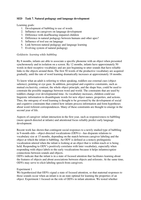
SED Task 7. Natural pedagogy and language development
Learning goals:
1. Development of babbling to use of words
2. Influence on caregivers on language development
3. Difference with deaf/hearing impaired children
4. Difference in natural pedagogy between humans and other apes?
5. Influence of tool use on language
6. Link between natural pedagogy and language learning
7. Evolving system of natural pedagogy
Goldstein: learning while babbling
By 8 months, infants are able to associate a specific phoneme with an object when presented
synchronously and in isolation on a screen. By 12 months, infants have approximately 50
words in their receptive vocabulary and are just beginning to utter sounds that have reliable
links to the objects around them. The first 50 words of the productive vocabulary are acquired
gradually, until the rate of word learning dramatically increases at approximately 18 months.
To know what an adult is referring to when speaking, toddlers use external cues (object
salience), pointing or eye gaze. In addition, perceptual and cognitive constraints, such as
mutual exclusivity, contrast, the whole object principle, and the shape bias, could be used to
constrain the possible mappings between word and world. The constraints that are used by
toddlers change over developmental time. As vocabulary increases, children could use
linguistic information to disambiguate words for new object names, properties, and actions.
Thus, the ontogeny of word learning is thought to be governed by the development of social
and cognitive constraints that control how infants process information and form hypotheses
about word ⁄referent correspondences. Many of these constraints are thought to emerge in the
second year of life.
Aspects of caregiver–infant interaction in the first year, such as responsiveness to babbling
(more speech directed at infants) and attentional focus reliably predict early language
development.
Recent work has shown that contingent social responses to a newly studied type of babbling
in 9-month-olds—object-directed vocalizations (ODVs)—has disparate relations to
vocabulary size at 15 months, depending on the match between caregiver labeling and the
object at which the infant is babbling. An ODV is defined as a noncry prelinguistic
vocalization uttered when the infant is looking at an object that is within reach or is being
held. Responding to ODV’s positively correlates with later vocabulary, especially when
responding with object labels to the early vocalizations because it helps infantrecognize
connections between sounds and objects.
ODVs indicate that the infant is in a state of focused attention that facilitates learning about
the features of objects and about associations between objects and referents. At the same time,
ODVs may serve to elicit labeling speech from caregivers.
Experiment 1
We hypothesized that ODVs signal a state of focused attention, so that maternal responses to
those sounds occur when an infant is in an state optimal for learning the properties of an
object. Experiment 1 focused on the role of ODVs in infant attention. We tested whether
Learning goals:
1. Development of babbling to use of words
2. Influence on caregivers on language development
3. Difference with deaf/hearing impaired children
4. Difference in natural pedagogy between humans and other apes?
5. Influence of tool use on language
6. Link between natural pedagogy and language learning
7. Evolving system of natural pedagogy
Goldstein: learning while babbling
By 8 months, infants are able to associate a specific phoneme with an object when presented
synchronously and in isolation on a screen. By 12 months, infants have approximately 50
words in their receptive vocabulary and are just beginning to utter sounds that have reliable
links to the objects around them. The first 50 words of the productive vocabulary are acquired
gradually, until the rate of word learning dramatically increases at approximately 18 months.
To know what an adult is referring to when speaking, toddlers use external cues (object
salience), pointing or eye gaze. In addition, perceptual and cognitive constraints, such as
mutual exclusivity, contrast, the whole object principle, and the shape bias, could be used to
constrain the possible mappings between word and world. The constraints that are used by
toddlers change over developmental time. As vocabulary increases, children could use
linguistic information to disambiguate words for new object names, properties, and actions.
Thus, the ontogeny of word learning is thought to be governed by the development of social
and cognitive constraints that control how infants process information and form hypotheses
about word ⁄referent correspondences. Many of these constraints are thought to emerge in the
second year of life.
Aspects of caregiver–infant interaction in the first year, such as responsiveness to babbling
(more speech directed at infants) and attentional focus reliably predict early language
development.
Recent work has shown that contingent social responses to a newly studied type of babbling
in 9-month-olds—object-directed vocalizations (ODVs)—has disparate relations to
vocabulary size at 15 months, depending on the match between caregiver labeling and the
object at which the infant is babbling. An ODV is defined as a noncry prelinguistic
vocalization uttered when the infant is looking at an object that is within reach or is being
held. Responding to ODV’s positively correlates with later vocabulary, especially when
responding with object labels to the early vocalizations because it helps infantrecognize
connections between sounds and objects.
ODVs indicate that the infant is in a state of focused attention that facilitates learning about
the features of objects and about associations between objects and referents. At the same time,
ODVs may serve to elicit labeling speech from caregivers.
Experiment 1
We hypothesized that ODVs signal a state of focused attention, so that maternal responses to
those sounds occur when an infant is in an state optimal for learning the properties of an
object. Experiment 1 focused on the role of ODVs in infant attention. We tested whether