Criminal Law Week 2 Updated Study Guide Latest Version.
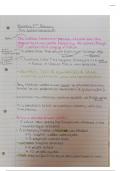
Mohamed & 3 others v R [2005]1 KLR 722 (Osiemo J): general rule of CL that a person may not convicted of a crime unless it is proved beyond reasonable doubt that he had caused a certain event or that responsibility is to be attributed to him for the existence of a certain state of affairs which is forbidden by criminal law, and that he had a definite state of mind in relation to the causing of the event or the existence of the state of affairs. 2. Cardinal rule of CL: An act does not make a person legally guilty unless the mind is legally blameworthy. 3. Two Elements of Criminal offence: Actus Reus and Mens rea-Emma d/o Mwaluko v R (1976) 3. The Actus Reus Element: Constituted by an act or deed or commission or omission or in some cases the occurrence of an event in which the offender is involved; and it may include surrounding circumstances, consequences and results of the act or omission. 4. Emma d/o Mwaluko v R (1976): however harmful or reckless an act may be, it does not constitute an offence unless the law has forbidden it. 6. Elements of Actus Reus: Commission- The doing part of the offence, the act. Failure to act or act when there exists a legal duty Sec. 202(2) or obligation to act in the circumstances. Omission Events or States of Affairs- For some offences no act or omission is required but rather the offence requires the occurrence of an event in which the accused is involved. 7. Commission- Alli s/o Mzee v R [1960] (Murphy J): Commission also covers offences where the act complained of is that of permitting something prohibited to be done - a driver and his conductor convicted for permitting persons to ride on the roof of an omnibus. 8. Omission as Found in the Penal Code: •S.128 of PC- creates the offence of neglect of duty-wilful neglect to perform any duty which he is bound by common law or any written law. •S.202(2) of the PC-defines an unlawful omission for the purpose of murder and manslaughter to mean an omission amounting to culpable negligence to discharge a duty relating to the preservation of life or health. 9. Omission- Njenga v The Rep: the appellant was convicted of omitting to take precautions by lighting a cigarette in a room where there were highly inflammable substances, despite having been warned not to. 10. (Events or States of Affairs) Being in possession: Principle- requires that the accused person be in possession of something that is prohibited or being in possession of it for illegal purposes e.g possessing drugs. e.g sec.323 PC makes it an offence to have possession of or convey suspected stolen property.
Schule, Studium & Fach
- Hochschule
- General
- Kurs
- General
Dokument Information
- Hochgeladen auf
- 10. märz 2023
- Anzahl der Seiten
- 5
- geschrieben in
- 2022/2023
- Typ
- Prüfung
- Enthält
- Fragen & Antworten
Themen
-
criminal law week 2 updated study guide latest version