- Reversible reactions: reactions that can go in either direction
- Reactants produce products and products produce reactants
- Example: Haber process: N2 + 3H2 → 2NH3
- Homogeneous reversible reaction: all reactants and products are in the same state
- Heterogenous reversible reaction: Different states of reactants and products
- Exothermic/Endothermic reversible reaction: The forward reaction can be endothermic, the
reverse will then be exothermic
Haber process
Delta H= -92
Reverse = +92
- Reversible reaction will never stop reacting
Dynamic equilibrium
Criteria: - System must be closed
- Rate of forward reaction must be equal to the reverse reaction (the point where both
reactant and product are being formed at the same rate as each other, meaning there is
no change in either)
- Concentrations of reactants and product are constant (this occurs when rate is equal)
- Every reversible reaction has a unique dynamic equilibrium
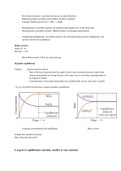
Constant concentrations for equilibrium Rate vs time
Orange line: product (reverse)
Blue: Reactant (forward)
Large K is equilibrium constant, small k is rate constant
, Kc/p
K is a constant
Kc used for aqueous reaction because c = concentration
Kp used for gas reaction because p = pressure
Kc = 1, concentration of reactant and product is same
Kc > 1 , concentration of product is higher
Kc < 1 , concentration of reactant is higher
- Reactants produce products and products produce reactants
- Example: Haber process: N2 + 3H2 → 2NH3
- Homogeneous reversible reaction: all reactants and products are in the same state
- Heterogenous reversible reaction: Different states of reactants and products
- Exothermic/Endothermic reversible reaction: The forward reaction can be endothermic, the
reverse will then be exothermic
Haber process
Delta H= -92
Reverse = +92
- Reversible reaction will never stop reacting
Dynamic equilibrium
Criteria: - System must be closed
- Rate of forward reaction must be equal to the reverse reaction (the point where both
reactant and product are being formed at the same rate as each other, meaning there is
no change in either)
- Concentrations of reactants and product are constant (this occurs when rate is equal)
- Every reversible reaction has a unique dynamic equilibrium
Constant concentrations for equilibrium Rate vs time
Orange line: product (reverse)
Blue: Reactant (forward)
Large K is equilibrium constant, small k is rate constant
, Kc/p
K is a constant
Kc used for aqueous reaction because c = concentration
Kp used for gas reaction because p = pressure
Kc = 1, concentration of reactant and product is same
Kc > 1 , concentration of product is higher
Kc < 1 , concentration of reactant is higher