- Rate of reaction
- Decrease in concentration of reactant per unit time or the increase in the
concentration of product per unit time
- A→B
- Conc in A decreases, Conc in B increases
- Speed of reaction is known as rate of the reaction,
- Rusting is slow, baking is fast, explosion is very fast
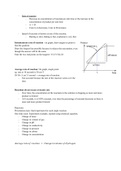
Instantaneous rate of reaction - on graph, draw tangent at point to
find the gradient
Draw the longest line possible because it reduces the uncertainty, even
though the answer will be the same
Take the two end points on the tangent= Y2-Y1/X2-X1
Average rate of reaction: On graph, single point
eg. rate at 10 seconds is 50 cm^3
50/10= 5 cm^3/ second = average rate of reaction
- Not accurate because the rate of the reaction varies over the
time
Reactions do not occur at steady rate
- Over time, the concentration of the reactants in the solution is dropping as more and more
product is formed
- At 0 seconds, it is 100% reactant, over time the percentage of reactant decreases as there is
more and more product formed
Reactions
Presentation task: find experiment for each single reaction
One slide each: Experiment example, explain using chemical equation,
- Change of mass
- Change in volume of gas
- Change in pH
- Change in conductivity
- Change in pressure
- Change in colour
- Change in concentration
𝐴𝑣𝑒𝑟𝑎𝑔𝑒 𝑟𝑎𝑡𝑒 𝑜𝑓 𝑟𝑒𝑎𝑐𝑡𝑖𝑜𝑛 = 𝐶ℎ𝑎𝑛𝑔𝑒 𝑖𝑛 𝑣𝑜𝑙𝑢𝑚𝑒 𝑜𝑓 𝐻𝑦𝑑𝑟𝑜𝑔𝑒𝑛
, Collision theory
Activation energy: The minimum energy required to make a chemical reaction happen
Activated complex: The transition state between reactants and products (the highest point on an
energy diagram). This is because it is the most unstable point
For particles to react:
- They must collide, old bond broken, new bond formed
- Not all collisions make successful reactions
- Collision must occur at the right angle and orientation to make a new bond
- Must also collide to the correct type of atom
- Must collide with an energy equal to or more energy than the activation energy
Rate of reaction
Can collisions occur faster?
If you increase the number of collisions, the rate of reaction will increase
5 factors
- Temperature
- Kinetic energy: movement of the particles
- Temperature is the average kinetic
energy of particles
- Higher the temperature, higher
kinetic energy for particles,
particles move faster, increased
successful collisions
- Increase in temperature also means
more particles have enough energy
to reach the activation energy, as
the average kinetic energy has
increased
- Maxwell-Boltzmann graph: area under curve= total number of particle, show
activation energy, random number, shade the areas
- Peak at higher temp will be lower and move to the right, better distribution of energy
- Never reaches 0, starts at 0 and never goes all the way down
- Decrease in concentration of reactant per unit time or the increase in the
concentration of product per unit time
- A→B
- Conc in A decreases, Conc in B increases
- Speed of reaction is known as rate of the reaction,
- Rusting is slow, baking is fast, explosion is very fast
Instantaneous rate of reaction - on graph, draw tangent at point to
find the gradient
Draw the longest line possible because it reduces the uncertainty, even
though the answer will be the same
Take the two end points on the tangent= Y2-Y1/X2-X1
Average rate of reaction: On graph, single point
eg. rate at 10 seconds is 50 cm^3
50/10= 5 cm^3/ second = average rate of reaction
- Not accurate because the rate of the reaction varies over the
time
Reactions do not occur at steady rate
- Over time, the concentration of the reactants in the solution is dropping as more and more
product is formed
- At 0 seconds, it is 100% reactant, over time the percentage of reactant decreases as there is
more and more product formed
Reactions
Presentation task: find experiment for each single reaction
One slide each: Experiment example, explain using chemical equation,
- Change of mass
- Change in volume of gas
- Change in pH
- Change in conductivity
- Change in pressure
- Change in colour
- Change in concentration
𝐴𝑣𝑒𝑟𝑎𝑔𝑒 𝑟𝑎𝑡𝑒 𝑜𝑓 𝑟𝑒𝑎𝑐𝑡𝑖𝑜𝑛 = 𝐶ℎ𝑎𝑛𝑔𝑒 𝑖𝑛 𝑣𝑜𝑙𝑢𝑚𝑒 𝑜𝑓 𝐻𝑦𝑑𝑟𝑜𝑔𝑒𝑛
, Collision theory
Activation energy: The minimum energy required to make a chemical reaction happen
Activated complex: The transition state between reactants and products (the highest point on an
energy diagram). This is because it is the most unstable point
For particles to react:
- They must collide, old bond broken, new bond formed
- Not all collisions make successful reactions
- Collision must occur at the right angle and orientation to make a new bond
- Must also collide to the correct type of atom
- Must collide with an energy equal to or more energy than the activation energy
Rate of reaction
Can collisions occur faster?
If you increase the number of collisions, the rate of reaction will increase
5 factors
- Temperature
- Kinetic energy: movement of the particles
- Temperature is the average kinetic
energy of particles
- Higher the temperature, higher
kinetic energy for particles,
particles move faster, increased
successful collisions
- Increase in temperature also means
more particles have enough energy
to reach the activation energy, as
the average kinetic energy has
increased
- Maxwell-Boltzmann graph: area under curve= total number of particle, show
activation energy, random number, shade the areas
- Peak at higher temp will be lower and move to the right, better distribution of energy
- Never reaches 0, starts at 0 and never goes all the way down