B&E2
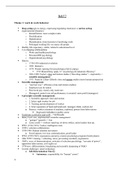
Theme 1: work & work behavior
Deep acting (gives energy, expressing/regulating emotions) vs surface acting
organizational dynamics:
o Intensification: more complex tasks
o Flexibilization
o Digitalization
o Mentalization: from factories to knowledge work
o Prolonged working life: too many old people
Healthy life expectancy: stable, related to educational level
3 overlapping subdisciplines
o Work (and health) psychology
o Personnel/HR psychology
o Organizational psychology
History:
o 1750-1850 industrial revolution
o 1892: Heiman’s
o 1879: Wundt: opening first psychological lab (Leipzig)
1913 Munsterberg: apply it!: “psychology & industrial efficiency”
o 1881-1890: Taylor’s time and motion studies (“shoveling studies” + stopwatch) ->
scientific management
o 1911: Frank & Lillian Gilbreth: time and motion studies (more human perspective)
Scientific management:
o “one best way”: efficiency (time and motion studies)
o Employee lazy by nature
o Piecework pay: money only motivator
o Managerial control over job performance is essential: more profit (managers)
4 principles scientific management:
o 1. Scientific approach: time and motion
o 2. Select right worker for job
o 3. Training and development of worker
o 4. Strict separation of head and handwork: managers think, workers do!
o Practice: worker extension of machine, exploited, protest from labor unions
Stopwatch forbidden in public sector
Taylorism is still alive and well! -> McDonalds
Henry Ford: cars, implemented scientific management
o “gestapo” (guards) -> fear
o Loose credit -> workers stand-up, sit-down strikes, union leaders beat up,
WW1 (1914-1918): Yerkes: intelligence tests
1920’s: selection collaboration
1930-1940: Human relations movement
o Social aspects, two-way communication, good leader
WW2 (1939-1945): ergonomics and army aviation psychology program (bomb planes)
After WW2: training + schooling, stress, preventing accidents, ergonomics
1960’s: wave of democratization, criticism of selection psychology, “servants of power”,
opposition labor unions, civil rights act
1970-now: differentiation, broadening and scientific deepening of W&O
Current challenges: smart technology
o Self-Determination Theory:
Autonomy: responsibility for “human” errors?
1
, Competence: de-skilling of workers?
Relatedness: de-socialization of workers in platform businesses?
Inclusiveness of labor market? – dumb people
o Science (prolonged working life) <-> practice (exercise, diets)
2
, Theme 2: Organizations, Groups, & Leadership
All companies are organizations, but not all organizations are companies
Descriptive (how existing organizations work) vs prescriptive (how they should work)
theories
Organizations as open systems:
o 1. Import energy, 2. transform energy, 3. output, 4. cycle of events, 5. escaping from
entropy (so it survives), 6. input of info, 7. homeostasis, 8. specialization, 9.
coordination and integration, 10. equifinality
Organizational theories:
o Bureaucracy (improvement compared to situation then)
Objective: eliminate privileges, inefficiency (suitable for job, not bc of
birthright)
Characteristics:
Division of labor and task specialization
Hierarchy based on legitimized authority and delegation of authority
Recruitment, selection and careers based on competencies
Regulations and procedures
Impersonal = “a blessing!”
Fewer KSAO’s, but more supervisors
o Taylorism (micro level, dividing into smaller tasks)
“Scientific management” -> time and motion studies (detailed mapping)
Employees as machines
Pay based on performance
Employees are lazy…
o Human relations
Organization /= machine
Human behavior influenced not only by externally imposed rules, but also by
attention, respect, interest, and interpersonal contact
Hawthorne studies
o theory x (traditional model) -> theory y (human relations model)
theory z: long-term employment is basis for effective organizations (bc of
higher employee commitment
o Sociotechnical systems
Joint optimization; each system = technical and social
Best of both worlds
Unit control of variances; (semi)-self-directing team
Supervisor’s role is to facilitate
Only works if underlying support system (task assignments) is aligned with
this
Principles for structuring an organization
o 1. Division of labor (job differentiation) -> who does what?
o 2. Delegation of authority
Power -> who control and decides
Communication and control -> who reports what to whom
o 3. Span of control
Number employees ranking directly below you -> depends on skills, type of
leadership style
Narrow (more rules) vs. wide (more autonomy and trust in employees)
o 4. Line vs staff position (deciders vs advisors)
Organizational structure
o Functional structure: people with same job/function put together
Only with small organization
3
Theme 1: work & work behavior
Deep acting (gives energy, expressing/regulating emotions) vs surface acting
organizational dynamics:
o Intensification: more complex tasks
o Flexibilization
o Digitalization
o Mentalization: from factories to knowledge work
o Prolonged working life: too many old people
Healthy life expectancy: stable, related to educational level
3 overlapping subdisciplines
o Work (and health) psychology
o Personnel/HR psychology
o Organizational psychology
History:
o 1750-1850 industrial revolution
o 1892: Heiman’s
o 1879: Wundt: opening first psychological lab (Leipzig)
1913 Munsterberg: apply it!: “psychology & industrial efficiency”
o 1881-1890: Taylor’s time and motion studies (“shoveling studies” + stopwatch) ->
scientific management
o 1911: Frank & Lillian Gilbreth: time and motion studies (more human perspective)
Scientific management:
o “one best way”: efficiency (time and motion studies)
o Employee lazy by nature
o Piecework pay: money only motivator
o Managerial control over job performance is essential: more profit (managers)
4 principles scientific management:
o 1. Scientific approach: time and motion
o 2. Select right worker for job
o 3. Training and development of worker
o 4. Strict separation of head and handwork: managers think, workers do!
o Practice: worker extension of machine, exploited, protest from labor unions
Stopwatch forbidden in public sector
Taylorism is still alive and well! -> McDonalds
Henry Ford: cars, implemented scientific management
o “gestapo” (guards) -> fear
o Loose credit -> workers stand-up, sit-down strikes, union leaders beat up,
WW1 (1914-1918): Yerkes: intelligence tests
1920’s: selection collaboration
1930-1940: Human relations movement
o Social aspects, two-way communication, good leader
WW2 (1939-1945): ergonomics and army aviation psychology program (bomb planes)
After WW2: training + schooling, stress, preventing accidents, ergonomics
1960’s: wave of democratization, criticism of selection psychology, “servants of power”,
opposition labor unions, civil rights act
1970-now: differentiation, broadening and scientific deepening of W&O
Current challenges: smart technology
o Self-Determination Theory:
Autonomy: responsibility for “human” errors?
1
, Competence: de-skilling of workers?
Relatedness: de-socialization of workers in platform businesses?
Inclusiveness of labor market? – dumb people
o Science (prolonged working life) <-> practice (exercise, diets)
2
, Theme 2: Organizations, Groups, & Leadership
All companies are organizations, but not all organizations are companies
Descriptive (how existing organizations work) vs prescriptive (how they should work)
theories
Organizations as open systems:
o 1. Import energy, 2. transform energy, 3. output, 4. cycle of events, 5. escaping from
entropy (so it survives), 6. input of info, 7. homeostasis, 8. specialization, 9.
coordination and integration, 10. equifinality
Organizational theories:
o Bureaucracy (improvement compared to situation then)
Objective: eliminate privileges, inefficiency (suitable for job, not bc of
birthright)
Characteristics:
Division of labor and task specialization
Hierarchy based on legitimized authority and delegation of authority
Recruitment, selection and careers based on competencies
Regulations and procedures
Impersonal = “a blessing!”
Fewer KSAO’s, but more supervisors
o Taylorism (micro level, dividing into smaller tasks)
“Scientific management” -> time and motion studies (detailed mapping)
Employees as machines
Pay based on performance
Employees are lazy…
o Human relations
Organization /= machine
Human behavior influenced not only by externally imposed rules, but also by
attention, respect, interest, and interpersonal contact
Hawthorne studies
o theory x (traditional model) -> theory y (human relations model)
theory z: long-term employment is basis for effective organizations (bc of
higher employee commitment
o Sociotechnical systems
Joint optimization; each system = technical and social
Best of both worlds
Unit control of variances; (semi)-self-directing team
Supervisor’s role is to facilitate
Only works if underlying support system (task assignments) is aligned with
this
Principles for structuring an organization
o 1. Division of labor (job differentiation) -> who does what?
o 2. Delegation of authority
Power -> who control and decides
Communication and control -> who reports what to whom
o 3. Span of control
Number employees ranking directly below you -> depends on skills, type of
leadership style
Narrow (more rules) vs. wide (more autonomy and trust in employees)
o 4. Line vs staff position (deciders vs advisors)
Organizational structure
o Functional structure: people with same job/function put together
Only with small organization
3