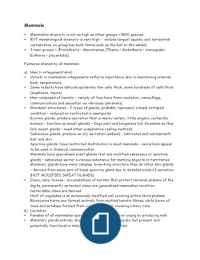
Mammals
Mammalian diversity is not as high as other groups ~4800 species
BUT morphological diversity is very high - include largest aquatic and terrestrial
vertebrates, no group has both forms such as the bat or the whale)
3 main groups = (Prototheria – Monotremes (Theria = Metatheria – marsupials+
Eutheria – placentals))
Features shared by all mammals
a) Hair (+ integument/skin)
Variety in mammalian integuments reflects importance skin in maintaining internal
body temperature
Some rodents have delicate epidermis few cells thick, some hundreds of cells thick
(elephants, tapirs)
Hair composed of keratin – variety of functions from insulation, camouflage,
communications and sensation via vibrissae (whiskers)
Glandular structures – 3 types of glands, probably represent a basal tetrapod
condition – reduced or restricted in sauropsids
Eccrine glands: produce secretion that is mainly watery, little organic content(in
humans – function as sweat glands) – Dogs pant and kangaroos lick forearms as they
lack sweat glands – need other evaporative cooling methods
Sebaceous glands: produce an oily secretion (sebum) – lubricates and waterproofs
hair and skin
Apocrine glands: have restricted distribution in most mammals – secretions appear
to be used in chemical communication
Mammals have specialised scent glands that are modified sebaceous or apocrine
glands – sebaceous secret a viscous substance for marking objects or territories
Mammary glands have more complex, branching structure than do other skin glands
– derived from some sort of basal apocrine gland due to detailed mode of secretion
(NOT MODIFIED SWEAT GLANDS)
Claws, nails, hooves – accumulations of keratin that protect terminal phalanx of the
digits, permanently extended claws are generalised mammalian condition,
retractable claws are derived
Hoof of ungulates is an extensively modified nail covering entire third phalanx
Rhinoceros horns are formed entirely from matted keratin fibres, while horns of
cows and antelope formed from a keratin sheath covering a bony core
b) Lactation
Females of all mammalian species lactate, feeding their young by producing milk
Mammary glands entirely absent from males of marsupials, but present and
potentially functional in male monotremes and placentals
, Eg. 2 species of bats hat lactate, some examples of human males lactating (Kunz and
Hoksen, 2009)
Only therians have nipples
Mammary hairs (probably primitive feature) present in monotremes and marsupials,
develop from areola patches confined to abdominal region
Placentals lack mammary hairs – mammae develop from mammary lines that form
along entire length of the ventral surface
c) Skeletomuscular features
Dentition
Heterodonty: incisors, canines, premolars, molars
Diphyodonty: Most placental mammals have 2 sets of dentitions in their lifetime
Marsupials replace only one tooth – last premolar
First set – milk teeth, then permanent adult dentition and addition of later-erupting
molars
Mammals are only animals that masticate and swallow discrete bolus of food
comprised of small food particles mixed with saliva (= deglutination)
Therian mammals have unique types of molars (tribosphenic molars)
Postcranial Features
Unlike sprawling posture of extant reptiles, mammals have more upright posture
with limbs positioned underneath the body (fully upright is a derived condition,
semisprawling stance of an opossum probably the generalised mammalian condition)
Mammals have an different ankle joint from other amniotes – main site of movement
not within bones of the ankle joint (mesotarsal joint) – between tibia and one of the
proximal ankle bones (astralagus)
New ankle joint allows only fore-and-aft movement of the foot on leg – good for
rapid locomotion
Original intratarsal joint is retained in some mammals to allow for movement within
foot (eg. inversion and eversion)
Vertebrae
With very few exceptions, all mammals have 7 cervical vertebrae (Mamatees and
tree sloth have 6 vertebrae)
Specialised atlas-axis complex of first 2 cervical process allows head rotation in 2
places (up and down, side to side)
Mammals have restricted ribs to the thoracic trunk vertebrae
Lumbar vertebrae now have zygapophyseal connections that allow dorsoventral
flexion
d) Sensory systems
3 middle ear bones (incus, malleus, stapes)
, Homologous = same developmental and evolutionary origin
Stapes is homologous to columnella in reptiles
Incus is homologous to the quadrate in the upper jaw of reptiles
Malleus is homologous to the articular in the lower jaw of reptiles
Enlargement of the brain – cerebral hemispheres (neocortex or neopallium) forms
differently from enlarged forebrain of derived sauropsids
Infolded cerebellum and large representation of the area for cranial nerve VII,
which is associated with facial musculature
Monotremes – Prototheria (~5 extant species, Australia + New Guinea)
2 families – Cenozoic fossils suggest that monotreme diversity has always been
limited to echidna and platypus forms (Tachyglossidae and Ornithorhynchidae)
Egg layers, single posterior opening (cloaca or excretion and reproduction –
ancestral amniote condition)
Sprawling stance, reminiscent of reptiles – may be specialisation for swimming or
digging rather than a basal mammalian condition
Lack teeth as adults, have leathery bill or beak – contains receptors that sense
electromagnetic signals from muscles of other animals, detecting prey underwater
or in a termite nest
Platypus genome has more bird characteristics than do genomes of therians –
suggest that there are basal amniote features retained in monotremes and birds
but lost in therians
Male platypuses have spur on hind leg attached to venom gland (similar spur seen in
some Mesozoic mammals – so may not be unique feature of monotremes) (Hurum et
al., 2006)
Possession of venom rare in mammals – others found in order Liptyphla – shrews,
cat-size Solenodon
Marsupials – Metatheria (~270 species, Americas + Australia)
Divided into at least 4 lineages that are equivalent in morphological and genetic
diversity to placental orders
Fundamental split between extant marsupials into the (supported by ankle
morphology, genetic, molecular data):
Ameridelphia Australidelphia Deltatheroidea
Didelphimorphia Dasyuromorphia - Extinct lineage
- American opossums - Australiasian - Probably more
Paucituberculata carnivorous marsulpials basal than extant
Mammalian diversity is not as high as other groups ~4800 species
BUT morphological diversity is very high - include largest aquatic and terrestrial
vertebrates, no group has both forms such as the bat or the whale)
3 main groups = (Prototheria – Monotremes (Theria = Metatheria – marsupials+
Eutheria – placentals))
Features shared by all mammals
a) Hair (+ integument/skin)
Variety in mammalian integuments reflects importance skin in maintaining internal
body temperature
Some rodents have delicate epidermis few cells thick, some hundreds of cells thick
(elephants, tapirs)
Hair composed of keratin – variety of functions from insulation, camouflage,
communications and sensation via vibrissae (whiskers)
Glandular structures – 3 types of glands, probably represent a basal tetrapod
condition – reduced or restricted in sauropsids
Eccrine glands: produce secretion that is mainly watery, little organic content(in
humans – function as sweat glands) – Dogs pant and kangaroos lick forearms as they
lack sweat glands – need other evaporative cooling methods
Sebaceous glands: produce an oily secretion (sebum) – lubricates and waterproofs
hair and skin
Apocrine glands: have restricted distribution in most mammals – secretions appear
to be used in chemical communication
Mammals have specialised scent glands that are modified sebaceous or apocrine
glands – sebaceous secret a viscous substance for marking objects or territories
Mammary glands have more complex, branching structure than do other skin glands
– derived from some sort of basal apocrine gland due to detailed mode of secretion
(NOT MODIFIED SWEAT GLANDS)
Claws, nails, hooves – accumulations of keratin that protect terminal phalanx of the
digits, permanently extended claws are generalised mammalian condition,
retractable claws are derived
Hoof of ungulates is an extensively modified nail covering entire third phalanx
Rhinoceros horns are formed entirely from matted keratin fibres, while horns of
cows and antelope formed from a keratin sheath covering a bony core
b) Lactation
Females of all mammalian species lactate, feeding their young by producing milk
Mammary glands entirely absent from males of marsupials, but present and
potentially functional in male monotremes and placentals
, Eg. 2 species of bats hat lactate, some examples of human males lactating (Kunz and
Hoksen, 2009)
Only therians have nipples
Mammary hairs (probably primitive feature) present in monotremes and marsupials,
develop from areola patches confined to abdominal region
Placentals lack mammary hairs – mammae develop from mammary lines that form
along entire length of the ventral surface
c) Skeletomuscular features
Dentition
Heterodonty: incisors, canines, premolars, molars
Diphyodonty: Most placental mammals have 2 sets of dentitions in their lifetime
Marsupials replace only one tooth – last premolar
First set – milk teeth, then permanent adult dentition and addition of later-erupting
molars
Mammals are only animals that masticate and swallow discrete bolus of food
comprised of small food particles mixed with saliva (= deglutination)
Therian mammals have unique types of molars (tribosphenic molars)
Postcranial Features
Unlike sprawling posture of extant reptiles, mammals have more upright posture
with limbs positioned underneath the body (fully upright is a derived condition,
semisprawling stance of an opossum probably the generalised mammalian condition)
Mammals have an different ankle joint from other amniotes – main site of movement
not within bones of the ankle joint (mesotarsal joint) – between tibia and one of the
proximal ankle bones (astralagus)
New ankle joint allows only fore-and-aft movement of the foot on leg – good for
rapid locomotion
Original intratarsal joint is retained in some mammals to allow for movement within
foot (eg. inversion and eversion)
Vertebrae
With very few exceptions, all mammals have 7 cervical vertebrae (Mamatees and
tree sloth have 6 vertebrae)
Specialised atlas-axis complex of first 2 cervical process allows head rotation in 2
places (up and down, side to side)
Mammals have restricted ribs to the thoracic trunk vertebrae
Lumbar vertebrae now have zygapophyseal connections that allow dorsoventral
flexion
d) Sensory systems
3 middle ear bones (incus, malleus, stapes)
, Homologous = same developmental and evolutionary origin
Stapes is homologous to columnella in reptiles
Incus is homologous to the quadrate in the upper jaw of reptiles
Malleus is homologous to the articular in the lower jaw of reptiles
Enlargement of the brain – cerebral hemispheres (neocortex or neopallium) forms
differently from enlarged forebrain of derived sauropsids
Infolded cerebellum and large representation of the area for cranial nerve VII,
which is associated with facial musculature
Monotremes – Prototheria (~5 extant species, Australia + New Guinea)
2 families – Cenozoic fossils suggest that monotreme diversity has always been
limited to echidna and platypus forms (Tachyglossidae and Ornithorhynchidae)
Egg layers, single posterior opening (cloaca or excretion and reproduction –
ancestral amniote condition)
Sprawling stance, reminiscent of reptiles – may be specialisation for swimming or
digging rather than a basal mammalian condition
Lack teeth as adults, have leathery bill or beak – contains receptors that sense
electromagnetic signals from muscles of other animals, detecting prey underwater
or in a termite nest
Platypus genome has more bird characteristics than do genomes of therians –
suggest that there are basal amniote features retained in monotremes and birds
but lost in therians
Male platypuses have spur on hind leg attached to venom gland (similar spur seen in
some Mesozoic mammals – so may not be unique feature of monotremes) (Hurum et
al., 2006)
Possession of venom rare in mammals – others found in order Liptyphla – shrews,
cat-size Solenodon
Marsupials – Metatheria (~270 species, Americas + Australia)
Divided into at least 4 lineages that are equivalent in morphological and genetic
diversity to placental orders
Fundamental split between extant marsupials into the (supported by ankle
morphology, genetic, molecular data):
Ameridelphia Australidelphia Deltatheroidea
Didelphimorphia Dasyuromorphia - Extinct lineage
- American opossums - Australiasian - Probably more
Paucituberculata carnivorous marsulpials basal than extant