Chemistry Notes Topic 2 - Covalent Bonding
Covalent bonding:
● The strong electrostatic attraction between two positive nuclei and the shared pair of
electrons between them.
● Usually happens between non-metals.
Dot-and-cross diagrams:
● Can also be used for covalent substances.
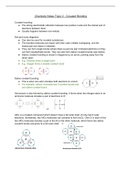
● The bonded molecules are drawn with their outer orbitals overlapping, and the
shared pair are drawn in between.
● They can form single bonds (where there is just one pair of shared electrons) or they
can form double/triple bonds. They can also form dative covalent bonds (see below).
● Dative covalent bonding is shown in diagrams by an arrow, pointing away from the
donor atom.
● E.g. Chlorine forms a single bond
● E.g. Oxygen forms a double covalent bond
Dative covalent bonding:
● This is when one atom donates both electrons to a bond
● For example, carbon monoxide has 2 covalent bonds and
one dative covalent bond.
Ammonium is also formed by dative covalent bonding. It forms when the nitrogen atom in an
ammonia molecule donates a pair of electrons to H+.
or
AlCl3 is a covalent compound which doesn’t have a full outer shell. Al only has 6 outer
electrons. Sometimes, two AlCl3 molecules can combine to form Al2Cl6. One Cl in each of the
two AlCl3 molecules donates a pair to the Al on the other molecule, which forms two dative
covalent bonds and gives Al a full outer shell.
, Bond length and bond strength:
● In covalent molecules, the positive nuclei are attracted to an area of electron density
where the shared electrons are, but the two nuclei also repel each other, so there
has to be a balance between these forces.
● Bond length - the distance between the two nuclei where the attractive and repulsive
forces balance each other.
● The higher the electron density between the nuclei (the more electrons), the stronger
the attraction between the atoms, and therefore the higher the bond strength and the
shorter the bond length.
Structure of covalent substances:
● The structure of covalently bonded substances is simple molecular, as covalent
bonds are formed when atoms share electrons with other atoms and this usually
forms small molecules.
● However some covalent substances have giant covalent lattice structures. These
have billions of atoms and much stronger electrostatic attractions.
● Carbon and silicon can form these giant covalent lattices because they each form 4
strong covalent bonds.
● Giant structures have high melting/boiling points, are very hard, are good thermal
conductors, are insoluble and most can’t conduct electricity.
Giant covalent lattices:
● Diamond - each carbon atom is bonded to 4 others in a tetrahedral arrangement.
● Silicon dioxide (silica) - forms a similar lattice structure to diamond, but there are
oxygen atoms between each silicon atom.
● Graphite - the carbon atoms form sheets, and each carbon atom shares 3 outer
electrons with 3 other carbon atoms. The fourth electron is then able to move freely
between layers, so graphite can conduct electricity. The forces between the sheets
are also relatively weak.
● Graphene - this is 1 layer of graphite, so it is just a sheet of carbon atoms joined
together in hexagons. The sheet is 1 atom thick, so is two-dimensional. It can also
conduct electricity, and is strong and very light.
Shapes of molecules:
● Molecular shape depends on the number and type of pairs of electrons in the outer
shell of the central atom.
● A lone pair of electrons is not shared, and a bonding pair of electrons is shared with
another atom.
● Since electrons are negative, so electron pairs will repel each other. The type of the
electron pair affects how much it repels other pairs.
● Lone pairs repel more than bonding pairs, which means the greatest angles are
between lone pairs of electrons.
Predicting molecular shape:
You can predict molecular shape with electron pair repulsion theory.
1. Find the central atom.
2. Work out the number of electrons in the outer shell of the central atom.
Covalent bonding:
● The strong electrostatic attraction between two positive nuclei and the shared pair of
electrons between them.
● Usually happens between non-metals.
Dot-and-cross diagrams:
● Can also be used for covalent substances.
● The bonded molecules are drawn with their outer orbitals overlapping, and the
shared pair are drawn in between.
● They can form single bonds (where there is just one pair of shared electrons) or they
can form double/triple bonds. They can also form dative covalent bonds (see below).
● Dative covalent bonding is shown in diagrams by an arrow, pointing away from the
donor atom.
● E.g. Chlorine forms a single bond
● E.g. Oxygen forms a double covalent bond
Dative covalent bonding:
● This is when one atom donates both electrons to a bond
● For example, carbon monoxide has 2 covalent bonds and
one dative covalent bond.
Ammonium is also formed by dative covalent bonding. It forms when the nitrogen atom in an
ammonia molecule donates a pair of electrons to H+.
or
AlCl3 is a covalent compound which doesn’t have a full outer shell. Al only has 6 outer
electrons. Sometimes, two AlCl3 molecules can combine to form Al2Cl6. One Cl in each of the
two AlCl3 molecules donates a pair to the Al on the other molecule, which forms two dative
covalent bonds and gives Al a full outer shell.
, Bond length and bond strength:
● In covalent molecules, the positive nuclei are attracted to an area of electron density
where the shared electrons are, but the two nuclei also repel each other, so there
has to be a balance between these forces.
● Bond length - the distance between the two nuclei where the attractive and repulsive
forces balance each other.
● The higher the electron density between the nuclei (the more electrons), the stronger
the attraction between the atoms, and therefore the higher the bond strength and the
shorter the bond length.
Structure of covalent substances:
● The structure of covalently bonded substances is simple molecular, as covalent
bonds are formed when atoms share electrons with other atoms and this usually
forms small molecules.
● However some covalent substances have giant covalent lattice structures. These
have billions of atoms and much stronger electrostatic attractions.
● Carbon and silicon can form these giant covalent lattices because they each form 4
strong covalent bonds.
● Giant structures have high melting/boiling points, are very hard, are good thermal
conductors, are insoluble and most can’t conduct electricity.
Giant covalent lattices:
● Diamond - each carbon atom is bonded to 4 others in a tetrahedral arrangement.
● Silicon dioxide (silica) - forms a similar lattice structure to diamond, but there are
oxygen atoms between each silicon atom.
● Graphite - the carbon atoms form sheets, and each carbon atom shares 3 outer
electrons with 3 other carbon atoms. The fourth electron is then able to move freely
between layers, so graphite can conduct electricity. The forces between the sheets
are also relatively weak.
● Graphene - this is 1 layer of graphite, so it is just a sheet of carbon atoms joined
together in hexagons. The sheet is 1 atom thick, so is two-dimensional. It can also
conduct electricity, and is strong and very light.
Shapes of molecules:
● Molecular shape depends on the number and type of pairs of electrons in the outer
shell of the central atom.
● A lone pair of electrons is not shared, and a bonding pair of electrons is shared with
another atom.
● Since electrons are negative, so electron pairs will repel each other. The type of the
electron pair affects how much it repels other pairs.
● Lone pairs repel more than bonding pairs, which means the greatest angles are
between lone pairs of electrons.
Predicting molecular shape:
You can predict molecular shape with electron pair repulsion theory.
1. Find the central atom.
2. Work out the number of electrons in the outer shell of the central atom.