

Lecture 1 – Introduction and History of Artificial
Intelligence
What is Artificial Intelligence
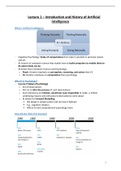
Thinking Humanly Thinking Rationally
AI = Balance
Acting Humanly Acting Rationally
- Cognitive Psychology: Study of computations that make it possible to perceive reason
and act
- AI: branch of computer science that studies how to build computers to enable them to
do what minds can do
- AI draws from Computer Science and Psychology
o Psych: Greater emphasis on perception, reasoning, and action than CS
o CS: Greater emphasis on computation than psychology
Why AI in Psychology?
- Inverse Problem (Psychology)
o Set of observations
o We try to infer the process of such observations
o Such inferences are limited, sometimes even impossible to make → million
underlying reasons why behaviour (observations) come about
o AI allows for Forward Modelling
§ We design a simple system and see how it behaves
§ E.g., cognitive robotics
§ Where AI and computational psychology meet
How did the field of AI develop?
1
,- Philosophy of mind
o How physical brain give rise to mental mind?
o Descartes: Dualism because mind is not physical
o Materialists: all mental states are caused by (or identical to) physical states →
strong AI possible
1940s
- Warren McColloch and Walter Pitts’ three principles (about what neurons can do)
o Basic Physiology (biological foundations about neurons)
o Propositional Logic (If-Then)
o Turing’s theory of computation (any computation can be executed by a machine
with big enough capacity)
è These principles proved that
o Any computable function can be computed by a network of neurons
o All logical operators can be implemented by simple neural networks (logical
operators)
Weak vs. Strong AI
- Weak AI: Turing Test
o Non-Sentient AI
o Turing’s Imitation Game: machine is intelligent if we CANNOT distinguish it from a
human in conversation
§ NO claims about underlying principles
§ How does it determine intelligence?
• Complex grammatical structures (used by chatbots, not humans)
• Realistic world knowledge (e.g., missing context of conversation)
§ Searle: only Brains can cause minds/intelligence → only a collection of
cells/physical-chemical properties
o Chinese Room Argument:
§ Foundation:
• In a room in China, does not speak Chinese, people outside write him
questions in Chinese, he must answer in Chinese, has books with every
answer in there (even if he does not understand them) so he can answer
correctly
• To Chinese outside → responder obviously speaks Chinese (even if we
know he does not)
• Any computer passing the Turing Test has same architecture → would be
intelligent? → no, it’s a very simple but stupid architecture (rule-based
manipulation)
• Does not represent true intelligence or sentience!
§ Replace neurons with Chinese room → how many neurons connected to
Chinese Rooms would stop true ‘intelligence’
o Weak AI is just rule-based manipulation of symbols
- Strong AI
o Intelligent systems can actually think
o Computational calculations are always the same, does not matter if brain or chip
2
, o Should have connectivist architecture (like neurons)
o Problems:
§ Can machines think?
• Matter of language
• Are we asking the right questions?
• Human mind is an information processing system and thinking is a form of
computing
§ Will a simulated human mind have all the same properties as real human
minds?
1950s
- Minsky and Edmond’s SNARC: First neural network computer with 40 neurons → Is it
mathematics? → If not now, it will be in the future
- Dartmouth Conference in 1956: birth of AI
o Computer Science, Mathematics, Cognitive Science
o Coined term AI
1980s
- Intelligence = Manipulation of Physical Symbol Systems
o Beforehand: Idea that Machines can never to X
o Now: proving that they can do
§ Checkers
§ Chess
§ Formal theorem proving
- Symbolic AI (GOFAI – Good Old-Fashioned AI):
o NOT concerned with neurophysiology
o Propositional Logic: Human thinking = symbol manipulation = IF (A>B) AND (B>C)
THEN (A>C)
o Intelligence = symbols and relationship between them
o Lead to knowledge-based, expert systems were huge success (e.g., MYCIN)
- 1965: ELIZA
o Natural language processor, Create illusion of understanding, Mimic
psychotherapist
o Response from public: computers can have conversations!
o Weizenbaum: Anthromorphisation of computers is a mind trick
o How does she work?
§ Looks for keywords
§ Look in database for rules, constructs new sentences using keywords and
database
- 1972: PARRY
o Modified Turing Test, simulated paranoid schizophrenia patient → since they
normally talk chaotically and meaningless it seemed realistic
o Only 48% of psychiatrists were able to tell him from real patients
3
, - STRIPS
o Stanford Research Institute Problem Solver: automated planner
o Realization of goals (make coffee) → divide task into subgoals (turn on coffee
maker etc.), identify necessary actions
§ Certain hierarchies on what to do first but also irrelevant things (like putting
sugar or milk in first)
o Early action planners were susceptible to Sussman anomaly
§ Exceptions to rules, stacking blocks on top of each other with constraint that
only one block allowed to be moved at one time, easy to solve subgoals but
one subgoal solved with one move may hinder second subgoal
- Expert Systems: MYCIN
o Emulates the decision-making ability of a human expert → physicians
o E.g., MYCIN recommends treatment for certain
blood infections
§ Propositional Logic: Simple If-Then rules
§ Better than actual physicians
§ Never used in practice because of ethical
and legal difficulties (who do we blame if sth goes wrong?)
1970-80s
- Overconfidence in AI systems led to AI winter
- AI not as powerful as many thought
- Many questions: how do we deal with perception, robotics, learning, pattern
recognition?
è Symbolic AI does not suffice
2000s
- Symbolic AI criticism
o Seems unnecessary for many behaviours
o Untransparent processes: Unclear how processes like pattern recognition would
work in symbolic way
o Representations dealing with noisy input are needed
- Connectionist AI
o Study of artificial neural networks (ANNs) to explain cognition
o Early PDP work: McCelland 1981
§ Model of human memory
• Memory is content-addressable (if you want to activate memory, think
about something similar/associated to it)
• Memory not stored in neurons but in connections BETWEEN them →
Synapses, Connection Weights!
4
Intelligence
What is Artificial Intelligence
Thinking Humanly Thinking Rationally
AI = Balance
Acting Humanly Acting Rationally
- Cognitive Psychology: Study of computations that make it possible to perceive reason
and act
- AI: branch of computer science that studies how to build computers to enable them to
do what minds can do
- AI draws from Computer Science and Psychology
o Psych: Greater emphasis on perception, reasoning, and action than CS
o CS: Greater emphasis on computation than psychology
Why AI in Psychology?
- Inverse Problem (Psychology)
o Set of observations
o We try to infer the process of such observations
o Such inferences are limited, sometimes even impossible to make → million
underlying reasons why behaviour (observations) come about
o AI allows for Forward Modelling
§ We design a simple system and see how it behaves
§ E.g., cognitive robotics
§ Where AI and computational psychology meet
How did the field of AI develop?
1
,- Philosophy of mind
o How physical brain give rise to mental mind?
o Descartes: Dualism because mind is not physical
o Materialists: all mental states are caused by (or identical to) physical states →
strong AI possible
1940s
- Warren McColloch and Walter Pitts’ three principles (about what neurons can do)
o Basic Physiology (biological foundations about neurons)
o Propositional Logic (If-Then)
o Turing’s theory of computation (any computation can be executed by a machine
with big enough capacity)
è These principles proved that
o Any computable function can be computed by a network of neurons
o All logical operators can be implemented by simple neural networks (logical
operators)
Weak vs. Strong AI
- Weak AI: Turing Test
o Non-Sentient AI
o Turing’s Imitation Game: machine is intelligent if we CANNOT distinguish it from a
human in conversation
§ NO claims about underlying principles
§ How does it determine intelligence?
• Complex grammatical structures (used by chatbots, not humans)
• Realistic world knowledge (e.g., missing context of conversation)
§ Searle: only Brains can cause minds/intelligence → only a collection of
cells/physical-chemical properties
o Chinese Room Argument:
§ Foundation:
• In a room in China, does not speak Chinese, people outside write him
questions in Chinese, he must answer in Chinese, has books with every
answer in there (even if he does not understand them) so he can answer
correctly
• To Chinese outside → responder obviously speaks Chinese (even if we
know he does not)
• Any computer passing the Turing Test has same architecture → would be
intelligent? → no, it’s a very simple but stupid architecture (rule-based
manipulation)
• Does not represent true intelligence or sentience!
§ Replace neurons with Chinese room → how many neurons connected to
Chinese Rooms would stop true ‘intelligence’
o Weak AI is just rule-based manipulation of symbols
- Strong AI
o Intelligent systems can actually think
o Computational calculations are always the same, does not matter if brain or chip
2
, o Should have connectivist architecture (like neurons)
o Problems:
§ Can machines think?
• Matter of language
• Are we asking the right questions?
• Human mind is an information processing system and thinking is a form of
computing
§ Will a simulated human mind have all the same properties as real human
minds?
1950s
- Minsky and Edmond’s SNARC: First neural network computer with 40 neurons → Is it
mathematics? → If not now, it will be in the future
- Dartmouth Conference in 1956: birth of AI
o Computer Science, Mathematics, Cognitive Science
o Coined term AI
1980s
- Intelligence = Manipulation of Physical Symbol Systems
o Beforehand: Idea that Machines can never to X
o Now: proving that they can do
§ Checkers
§ Chess
§ Formal theorem proving
- Symbolic AI (GOFAI – Good Old-Fashioned AI):
o NOT concerned with neurophysiology
o Propositional Logic: Human thinking = symbol manipulation = IF (A>B) AND (B>C)
THEN (A>C)
o Intelligence = symbols and relationship between them
o Lead to knowledge-based, expert systems were huge success (e.g., MYCIN)
- 1965: ELIZA
o Natural language processor, Create illusion of understanding, Mimic
psychotherapist
o Response from public: computers can have conversations!
o Weizenbaum: Anthromorphisation of computers is a mind trick
o How does she work?
§ Looks for keywords
§ Look in database for rules, constructs new sentences using keywords and
database
- 1972: PARRY
o Modified Turing Test, simulated paranoid schizophrenia patient → since they
normally talk chaotically and meaningless it seemed realistic
o Only 48% of psychiatrists were able to tell him from real patients
3
, - STRIPS
o Stanford Research Institute Problem Solver: automated planner
o Realization of goals (make coffee) → divide task into subgoals (turn on coffee
maker etc.), identify necessary actions
§ Certain hierarchies on what to do first but also irrelevant things (like putting
sugar or milk in first)
o Early action planners were susceptible to Sussman anomaly
§ Exceptions to rules, stacking blocks on top of each other with constraint that
only one block allowed to be moved at one time, easy to solve subgoals but
one subgoal solved with one move may hinder second subgoal
- Expert Systems: MYCIN
o Emulates the decision-making ability of a human expert → physicians
o E.g., MYCIN recommends treatment for certain
blood infections
§ Propositional Logic: Simple If-Then rules
§ Better than actual physicians
§ Never used in practice because of ethical
and legal difficulties (who do we blame if sth goes wrong?)
1970-80s
- Overconfidence in AI systems led to AI winter
- AI not as powerful as many thought
- Many questions: how do we deal with perception, robotics, learning, pattern
recognition?
è Symbolic AI does not suffice
2000s
- Symbolic AI criticism
o Seems unnecessary for many behaviours
o Untransparent processes: Unclear how processes like pattern recognition would
work in symbolic way
o Representations dealing with noisy input are needed
- Connectionist AI
o Study of artificial neural networks (ANNs) to explain cognition
o Early PDP work: McCelland 1981
§ Model of human memory
• Memory is content-addressable (if you want to activate memory, think
about something similar/associated to it)
• Memory not stored in neurons but in connections BETWEEN them →
Synapses, Connection Weights!
4


