Memory
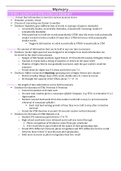
CODING, CAPACITY & DURATION OF MEMORY
Coding: format that information is stored in various memory stores
Semantic, acoustic, visual
Process of converting one format to another
Evidence: Baddeley gave different lists of words to 4 groups of ppts to remember
o Acoustically similar, acoustically dissimilar, semantically (meaning) similar &
semantically dissimilar
o When ppts had to recall the words immediately (STM) they did worse with acoustically
similar words but when recalled 20 mins later (LTM) did worse with semantically
similar words
Suggests information is coded acoustically in STM & semantically in LTM
Capacity: the amount of information that can be held at any one time in memory
Evidence: Jacobs digit span test was designed to investigate how much information can
be stored in the short-term memory.
o Sample of 443 female students (aged from 8-19) from North London Collegiate School
o Pps had to repeat back a string of numbers or letters in the same order
o Number of digits/letters was gradually increased, until the pps couldn’t recall the
sequence
o Found mean for digits was 9.3 items and letters was 7.3
Evidence: Miller researched chunking (grouping sets of digits/letters into chunks)
o Noted everyday things (days of the week, deadly sins etc.) came in sevens
o He thought the capacity of the STM is about 7 (+ & - 2)
Duration: the length of time information can be held in memory
Evidence for duration of STM: Peterson & Peterson
o Tested 24 students in 8 trials each
o On each trial, student given a consonant syllable (trigram) (e.g. YCG) to remember & a 3
digit number
o Student counted backwards from this number until told to stop (to prevent mental
rehearsal of consonant syllable)
Each trial had varying periods of time they were told to stop after (retention
interval)
o Found the STM duration is around 18 seconds (unless verbal rehearsal)
Evidence for duration of LTM: Bahrick et al
o Studied 392 American pps between 17 & 74
o High school yearbooks were obtained and recall was tested through
1. Photo-recognition of 50 photos (some from pps’ yearbook)
2. Free recall where pps recalled all the names of their graduating class
o Found 20% difference between photo recognition and 30% difference for free recall
between those tested 15 and 48 years after graduation
o Both more accurate in photo recognition than free recall
, MULTI-STORE MODEL OF MEMORY
The Multi-Store Model is a representation of how memory works
3 stores called: sensory register, STM and LTM
Also describes how information is transferred from one store to another, how it is remembered
& how it is forgotten
Sensory register (SR)
All stimuli from the environment pass through SR
Comprised of sensory memory stores (1 for each sense)
Coding in each store is modality-specific (depends on sense)
Duration in the SRs is very brief (less than half a second)
Capacity is very large e.g. 100 million cells in one eye, each storing data
Info passes into the rest of the memory system only if you pay attention to it
STM
Mainly coded acoustically & lasts about 18 seconds so it is a temporary store
o Baddeley evidence (showed it was coded acoustically)
o Peterson & Peterson evidence
Capacity is limited (5-9 items)
o Jacob’s digit span test evidence
Maintenance rehearsal is when we rehearse material to ourselves over & over until it passes
into LTM
LTM
Permanent store for info that has been rehearsed
Duration may be up to a lifetime
o Bahrick evidence
Capacity is unlimited
To recall information from LTM is has to be transferred back into STM by retrieval
AO3 PARAGRAPHS
P- One strength is that there is supporting research.
E- For example, Baddeley found that we tend to mix up words that sound similar when using our STM
but mix up semantically sounding when using our LTM.
E- This shows that STM and LTM are separate and independent memory stores shown by the MSM.
C- However, Baddeley’s research has low ecological validity because the task of remembering the
words is not representative of real-life uses of memory, lacking mundane realism. Therefore, it is
difficult to generalise the findings to outside of the lab.
L- Therefore, this shows that the MSM may not be a valid model or how memory works in our
everyday lives.
P- A limitation of the MSM is that there is evidence of the STM not being a unitary store
E- Shallice and Warrington’s client, referred to as KF, had amnesia. His recall for digits when read out
loud was very poor however when reading himself, his recall was much better.
E- Therefore, this shows that there could be another short-term memory store. Furthermore, his
visual STM was undamaged whereas his verbal STM was damaged suggesting STM is not a passive,
CODING, CAPACITY & DURATION OF MEMORY
Coding: format that information is stored in various memory stores
Semantic, acoustic, visual
Process of converting one format to another
Evidence: Baddeley gave different lists of words to 4 groups of ppts to remember
o Acoustically similar, acoustically dissimilar, semantically (meaning) similar &
semantically dissimilar
o When ppts had to recall the words immediately (STM) they did worse with acoustically
similar words but when recalled 20 mins later (LTM) did worse with semantically
similar words
Suggests information is coded acoustically in STM & semantically in LTM
Capacity: the amount of information that can be held at any one time in memory
Evidence: Jacobs digit span test was designed to investigate how much information can
be stored in the short-term memory.
o Sample of 443 female students (aged from 8-19) from North London Collegiate School
o Pps had to repeat back a string of numbers or letters in the same order
o Number of digits/letters was gradually increased, until the pps couldn’t recall the
sequence
o Found mean for digits was 9.3 items and letters was 7.3
Evidence: Miller researched chunking (grouping sets of digits/letters into chunks)
o Noted everyday things (days of the week, deadly sins etc.) came in sevens
o He thought the capacity of the STM is about 7 (+ & - 2)
Duration: the length of time information can be held in memory
Evidence for duration of STM: Peterson & Peterson
o Tested 24 students in 8 trials each
o On each trial, student given a consonant syllable (trigram) (e.g. YCG) to remember & a 3
digit number
o Student counted backwards from this number until told to stop (to prevent mental
rehearsal of consonant syllable)
Each trial had varying periods of time they were told to stop after (retention
interval)
o Found the STM duration is around 18 seconds (unless verbal rehearsal)
Evidence for duration of LTM: Bahrick et al
o Studied 392 American pps between 17 & 74
o High school yearbooks were obtained and recall was tested through
1. Photo-recognition of 50 photos (some from pps’ yearbook)
2. Free recall where pps recalled all the names of their graduating class
o Found 20% difference between photo recognition and 30% difference for free recall
between those tested 15 and 48 years after graduation
o Both more accurate in photo recognition than free recall
, MULTI-STORE MODEL OF MEMORY
The Multi-Store Model is a representation of how memory works
3 stores called: sensory register, STM and LTM
Also describes how information is transferred from one store to another, how it is remembered
& how it is forgotten
Sensory register (SR)
All stimuli from the environment pass through SR
Comprised of sensory memory stores (1 for each sense)
Coding in each store is modality-specific (depends on sense)
Duration in the SRs is very brief (less than half a second)
Capacity is very large e.g. 100 million cells in one eye, each storing data
Info passes into the rest of the memory system only if you pay attention to it
STM
Mainly coded acoustically & lasts about 18 seconds so it is a temporary store
o Baddeley evidence (showed it was coded acoustically)
o Peterson & Peterson evidence
Capacity is limited (5-9 items)
o Jacob’s digit span test evidence
Maintenance rehearsal is when we rehearse material to ourselves over & over until it passes
into LTM
LTM
Permanent store for info that has been rehearsed
Duration may be up to a lifetime
o Bahrick evidence
Capacity is unlimited
To recall information from LTM is has to be transferred back into STM by retrieval
AO3 PARAGRAPHS
P- One strength is that there is supporting research.
E- For example, Baddeley found that we tend to mix up words that sound similar when using our STM
but mix up semantically sounding when using our LTM.
E- This shows that STM and LTM are separate and independent memory stores shown by the MSM.
C- However, Baddeley’s research has low ecological validity because the task of remembering the
words is not representative of real-life uses of memory, lacking mundane realism. Therefore, it is
difficult to generalise the findings to outside of the lab.
L- Therefore, this shows that the MSM may not be a valid model or how memory works in our
everyday lives.
P- A limitation of the MSM is that there is evidence of the STM not being a unitary store
E- Shallice and Warrington’s client, referred to as KF, had amnesia. His recall for digits when read out
loud was very poor however when reading himself, his recall was much better.
E- Therefore, this shows that there could be another short-term memory store. Furthermore, his
visual STM was undamaged whereas his verbal STM was damaged suggesting STM is not a passive,