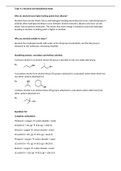
Topic 4.3 Alcohols and Haloalkanes Notes
Why do alcohols have higher boiling points than alkanes?
Alcohols have van der Waals’ forces and hydrogen bonding intermolecular forces. Hydroxyl groups in
alcohols allow hydrogen bonding to occur between alcohol molecules. Alkanes only have van der
Waals’ forces between molecules. This means that more energy is needed to overcome hydrogen
bonding in alcohols, so boiling point is higher in alcohols.
Why are alcohols soluble in water?
Alcohols form hydrogen bonds with water as the OH group is hydrophilic, and the OH group is
attracted to H2O molecules, enhancing solubility.
Classifying primary, secondary and tertiary alcohols
A primary alcohol is an alcohol whose OH group is attached to only one single alkyl group.
Eg.
A secondary alcohol is an alcohol whose OH group is attached to a saturated carbon atom which has
two other carbons attached to it.
Eg.
A tertiary alcohol is an alcohol whose OH group is attached to a saturated carbon which has three
other carbons attached to it.
Eg.
Equations for:
Complete combustion:
Methanol + oxygen carbon dioxide + water
2CH3OH (l) + 3O2 (g) 2CO2 (g) + 4H2O (l)
Ethanol + oxygen carbon dioxide + water
2C2H5OH (l) + 6O2 (g) 4CO2 (g) + 6H2O (l)
Propanol + oxygen carbon dioxide + water
2C3H7OH (l) + 9O2 (g) 6CO2 (g) + 8H2O (l)
Butanol + oxygen carbon dioxide + water
2C4H9OH (l) + 12O2 (g) 8CO2 (g) + 12H2O (l)
, Topic 4.3 Alcohols and Haloalkanes Notes
Incomplete combustion:
Methanol + oxygen carbon monoxide + water
CH3OH + O2 CO + 2H2O
Ethanol + oxygen carbon monoxide + water
C2H5OH + 2O2 2CO + 3H2O
Propanol + oxygen carbon monoxide + water
C3H7OH + 3O2 3CO + 4H2O
Butanol + oxygen carbon monoxide + water
C4H9OH + 4O2 4CO + 5H2O
Oxidation of alcohols:
Partial oxidation of primary alcohols:
Ethanol + oxygen ethanal
C2H5OH + [O] CH3CHO
Primary Aldehyde
alcohol
Complete oxidation of primary alcohols:
Ethanol + oxygen ethanoic acid
C2H5OH + [O] CH3COOH
Primary Carboxylic
alcohol acid
Partial oxidation of secondary alcohols:
Why do alcohols have higher boiling points than alkanes?
Alcohols have van der Waals’ forces and hydrogen bonding intermolecular forces. Hydroxyl groups in
alcohols allow hydrogen bonding to occur between alcohol molecules. Alkanes only have van der
Waals’ forces between molecules. This means that more energy is needed to overcome hydrogen
bonding in alcohols, so boiling point is higher in alcohols.
Why are alcohols soluble in water?
Alcohols form hydrogen bonds with water as the OH group is hydrophilic, and the OH group is
attracted to H2O molecules, enhancing solubility.
Classifying primary, secondary and tertiary alcohols
A primary alcohol is an alcohol whose OH group is attached to only one single alkyl group.
Eg.
A secondary alcohol is an alcohol whose OH group is attached to a saturated carbon atom which has
two other carbons attached to it.
Eg.
A tertiary alcohol is an alcohol whose OH group is attached to a saturated carbon which has three
other carbons attached to it.
Eg.
Equations for:
Complete combustion:
Methanol + oxygen carbon dioxide + water
2CH3OH (l) + 3O2 (g) 2CO2 (g) + 4H2O (l)
Ethanol + oxygen carbon dioxide + water
2C2H5OH (l) + 6O2 (g) 4CO2 (g) + 6H2O (l)
Propanol + oxygen carbon dioxide + water
2C3H7OH (l) + 9O2 (g) 6CO2 (g) + 8H2O (l)
Butanol + oxygen carbon dioxide + water
2C4H9OH (l) + 12O2 (g) 8CO2 (g) + 12H2O (l)
, Topic 4.3 Alcohols and Haloalkanes Notes
Incomplete combustion:
Methanol + oxygen carbon monoxide + water
CH3OH + O2 CO + 2H2O
Ethanol + oxygen carbon monoxide + water
C2H5OH + 2O2 2CO + 3H2O
Propanol + oxygen carbon monoxide + water
C3H7OH + 3O2 3CO + 4H2O
Butanol + oxygen carbon monoxide + water
C4H9OH + 4O2 4CO + 5H2O
Oxidation of alcohols:
Partial oxidation of primary alcohols:
Ethanol + oxygen ethanal
C2H5OH + [O] CH3CHO
Primary Aldehyde
alcohol
Complete oxidation of primary alcohols:
Ethanol + oxygen ethanoic acid
C2H5OH + [O] CH3COOH
Primary Carboxylic
alcohol acid
Partial oxidation of secondary alcohols: