Chapter 1 - PLANNING
I
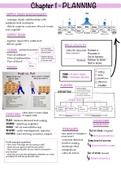
SUPPLY CHAIN MANAGEMENT
- manage (link) relationships with
suppliers and customers
- deliver superior customer value at lowest
cost supplied
SUPPLY CHAIN
System required to make and
deliver goods
What starts it?
- raw materials
FLOWS upstream/downstream - work in progress Natural resources Extract it
- finished good
Flow of material
(Raw material) Process it
Flow of information
- dispatch advice Go to factory
- order confirmation
- purchase order Product Deliver to store
Flow of fund
Sell in store
Money
FORCES
S upply
PUSH - Product supply C hain
PULL - Customer demand
O perations
R eference
PLAYERS Model
Extended Chain
Simple Chain
takes place in every stage
FUNCTIONS of supply chain
PLAN - balance demand and supply MANAGING
SOURCE - selecting suppliers INVENTORY
MAKE - set up manufacturing
DELIVER - order management, logistics DYNAMICS Out of stock (Higher)
RETURN - post delivery customer support How reacts to changes in
environment > Increase inventory
- customer demand Same level of service
PLAN example questions - product supply
- How many Tea bags are you going to sell?
:
- exchange rates Keep inventory same
- where are you gong to sell the and when?
- How much production do you need to schedule in - temperature
your factory?
- what are your raw and packaging materials you need
- natural events Our of stock (lower)
unordered to fulfil the production plan
Reduce inventory
, Chapter 3 - SOURCING
How much are we going to buy from suppliers to produce product/good?
Focus on:
- selecting/manage suppliers
- establishing policies
- assessing performence
DIRECT ITEMS INDIRECT ITEMS
Directly related to All other products and
products services that are needed
manufacturing to run company
'
process
1- V
RAW MATERIAL (Factory security, consultants,
(Glass, label, sugar, cleaning products, electricity,
closure(cap), flavouring, protective clothings,
Sourcing process carbon dioxide) stationary)
=
Pre-order Looking for suppliers Post-order
-
Waiting for order
Need: what customer needs Placing & handling orders
Specification: what quantity/quality Progressing & delivery
- split between 2 teams:
INBOUND LOGISTICS team: operational view
BUYING team: for service issues
Sourcing: exploring possible supplier
Tendering: select preferred supplier Payment & review:
- allows buyer to address issues
- gives supplier chance for feedback on feasibility
Negotiation: detail of agreement established
Performance indicators: ex service & quality
Selection: make preferred supplier selection measures
Contracts: prepared by buyers legal team
-
Tactical sourcing (Initiatives) Immediate benefits
-Marketing research
-Commodity analysis -Purchasing process of pre/post-order continue on
-Forecasting requirements operational level
- Supplier performance analysis - may be used in conjunction with pre/post-order steps or
outside
& bench marketing
- Price & Cost analysis
I
SUPPLY CHAIN MANAGEMENT
- manage (link) relationships with
suppliers and customers
- deliver superior customer value at lowest
cost supplied
SUPPLY CHAIN
System required to make and
deliver goods
What starts it?
- raw materials
FLOWS upstream/downstream - work in progress Natural resources Extract it
- finished good
Flow of material
(Raw material) Process it
Flow of information
- dispatch advice Go to factory
- order confirmation
- purchase order Product Deliver to store
Flow of fund
Sell in store
Money
FORCES
S upply
PUSH - Product supply C hain
PULL - Customer demand
O perations
R eference
PLAYERS Model
Extended Chain
Simple Chain
takes place in every stage
FUNCTIONS of supply chain
PLAN - balance demand and supply MANAGING
SOURCE - selecting suppliers INVENTORY
MAKE - set up manufacturing
DELIVER - order management, logistics DYNAMICS Out of stock (Higher)
RETURN - post delivery customer support How reacts to changes in
environment > Increase inventory
- customer demand Same level of service
PLAN example questions - product supply
- How many Tea bags are you going to sell?
:
- exchange rates Keep inventory same
- where are you gong to sell the and when?
- How much production do you need to schedule in - temperature
your factory?
- what are your raw and packaging materials you need
- natural events Our of stock (lower)
unordered to fulfil the production plan
Reduce inventory
, Chapter 3 - SOURCING
How much are we going to buy from suppliers to produce product/good?
Focus on:
- selecting/manage suppliers
- establishing policies
- assessing performence
DIRECT ITEMS INDIRECT ITEMS
Directly related to All other products and
products services that are needed
manufacturing to run company
'
process
1- V
RAW MATERIAL (Factory security, consultants,
(Glass, label, sugar, cleaning products, electricity,
closure(cap), flavouring, protective clothings,
Sourcing process carbon dioxide) stationary)
=
Pre-order Looking for suppliers Post-order
-
Waiting for order
Need: what customer needs Placing & handling orders
Specification: what quantity/quality Progressing & delivery
- split between 2 teams:
INBOUND LOGISTICS team: operational view
BUYING team: for service issues
Sourcing: exploring possible supplier
Tendering: select preferred supplier Payment & review:
- allows buyer to address issues
- gives supplier chance for feedback on feasibility
Negotiation: detail of agreement established
Performance indicators: ex service & quality
Selection: make preferred supplier selection measures
Contracts: prepared by buyers legal team
-
Tactical sourcing (Initiatives) Immediate benefits
-Marketing research
-Commodity analysis -Purchasing process of pre/post-order continue on
-Forecasting requirements operational level
- Supplier performance analysis - may be used in conjunction with pre/post-order steps or
outside
& bench marketing
- Price & Cost analysis