Summary Book Sustainable Business
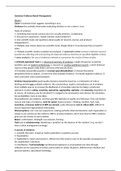
Chapter 1
Sustainability = the capacity to support, maintain or endure; it can indicate both a goal and a
process. Sustainability can be maintained at a certain rate or level, as in sustainable
economic growth. It can also be upheld or defended, as in sustainable definition of good
corporate practice.
• Social sustainability = conceived in terms of sustaining the well-being of people
• Environmental sustainability = refers to sustaining nature or natural resources
> are interlinked, due to the fact that human welfare depends on the sustainability of
the environment.
• In business they refer to CSR, 3BL et cetera
Club of Rome = report that demonstrated that an economy built on the continuous
expansion of material consumption is fundamentally not sustainable.
Unprecedented economic growth and technological progress were linked to severe
environmental consequences.
Being a sustainable business can be good public relations (PR) for business. As found,
customers also express the importance of a sustainable business.
Green-washing = term used to describe an individual or business promoting somethings as
green – either their business as a whole or an initiative, product or activity while actually
continuing to operate in socially and environmentally damaging ways.
UN Sustainable Development Solutions Network (SDSN) = explains that innovation,
management skills, and corporate financial resource will be a major provider of solutions to
most of the sustainability challenges that we face.
Some businesses choose to be sustainable in order to prevent government intervention or
policies that might restrict their operations. They use sustainability measures to forestall
legislation or to avoid persecution and litigation. (i.e., polluting industries or factories with
poor working conditions).
Sustainability can thus mean anything from businesses that are working to minimize or
eliminate negative environmental impacts thereby becoming environmentally positive as
opposed to a business that is merely able to sustain itself over time.
The Brundtland Report = refers to sustainable development as development that meets the
needs of the present without compromising the ability of future generations to meet their
own needs. Sustainable development is targeted at finding strategies to promote economic
and social development in ways that avoid environmental degradation, over-exploitation,
and pollution, often known in business as the Triple Bottom Line.
Living in poverty can restrict the options people have for resource management because
they have to use environmental assets unstainable due to short-term necessities Differences
, in income can be seen as an important factor in explaining ‘unsustainable development’, and
preventing what is often described as ecological modernization.
In ecological modernization theory = it is believed that enlightened self-interest, economy,
and ecology can be favorably combined, and productive use of natural resources can be a
source of future growth and development.
• Thus, poverty is seen as both a major cause and effect of global environmental
problems and addressing inequality is presented as a long-standing concern of
sustainable development.
Environmental Kuznets Curve (EKC) hypothesis = it is believed that during early
industrialization, economies use material resources more intensively until a threshold is
reached after which structural changes in the economy lead to a progressively less intensive
use of materials.
• It is believed that higher income levels and economic growth will lead to
environmental improvement or at least reduced environmental degradation.
European Environment Agency (EEA) define sustainability as a concept and strategy enabling
sufficient delinking of the “use of nature” from economic activity needed to meet human
needs to allow it to remain within carrying capacities; and to permit equitable access and
use of the environment by current and future generations.
Social Sustainability = refers to issues concerned with social equality, poverty, and problems
associated with justice. Equity considerations are primary in order to have the resources to
reduce poverty and increase well-being in developing countries.
Economic Sustainability = is linked to well-being in relation to financial indicators such as
GDP and is characterized by underlying economic approaches to the range of social issues
attempting to capture the values embedded in human and natural capital.
• combination of 5 different capitals
o natural, social, human, financial, and manufactured.
Eco-efficiency = refers to the idea of doing more with less. Compared to early industrial
products, modern alternatives are able to generate more value by being produced on a
much larger scale with less impact and using less material.
• The OECD definition of sustainability in relation to eco-efficiency is
o ‘the efficiency with which ecological resources are used to meet human
needs’ and represents it as a ratio of output divided by the input.
§ the output includes the value of products and services produced by a
firm, sector, or economy as a whole.
§ the input typically refers to the sum of environmental pressures
generated by the firm, the sector, or the economy.
• WBCSD defines eco-efficiency as being the delivery of competitively-priced goods
and services that satisfy human needs and bring quality of life, while progressively
reducing ecological impacts and resource intensity throughout the life-cycle to a level
at least in line with the Earth’s estimated carrying capacity.
Chapter 1
Sustainability = the capacity to support, maintain or endure; it can indicate both a goal and a
process. Sustainability can be maintained at a certain rate or level, as in sustainable
economic growth. It can also be upheld or defended, as in sustainable definition of good
corporate practice.
• Social sustainability = conceived in terms of sustaining the well-being of people
• Environmental sustainability = refers to sustaining nature or natural resources
> are interlinked, due to the fact that human welfare depends on the sustainability of
the environment.
• In business they refer to CSR, 3BL et cetera
Club of Rome = report that demonstrated that an economy built on the continuous
expansion of material consumption is fundamentally not sustainable.
Unprecedented economic growth and technological progress were linked to severe
environmental consequences.
Being a sustainable business can be good public relations (PR) for business. As found,
customers also express the importance of a sustainable business.
Green-washing = term used to describe an individual or business promoting somethings as
green – either their business as a whole or an initiative, product or activity while actually
continuing to operate in socially and environmentally damaging ways.
UN Sustainable Development Solutions Network (SDSN) = explains that innovation,
management skills, and corporate financial resource will be a major provider of solutions to
most of the sustainability challenges that we face.
Some businesses choose to be sustainable in order to prevent government intervention or
policies that might restrict their operations. They use sustainability measures to forestall
legislation or to avoid persecution and litigation. (i.e., polluting industries or factories with
poor working conditions).
Sustainability can thus mean anything from businesses that are working to minimize or
eliminate negative environmental impacts thereby becoming environmentally positive as
opposed to a business that is merely able to sustain itself over time.
The Brundtland Report = refers to sustainable development as development that meets the
needs of the present without compromising the ability of future generations to meet their
own needs. Sustainable development is targeted at finding strategies to promote economic
and social development in ways that avoid environmental degradation, over-exploitation,
and pollution, often known in business as the Triple Bottom Line.
Living in poverty can restrict the options people have for resource management because
they have to use environmental assets unstainable due to short-term necessities Differences
, in income can be seen as an important factor in explaining ‘unsustainable development’, and
preventing what is often described as ecological modernization.
In ecological modernization theory = it is believed that enlightened self-interest, economy,
and ecology can be favorably combined, and productive use of natural resources can be a
source of future growth and development.
• Thus, poverty is seen as both a major cause and effect of global environmental
problems and addressing inequality is presented as a long-standing concern of
sustainable development.
Environmental Kuznets Curve (EKC) hypothesis = it is believed that during early
industrialization, economies use material resources more intensively until a threshold is
reached after which structural changes in the economy lead to a progressively less intensive
use of materials.
• It is believed that higher income levels and economic growth will lead to
environmental improvement or at least reduced environmental degradation.
European Environment Agency (EEA) define sustainability as a concept and strategy enabling
sufficient delinking of the “use of nature” from economic activity needed to meet human
needs to allow it to remain within carrying capacities; and to permit equitable access and
use of the environment by current and future generations.
Social Sustainability = refers to issues concerned with social equality, poverty, and problems
associated with justice. Equity considerations are primary in order to have the resources to
reduce poverty and increase well-being in developing countries.
Economic Sustainability = is linked to well-being in relation to financial indicators such as
GDP and is characterized by underlying economic approaches to the range of social issues
attempting to capture the values embedded in human and natural capital.
• combination of 5 different capitals
o natural, social, human, financial, and manufactured.
Eco-efficiency = refers to the idea of doing more with less. Compared to early industrial
products, modern alternatives are able to generate more value by being produced on a
much larger scale with less impact and using less material.
• The OECD definition of sustainability in relation to eco-efficiency is
o ‘the efficiency with which ecological resources are used to meet human
needs’ and represents it as a ratio of output divided by the input.
§ the output includes the value of products and services produced by a
firm, sector, or economy as a whole.
§ the input typically refers to the sum of environmental pressures
generated by the firm, the sector, or the economy.
• WBCSD defines eco-efficiency as being the delivery of competitively-priced goods
and services that satisfy human needs and bring quality of life, while progressively
reducing ecological impacts and resource intensity throughout the life-cycle to a level
at least in line with the Earth’s estimated carrying capacity.