Language Management in International Organizations
Chapter 1: Language and global business expansion - Piekkari et al. (2014)
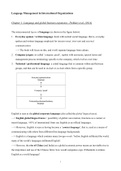
The interconnected layers of language (as shown in the figure below):
1. Everyday spoken / written language: deals with normal social language, that is, everyday
spoken and written language employed for interpersonal, inter-unit and external
communication.
—> The book will focus on this, and it will separate language from culture.
2. Company jargon: so-called ‘company speak’, replete with acronyms, special terms and
management process terminology specific to the company, which evolves over time.
3. Technical / professional language: a coded language that is common within and between
groups, and that can be used to include or exclude others from a specific group.
English is seen as the global corporate language (also called the global lingua franca).
—> English global lingua franca = possibility of global conversation, functions as a contact or
transit language; >85% of international firms use English as an official languages.
—> Moreover, English is seen as having become a ‘contact language’; that is, used as a means of
communicating with others from different first-language backgrounds.
—> English is a language which contains many foreign words: ‘before English infiltrated the world,
many of the world’s languages infiltrated English’.
—> However, the rise of China (and India) as a global economic power means an inevitable rise in
the importance and use of the Chinese firms: how would companies cope if Mandarin overtakes
English as a world language?
1
,How companies handle language boundaries is seen as being an important part of the ability to
operate as a global entity.
—> According to the basic communication model, the effectiveness of the communication depends
on the ability of the sender to accurately encode a meaningful, complete message; the selection of
the correct medium or channel of transfer; and the ability of the receiver to decode and understand
the message as it was intended. Noise can interfere this process.
—> Foreign languages add more noise, potentially.
—> A seemingly simple solution to the problems of operating in multiple language environments
has been to impose a common corporate language (called the CCL) on the firm’s internal
interactions (i.e. the business lingua franca). Here, English is often the first choice.
—> Studies and business in general seem to ignore language as an important factor of a company,
or it has been accommodated by including culture, while culture and language are two different
concepts. Therefore, the book demonstrates evidence for the role of language in organizations.
A common corporate language (CCL) requires:
• Fluency: individuals can create social networks, internally and externally, to grow, maintain a
business.
• Understanding of subconscious influence of language (/culture) on business decisions; e.g.
psychic distance.
Language impacts the communication processes, knowledge transfer, and internal (re)structuring
mechanism.
2
,Language aspects are often viewed by management as a mechanical
translation problem, often solved by using automatic translation
software or viewing it as a selection issue (= hiring employees with the
requisite of foreign language skills).
—> Problems with automatic translation software: translation is not the
same as social communication and doesn’t ensure the creation of social
capital or networks; it might be inaccurately translated; commercial-in-
confidence material might not be well enough secured.
Individual and organizational interest may unite, but this is not always the case, for example
because of knowledge-sharing hostility, the exercise of power, lack of time, or because the language
task is outside and in addition to an individual’s assigned job tasks.
—> Thus, the reality for internationalizing firms is that foreign language use in and for a company
is mediated or influenced by the individual, as the figure shows.
International marketers feel more at home in foreign markets that have a common language; also
called the language comfort zone of a company.
—> Staying within one’s language comfort zone not only helps reduce physic distance, but also has
business advantages such as no translation costs, easiness in building contacts and negotiating, and
cheaper promotional activities (such as advertising; less changes need to be done to an ad).
—> Expansion strategies: taking the Empire Language Path, which is about logical decisions for
firms where to expand next. The figures show two hypothetical language paths, which shows the
choice depends on language abilities first and on physic distance as well.
3
, For the Chinese Diaspora (e.g. the ‘bamboo network’ of Chinese immigrants) understanding the
importance of dialects and their distribution across East Asia is central to an understanding of how
ethnic Chinese business networks operated in the past, and operate in the present.
—> A study showed that Chinese persons with each a different accent even chose to speak English
instead of Mandarin, because of their different accents.
Theoretically, language and foreign expansion patterns are divided into these Empire Language path
and the Diaspora Language Path. However, there exist alternatives as well.
The difference between a Diaspora and an Empire:
—> Both are about the choice of a company to expand to a market on for instance a shared
language.
—> This can be done either through a Diaspora (rising superpower such as China or India, which
can make use of the Diaspora, the people who have migrated to other locations) or an Empire (e.g.
former colonies) or via another way.
The ‘paradox of language distance’ is the phenomenon of familiarity that can breed false
confidence and carelessness, when following along an Empire path with for example only
English-speaking countries.
Firms from countries such as Japan and Finland have to cope with foreign language demands from
the earliest stages of international expansion, since in no other country their language is spoken.
—> This means they have to develop mechanisms, competence and procedures that assist in
overcoming, or at least managing, language matters.
—> Nevertheless, all hypothetical firms depicted here will have to cross the language barrier.
4
Chapter 1: Language and global business expansion - Piekkari et al. (2014)
The interconnected layers of language (as shown in the figure below):
1. Everyday spoken / written language: deals with normal social language, that is, everyday
spoken and written language employed for interpersonal, inter-unit and external
communication.
—> The book will focus on this, and it will separate language from culture.
2. Company jargon: so-called ‘company speak’, replete with acronyms, special terms and
management process terminology specific to the company, which evolves over time.
3. Technical / professional language: a coded language that is common within and between
groups, and that can be used to include or exclude others from a specific group.
English is seen as the global corporate language (also called the global lingua franca).
—> English global lingua franca = possibility of global conversation, functions as a contact or
transit language; >85% of international firms use English as an official languages.
—> Moreover, English is seen as having become a ‘contact language’; that is, used as a means of
communicating with others from different first-language backgrounds.
—> English is a language which contains many foreign words: ‘before English infiltrated the world,
many of the world’s languages infiltrated English’.
—> However, the rise of China (and India) as a global economic power means an inevitable rise in
the importance and use of the Chinese firms: how would companies cope if Mandarin overtakes
English as a world language?
1
,How companies handle language boundaries is seen as being an important part of the ability to
operate as a global entity.
—> According to the basic communication model, the effectiveness of the communication depends
on the ability of the sender to accurately encode a meaningful, complete message; the selection of
the correct medium or channel of transfer; and the ability of the receiver to decode and understand
the message as it was intended. Noise can interfere this process.
—> Foreign languages add more noise, potentially.
—> A seemingly simple solution to the problems of operating in multiple language environments
has been to impose a common corporate language (called the CCL) on the firm’s internal
interactions (i.e. the business lingua franca). Here, English is often the first choice.
—> Studies and business in general seem to ignore language as an important factor of a company,
or it has been accommodated by including culture, while culture and language are two different
concepts. Therefore, the book demonstrates evidence for the role of language in organizations.
A common corporate language (CCL) requires:
• Fluency: individuals can create social networks, internally and externally, to grow, maintain a
business.
• Understanding of subconscious influence of language (/culture) on business decisions; e.g.
psychic distance.
Language impacts the communication processes, knowledge transfer, and internal (re)structuring
mechanism.
2
,Language aspects are often viewed by management as a mechanical
translation problem, often solved by using automatic translation
software or viewing it as a selection issue (= hiring employees with the
requisite of foreign language skills).
—> Problems with automatic translation software: translation is not the
same as social communication and doesn’t ensure the creation of social
capital or networks; it might be inaccurately translated; commercial-in-
confidence material might not be well enough secured.
Individual and organizational interest may unite, but this is not always the case, for example
because of knowledge-sharing hostility, the exercise of power, lack of time, or because the language
task is outside and in addition to an individual’s assigned job tasks.
—> Thus, the reality for internationalizing firms is that foreign language use in and for a company
is mediated or influenced by the individual, as the figure shows.
International marketers feel more at home in foreign markets that have a common language; also
called the language comfort zone of a company.
—> Staying within one’s language comfort zone not only helps reduce physic distance, but also has
business advantages such as no translation costs, easiness in building contacts and negotiating, and
cheaper promotional activities (such as advertising; less changes need to be done to an ad).
—> Expansion strategies: taking the Empire Language Path, which is about logical decisions for
firms where to expand next. The figures show two hypothetical language paths, which shows the
choice depends on language abilities first and on physic distance as well.
3
, For the Chinese Diaspora (e.g. the ‘bamboo network’ of Chinese immigrants) understanding the
importance of dialects and their distribution across East Asia is central to an understanding of how
ethnic Chinese business networks operated in the past, and operate in the present.
—> A study showed that Chinese persons with each a different accent even chose to speak English
instead of Mandarin, because of their different accents.
Theoretically, language and foreign expansion patterns are divided into these Empire Language path
and the Diaspora Language Path. However, there exist alternatives as well.
The difference between a Diaspora and an Empire:
—> Both are about the choice of a company to expand to a market on for instance a shared
language.
—> This can be done either through a Diaspora (rising superpower such as China or India, which
can make use of the Diaspora, the people who have migrated to other locations) or an Empire (e.g.
former colonies) or via another way.
The ‘paradox of language distance’ is the phenomenon of familiarity that can breed false
confidence and carelessness, when following along an Empire path with for example only
English-speaking countries.
Firms from countries such as Japan and Finland have to cope with foreign language demands from
the earliest stages of international expansion, since in no other country their language is spoken.
—> This means they have to develop mechanisms, competence and procedures that assist in
overcoming, or at least managing, language matters.
—> Nevertheless, all hypothetical firms depicted here will have to cross the language barrier.
4