PYC3703 – COGNITIVE PSYCHOLOGY
CHAPTER 10: VISUAL IMAGERY
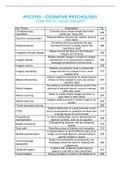
Key Terms Explanation Pg.
Conceptual peg Concrete nouns create images that other
296
hypothesis words can “hang onto”
Representations that are like realistic pictures
Depictive representation 299
of an object
Something that accompanies the real
Epiphenomenon mechanism but isn’t actually part of the 299
mechanism itself
Based around the idea of a link between
Imageless thought debate 296
imagery and thinking
Debate whether imagery is based on spatial
Imagery debate mechanisms or on mechanisms related to 299
language (propositional mechanisms)
Imagery neuron 306
Patients are asked to recall a problematic
Imagery rescripting image and then to change it into a more 319
positive form
Inferred cognitive processes by measuring the
Mental chronometry amount of time needed to carry out various 297
cognitive tasks
The ability to recreate the sensory world in the
Mental imagery absence of physical stimuli, occurs in senses 295
other than vision
Asked to create mental images and then to
Mental scanning 297
scan them in their minds
Imagine walking toward a mental image of an
Mental walk task 302
animal
Paired-associate learning 296
Graphic flashbacks to a past traumatic event
PTSD and is accompanied by powerful emotions and 318
a strong sense of current threat
Propositional In which relationships can be represented by
299
representation abstract symbols, such as an equation
Distinguishing between real and imagined
Reality monitoring 319
events
Scan path Resulting series of fixations and saccades 315
A representation in which different parts of an
Spatial representation image can be described as corresponding to 299
specific location in space
States that participants unconsciously use
Tacit knowledge
knowledge about the world in making their 300
explanation
judgements
A patient with unilateral neglect ignores
Unilateral neglect 310
objects in one half of their visual field
Visual imagery Seeing an object or scene in the absence of 294
, visual stimulus
Imagery in the history of psychology
Early ideas about imagery:
Wilhelm Wundt – first lab of psychology
Imageless thought debate
Behaviourism – the study of imagery was pushed out the door
Come back with the study of cognition
Imagery and the cognitive revolution:
Paivio – conceptual peg hypothesis
o Concrete nouns create images
o Inferred cognitive processes by measuring memory
Shepard and Metzler
o Inferred cognitive processes by measuring the amount of time needed
to carry out various tasks
o Mental chronometry
Imagery and perception: Do they share the same mechanisms?
The idea that there is a spatial correspondence between imagery and
perception is supported by a number of experiments by Kosslyn involving a
task called mental scanning
o In which participants are asked to create mental images and then to
scan them in their minds
Kosslyn’s early mental scanning experiments:
Memorise a picture of an object and then to create an image of that object in
their mind and to focus on one part of it
o If imagery is spatial then it should take participants longer to find parts
that are located farther from the initial point of focus because they
would have to scan across the whole image of the object
2 fictive places on a map
o Results supports the idea that visual imagery is spatial in nature
Pylyshyn proposed another explanation – starting the imagery debate
The imagery debate: is imagery spatial or propositional?
Pylyshyn proposed that the mechanism underlying imagery is not spatial but
propositional
Representations that are like realistic pictures of an object are called depictive
representations
Pylyshyn believed that participants simulated the results in Kosslyn’s
experiment
o This is called tacit knowledge explanation because it states that
participants unconsciously use knowledge about the world in making
their judgments
Behavioural experiments: Comparing imagery and perception
CHAPTER 10: VISUAL IMAGERY
Key Terms Explanation Pg.
Conceptual peg Concrete nouns create images that other
296
hypothesis words can “hang onto”
Representations that are like realistic pictures
Depictive representation 299
of an object
Something that accompanies the real
Epiphenomenon mechanism but isn’t actually part of the 299
mechanism itself
Based around the idea of a link between
Imageless thought debate 296
imagery and thinking
Debate whether imagery is based on spatial
Imagery debate mechanisms or on mechanisms related to 299
language (propositional mechanisms)
Imagery neuron 306
Patients are asked to recall a problematic
Imagery rescripting image and then to change it into a more 319
positive form
Inferred cognitive processes by measuring the
Mental chronometry amount of time needed to carry out various 297
cognitive tasks
The ability to recreate the sensory world in the
Mental imagery absence of physical stimuli, occurs in senses 295
other than vision
Asked to create mental images and then to
Mental scanning 297
scan them in their minds
Imagine walking toward a mental image of an
Mental walk task 302
animal
Paired-associate learning 296
Graphic flashbacks to a past traumatic event
PTSD and is accompanied by powerful emotions and 318
a strong sense of current threat
Propositional In which relationships can be represented by
299
representation abstract symbols, such as an equation
Distinguishing between real and imagined
Reality monitoring 319
events
Scan path Resulting series of fixations and saccades 315
A representation in which different parts of an
Spatial representation image can be described as corresponding to 299
specific location in space
States that participants unconsciously use
Tacit knowledge
knowledge about the world in making their 300
explanation
judgements
A patient with unilateral neglect ignores
Unilateral neglect 310
objects in one half of their visual field
Visual imagery Seeing an object or scene in the absence of 294
, visual stimulus
Imagery in the history of psychology
Early ideas about imagery:
Wilhelm Wundt – first lab of psychology
Imageless thought debate
Behaviourism – the study of imagery was pushed out the door
Come back with the study of cognition
Imagery and the cognitive revolution:
Paivio – conceptual peg hypothesis
o Concrete nouns create images
o Inferred cognitive processes by measuring memory
Shepard and Metzler
o Inferred cognitive processes by measuring the amount of time needed
to carry out various tasks
o Mental chronometry
Imagery and perception: Do they share the same mechanisms?
The idea that there is a spatial correspondence between imagery and
perception is supported by a number of experiments by Kosslyn involving a
task called mental scanning
o In which participants are asked to create mental images and then to
scan them in their minds
Kosslyn’s early mental scanning experiments:
Memorise a picture of an object and then to create an image of that object in
their mind and to focus on one part of it
o If imagery is spatial then it should take participants longer to find parts
that are located farther from the initial point of focus because they
would have to scan across the whole image of the object
2 fictive places on a map
o Results supports the idea that visual imagery is spatial in nature
Pylyshyn proposed another explanation – starting the imagery debate
The imagery debate: is imagery spatial or propositional?
Pylyshyn proposed that the mechanism underlying imagery is not spatial but
propositional
Representations that are like realistic pictures of an object are called depictive
representations
Pylyshyn believed that participants simulated the results in Kosslyn’s
experiment
o This is called tacit knowledge explanation because it states that
participants unconsciously use knowledge about the world in making
their judgments
Behavioural experiments: Comparing imagery and perception