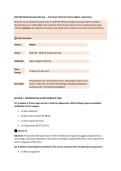
NUR 265 Medical-Surgical Nursing — Final Exam Ultimate Practice QBank ( Questions)
Welcome to the ultimate practice exam for NUR 265 Medical-Surgical Nursing at Galen College of
Nursing. Based on verified 2026 exam materials from Docsity and Stuvia, this comprehensive guide
contains questions with detailed rationales covering all major content areas tested on the Final Exam .
Exam Overview
Feature Details
Course NUR 265 – Medical-Surgical Nursing
Institution Galen College of Nursing
Exam
50 questions per exam
Format
Perioperative Care, Shock/Sepsis, Burns, Neurological, Spinal Cord
Key Topics Injuries, Endocrine, GI, Renal, Hematology, Oncology, Respiratory,
Cardiovascular, Prioritization/Delegation
SECTION 1: PERIOPERATIVE & POSTOPERATIVE CARE
Q1. A patient is 4 hours post-op from a total hip replacement. Which finding requires immediate
notification of the surgeon?
• A) Pain rated 6/10
• B) Heart rate 110 bpm, BP 88/50
• C) Urine output 35 mL/hr
• D) Temperature 99.6°F (37.6°C)
✅ Answer: B
Rationale: Tachycardia with hypotension in the immediate post-op period suggests hypovolemia or
hemorrhage until proven otherwise. This requires immediate surgical notification. Urine output of 35
mL/hr is adequate (>30 mL/hr) .
Q2. A patient received general anesthesia. The nurse's priority in the immediate post-op period is:
• A) Pain management
, • B) Airway patency
• C) Wound assessment
• D) Fluid replacement
✅ Answer: B
Rationale: Airway is always the first priority in the immediate post-operative period, as anesthesia can
cause airway obstruction and respiratory depression .
Q3. Which assessment finding indicates malignant hyperthermia?
• A) Hypothermia and bradycardia
• B) Muscle rigidity and hyperthermia
• C) Hypotension and polyuria
• D) Respiratory depression and miosis
✅ Answer: B
Rationale: Malignant hyperthermia is a life-threatening reaction to volatile anesthetics or
succinylcholine, characterized by muscle rigidity, hyperthermia, tachycardia, and tachypnea. Dantrolene
is the specific antidote .
Q4. A patient post-op has a Jackson-Pratt drain with 150 mL of bright red blood in 1 hour. What
should the nurse do first?
• A) Document as normal
• B) Empty the drain
• C) Notify the provider
• D) Increase IV fluids
✅ Answer: C
Rationale: Output greater than 100 mL/hr of bright red blood from a surgical drain indicates active
hemorrhage. The provider must be notified immediately .
Q5. A patient post-op from a thyroidectomy reports tingling around the mouth and muscle twitching.
The nurse should prepare to administer:
• A) Calcium gluconate
• B) Levothyroxine
• C) Potassium chloride
• D) Magnesium sulfate
✅ Answer: A
, Rationale: Tingling around the mouth and muscle twitching indicate hypocalcemia, a complication of
accidental parathyroid removal during thyroidectomy. Calcium gluconate is the treatment .
Q6. A patient is 6 hours post-op and has not voided. Bladder scan shows 800 mL. What action should
the nurse take?
• A) Encourage oral fluids
• B) Perform a straight catheterization
• C) Apply a warm compress to the perineum
• D) Document as normal for 6 hours post-op
✅ Answer: B
Rationale: Bladder distention with inability to void 6 hours post-op indicates urinary retention. Straight
catheterization provides immediate relief and prevents bladder injury .
Q7. A patient post-op develops a temperature of 103°F with muscle rigidity. The nurse suspects
malignant hyperthermia. What is the priority intervention?
• A) Apply cooling blankets
• B) Administer dantrolene
• C) Increase IV fluids
• D) Notify the family
✅ Answer: B
Rationale: Dantrolene is the specific antidote for malignant hyperthermia and should be administered
emergently. It works by inhibiting calcium release from the sarcoplasmic reticulum .
Q8. A patient is 8 hours post-op and received morphine via PCA. The patient's respiratory rate is 8
breaths/min and they are difficult to arouse. Which medication should the nurse prepare to
administer?
• A) Naloxone
• B) Flumazenil
• C) Neostigmine
• D) Protamine sulfate
✅ Answer: A
Rationale: This presentation indicates opioid-induced respiratory depression. Naloxone (Narcan) is the
reversal agent for opioids .
Q9. Which nutritional factor promotes wound healing?
Welcome to the ultimate practice exam for NUR 265 Medical-Surgical Nursing at Galen College of
Nursing. Based on verified 2026 exam materials from Docsity and Stuvia, this comprehensive guide
contains questions with detailed rationales covering all major content areas tested on the Final Exam .
Exam Overview
Feature Details
Course NUR 265 – Medical-Surgical Nursing
Institution Galen College of Nursing
Exam
50 questions per exam
Format
Perioperative Care, Shock/Sepsis, Burns, Neurological, Spinal Cord
Key Topics Injuries, Endocrine, GI, Renal, Hematology, Oncology, Respiratory,
Cardiovascular, Prioritization/Delegation
SECTION 1: PERIOPERATIVE & POSTOPERATIVE CARE
Q1. A patient is 4 hours post-op from a total hip replacement. Which finding requires immediate
notification of the surgeon?
• A) Pain rated 6/10
• B) Heart rate 110 bpm, BP 88/50
• C) Urine output 35 mL/hr
• D) Temperature 99.6°F (37.6°C)
✅ Answer: B
Rationale: Tachycardia with hypotension in the immediate post-op period suggests hypovolemia or
hemorrhage until proven otherwise. This requires immediate surgical notification. Urine output of 35
mL/hr is adequate (>30 mL/hr) .
Q2. A patient received general anesthesia. The nurse's priority in the immediate post-op period is:
• A) Pain management
, • B) Airway patency
• C) Wound assessment
• D) Fluid replacement
✅ Answer: B
Rationale: Airway is always the first priority in the immediate post-operative period, as anesthesia can
cause airway obstruction and respiratory depression .
Q3. Which assessment finding indicates malignant hyperthermia?
• A) Hypothermia and bradycardia
• B) Muscle rigidity and hyperthermia
• C) Hypotension and polyuria
• D) Respiratory depression and miosis
✅ Answer: B
Rationale: Malignant hyperthermia is a life-threatening reaction to volatile anesthetics or
succinylcholine, characterized by muscle rigidity, hyperthermia, tachycardia, and tachypnea. Dantrolene
is the specific antidote .
Q4. A patient post-op has a Jackson-Pratt drain with 150 mL of bright red blood in 1 hour. What
should the nurse do first?
• A) Document as normal
• B) Empty the drain
• C) Notify the provider
• D) Increase IV fluids
✅ Answer: C
Rationale: Output greater than 100 mL/hr of bright red blood from a surgical drain indicates active
hemorrhage. The provider must be notified immediately .
Q5. A patient post-op from a thyroidectomy reports tingling around the mouth and muscle twitching.
The nurse should prepare to administer:
• A) Calcium gluconate
• B) Levothyroxine
• C) Potassium chloride
• D) Magnesium sulfate
✅ Answer: A
, Rationale: Tingling around the mouth and muscle twitching indicate hypocalcemia, a complication of
accidental parathyroid removal during thyroidectomy. Calcium gluconate is the treatment .
Q6. A patient is 6 hours post-op and has not voided. Bladder scan shows 800 mL. What action should
the nurse take?
• A) Encourage oral fluids
• B) Perform a straight catheterization
• C) Apply a warm compress to the perineum
• D) Document as normal for 6 hours post-op
✅ Answer: B
Rationale: Bladder distention with inability to void 6 hours post-op indicates urinary retention. Straight
catheterization provides immediate relief and prevents bladder injury .
Q7. A patient post-op develops a temperature of 103°F with muscle rigidity. The nurse suspects
malignant hyperthermia. What is the priority intervention?
• A) Apply cooling blankets
• B) Administer dantrolene
• C) Increase IV fluids
• D) Notify the family
✅ Answer: B
Rationale: Dantrolene is the specific antidote for malignant hyperthermia and should be administered
emergently. It works by inhibiting calcium release from the sarcoplasmic reticulum .
Q8. A patient is 8 hours post-op and received morphine via PCA. The patient's respiratory rate is 8
breaths/min and they are difficult to arouse. Which medication should the nurse prepare to
administer?
• A) Naloxone
• B) Flumazenil
• C) Neostigmine
• D) Protamine sulfate
✅ Answer: A
Rationale: This presentation indicates opioid-induced respiratory depression. Naloxone (Narcan) is the
reversal agent for opioids .
Q9. Which nutritional factor promotes wound healing?