

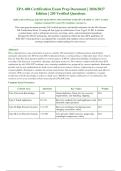
EPA 608 Certification Exam Prep Document | 2026/2027
Edition | 250 Verified Questions
SkillCat EPA 608 Exam 2026-2027 QUESTIONS AND ANSWERS ALREADY GRADED A+. 100% Verified
Solutions | Updated Per Latest EPA Guidelines | Graded A+
This exam prep document provides 250 verified questions and detailed rationales for the EPA Section
608 Certification Exam. Covering all four types of certifications (Core, Type I, II, III), it includes
essential topics such as refrigerant recovery, recycling, safety, and environmental regulations.
Designed for HVAC technicians, the material is updated to reflect the latest EPA guidelines for
2026-2027. Each question is accompanied by a rationale that explains correct and incorrect answers,
ensuring comprehensive understanding for exam success.
Abstract:
This comprehensive exam preparation resource contains 250 meticulously verified questions and detailed
rationales tailored for the EPA Section 608 Certification Exam, covering all four certification types (Core, Type I,
Type II, Type III). Each question addresses critical aspects of HVAC refrigerant handling, including recovery,
recycling, leak detection, evacuation, charging, and safety protocols. The content is aligned with the latest EPA
regulations for the 2026-2027 academic year, ensuring candidates are prepared for current standards. Rationales
provide step-by-step explanations for both correct and incorrect answer choices, reinforcing key concepts and
common pitfalls. Designed to simulate the actual exam format, this document enables targeted study and effective
retention. With coverage of ozone depletion, global warming potential, and regulatory compliance, it equips
technicians with the knowledge to achieve a high score. Whether for initial certification or recertification, this
resource serves as an essential tool for mastering the EPA 608 exam.
Content Area Overview:
Content Area Questions Key Topics Weight
Core (Universal Knowledge) 1-60 Ozone depletion, Clean Air Act, recovery 24%
requirements, safe handling, shipping
Type I: Small Appliances 61-110 Recovery methods for small appliances, leak 20%
detection, repair practices
Type II: High-Pressure Systems 111-170 Recovery techniques for high-pressure, 24%
charging, evacuation, safety
Type III: Low-Pressure Systems 171-250 Low-pressure chiller recovery, purge units, 32%
centrifugal compressors, safety
Page 1
,Q1. A refrigeration system contains 150 lb of R-22. Over a 30-day period, 4.5 lb of refrigerant is
lost. The system is subject to the Clean Air Act repair requirement. What action must be taken?
A. Immediately repair the leak and verify it is fixed within 30 days
B. No repair required because the leak rate is below 15% per year
C. Repair must be completed within 30 days, if the leak rate exceeds 35% per year
D. Must retrofit or retire the system within 120 days
Correct Answer: C. Repair must be completed within 30 days, if the leak rate exceeds 35% per year
Rationale: For commercial and industrial process refrigeration (Type II), if the annual leak rate exceeds
35%, repair must be initiated within 30 days. Annual leak rate = (4.5 lb lost / 150 lb charge) * (365 days /
30 days) = 36.5%, exceeding 35%.
Why Wrong:
A - Immediate repair is not required; there is a 30-day window to start repairs.
B - Leak rate exceeds 15% but the threshold for mandatory repair is 35% for this system type.
D - Retrofit or retire requirement only applies after multiple failed repair attempts or at 35% leak rate
for systems over 50 lb? Actually, that's for appliances with charge >50 lb but the first step is repair.
Reference: EPA Section 608, Repair Requirements for Commercial Refrigeration (Type II)
Q2. During recovery from a low-pressure centrifugal chiller (Type III), the purge unit must be
operated:
A. Only after the system pressure has been reduced to 0 psig
B. Continuously during the entire recovery process
C. Intermittently as needed to remove non-condensables
D. Prior to connecting recovery equipment to remove air
Correct Answer: B. Continuously during the entire recovery process
Rationale: For Type III (low-pressure) equipment, the purge unit must be operated continuously during
recovery to remove non-condensables and maintain efficiency. This prevents air from entering and
ensures proper evacuation.
Why Wrong:
A - The purge unit should be operated before pressure reaches 0 psig, not after.
C - Intermittent operation is not sufficient; continuous operation is required.
D - The purge unit is used during recovery, not just prior to connecting equipment.
Reference: EPA Section 608, Recovery Requirements for Low-Pressure Appliances (Type III)
Page 2
,Q3. A new refrigerant blend has an ozone depletion potential (ODP) of 0.02 and a global warming
potential (GWP) of 1500. According to current regulations, which statement is correct?
A. It is banned for use in new equipment because ODP > 0
B. It can be used but must be recovered and recycled due to ODP > 0
C. It is subject to venting prohibition and recordkeeping requirements
D. It is acceptable as a substitute for R-22 in existing systems
Correct Answer: C. It is subject to venting prohibition and recordkeeping requirements
Rationale: Refrigerants with ODP > 0 (CFCs, HCFCs) are prohibited from venting. Even with low ODP,
venting is illegal. Recordkeeping is required for all refrigerants. The blend likely contains an HCFC, so it
is still regulated.
Why Wrong:
A - New equipment using HCFCs was banned after 2010, but the question doesn't specify the exact
components; some HCFCs may still be used as of 2025 for servicing.
B - Recovery and recycling are required for all refrigerants, not just those with ODP > 0.
D - Substitution acceptability is determined by EPA SNAP, not solely by ODP and GWP.
Reference: Clean Air Act, Section 608; EPA SNAP Program
Q4. An HVAC contractor disposes of an appliance containing 10 lb of R-22. Which of the following
records must be kept?
A. Date of disposal, type of refrigerant recovered, quantity recovered, and destination of refrigerant
B. Name of technician, date, and system pressure before recovery
C. Only a log of the type and quantity of refrigerant purchased
D. No records are required because the appliance contains less than 15 lb of refrigerant
Correct Answer: A. Date of disposal, type of refrigerant recovered, quantity recovered, and
destination of refrigerant
Rationale: According to EPA Section 608, when disposing of appliances with a charge >5 lb, the
technician must keep records including the date, refrigerant type, quantity recovered, and where the
refrigerant was sent. This applies even for small charges.
Why Wrong:
B - System pressure before recovery is not a required record.
C - Purchase records are separate; disposal requires recovery records.
D - Records are required for appliances with charge >5 lb; 10 lb exceeds that threshold.
Reference: EPA Section 608, Recordkeeping Requirements for Disposal
Page 3
, Q5. When recovering R-290 (propane) from a small appliance, which safety measure is most
critical?
A. Using a recovery machine certified for flammable refrigerants
B. Ensuring the appliance is at atmospheric pressure before opening
C. Recovering the refrigerant into a steel cylinder painted yellow
D. Evacuating the system to 0 psig using a standard recovery unit
Correct Answer: A. Using a recovery machine certified for flammable refrigerants
Rationale: R-290 is flammable. Recovery equipment must be specifically certified for flammable
refrigerants to prevent ignition. Standard units may not have explosion-proof components.
Why Wrong:
B - R-290 is a refrigerant; it should not be opened to atmosphere regardless of pressure.
C - Yellow cylinders are for R-134a? Actually, color codes: white for R-22, yellow for R-134a, green
for R-404A? Flammable cylinders often have a red band or specific labeling; but most importantly,
the cylinder must be approved for flammable, not just color.
D - Standard recovery units may not be safe for flammable refrigerants.
Reference: EPA Section 608, Safety Requirements for Flammable Refrigerants
Q6. A high-pressure chiller (Type II) containing 200 lb of R-134a is being decommissioned. To meet
EPA recovery efficiency requirements, the system must be evacuated to which level?
A. 0 psig
B. 10 inches of vacuum
C. 15 psia
D. At least 90% of the refrigerant recovered
Correct Answer: A. 0 psig
Rationale: For Type II appliances with a charge >200 lb, the required evacuation level is 0 psig. For
smaller charges, vacuum levels vary. Since the charge is exactly 200 lb, it is considered a high-pressure
chiller and must be recovered to 0 psig.
Why Wrong:
B - 10 inches of vacuum is required for Type II systems with charge <200 lb? Actually, for
high-pressure appliances with charge 50-200 lb, the level is 10 inches vacuum. But here charge is
exactly 200 lb, the rule: if charge >200 lb, 0 psig; if 50-200 lb, 10 inches vacuum. 200 lb is the
threshold, so 0 psig applies.
C - 15 psia is not a standard evacuation target; recovery typically goes to 0 psig or vacuum.
D - Recovery efficiency (90%) is a separate requirement for small appliances (Type I), not the
evacuation level.
Reference: EPA Section 608, Evacuation Requirements for Type II High-Pressure Appliances
Page 4
Edition | 250 Verified Questions
SkillCat EPA 608 Exam 2026-2027 QUESTIONS AND ANSWERS ALREADY GRADED A+. 100% Verified
Solutions | Updated Per Latest EPA Guidelines | Graded A+
This exam prep document provides 250 verified questions and detailed rationales for the EPA Section
608 Certification Exam. Covering all four types of certifications (Core, Type I, II, III), it includes
essential topics such as refrigerant recovery, recycling, safety, and environmental regulations.
Designed for HVAC technicians, the material is updated to reflect the latest EPA guidelines for
2026-2027. Each question is accompanied by a rationale that explains correct and incorrect answers,
ensuring comprehensive understanding for exam success.
Abstract:
This comprehensive exam preparation resource contains 250 meticulously verified questions and detailed
rationales tailored for the EPA Section 608 Certification Exam, covering all four certification types (Core, Type I,
Type II, Type III). Each question addresses critical aspects of HVAC refrigerant handling, including recovery,
recycling, leak detection, evacuation, charging, and safety protocols. The content is aligned with the latest EPA
regulations for the 2026-2027 academic year, ensuring candidates are prepared for current standards. Rationales
provide step-by-step explanations for both correct and incorrect answer choices, reinforcing key concepts and
common pitfalls. Designed to simulate the actual exam format, this document enables targeted study and effective
retention. With coverage of ozone depletion, global warming potential, and regulatory compliance, it equips
technicians with the knowledge to achieve a high score. Whether for initial certification or recertification, this
resource serves as an essential tool for mastering the EPA 608 exam.
Content Area Overview:
Content Area Questions Key Topics Weight
Core (Universal Knowledge) 1-60 Ozone depletion, Clean Air Act, recovery 24%
requirements, safe handling, shipping
Type I: Small Appliances 61-110 Recovery methods for small appliances, leak 20%
detection, repair practices
Type II: High-Pressure Systems 111-170 Recovery techniques for high-pressure, 24%
charging, evacuation, safety
Type III: Low-Pressure Systems 171-250 Low-pressure chiller recovery, purge units, 32%
centrifugal compressors, safety
Page 1
,Q1. A refrigeration system contains 150 lb of R-22. Over a 30-day period, 4.5 lb of refrigerant is
lost. The system is subject to the Clean Air Act repair requirement. What action must be taken?
A. Immediately repair the leak and verify it is fixed within 30 days
B. No repair required because the leak rate is below 15% per year
C. Repair must be completed within 30 days, if the leak rate exceeds 35% per year
D. Must retrofit or retire the system within 120 days
Correct Answer: C. Repair must be completed within 30 days, if the leak rate exceeds 35% per year
Rationale: For commercial and industrial process refrigeration (Type II), if the annual leak rate exceeds
35%, repair must be initiated within 30 days. Annual leak rate = (4.5 lb lost / 150 lb charge) * (365 days /
30 days) = 36.5%, exceeding 35%.
Why Wrong:
A - Immediate repair is not required; there is a 30-day window to start repairs.
B - Leak rate exceeds 15% but the threshold for mandatory repair is 35% for this system type.
D - Retrofit or retire requirement only applies after multiple failed repair attempts or at 35% leak rate
for systems over 50 lb? Actually, that's for appliances with charge >50 lb but the first step is repair.
Reference: EPA Section 608, Repair Requirements for Commercial Refrigeration (Type II)
Q2. During recovery from a low-pressure centrifugal chiller (Type III), the purge unit must be
operated:
A. Only after the system pressure has been reduced to 0 psig
B. Continuously during the entire recovery process
C. Intermittently as needed to remove non-condensables
D. Prior to connecting recovery equipment to remove air
Correct Answer: B. Continuously during the entire recovery process
Rationale: For Type III (low-pressure) equipment, the purge unit must be operated continuously during
recovery to remove non-condensables and maintain efficiency. This prevents air from entering and
ensures proper evacuation.
Why Wrong:
A - The purge unit should be operated before pressure reaches 0 psig, not after.
C - Intermittent operation is not sufficient; continuous operation is required.
D - The purge unit is used during recovery, not just prior to connecting equipment.
Reference: EPA Section 608, Recovery Requirements for Low-Pressure Appliances (Type III)
Page 2
,Q3. A new refrigerant blend has an ozone depletion potential (ODP) of 0.02 and a global warming
potential (GWP) of 1500. According to current regulations, which statement is correct?
A. It is banned for use in new equipment because ODP > 0
B. It can be used but must be recovered and recycled due to ODP > 0
C. It is subject to venting prohibition and recordkeeping requirements
D. It is acceptable as a substitute for R-22 in existing systems
Correct Answer: C. It is subject to venting prohibition and recordkeeping requirements
Rationale: Refrigerants with ODP > 0 (CFCs, HCFCs) are prohibited from venting. Even with low ODP,
venting is illegal. Recordkeeping is required for all refrigerants. The blend likely contains an HCFC, so it
is still regulated.
Why Wrong:
A - New equipment using HCFCs was banned after 2010, but the question doesn't specify the exact
components; some HCFCs may still be used as of 2025 for servicing.
B - Recovery and recycling are required for all refrigerants, not just those with ODP > 0.
D - Substitution acceptability is determined by EPA SNAP, not solely by ODP and GWP.
Reference: Clean Air Act, Section 608; EPA SNAP Program
Q4. An HVAC contractor disposes of an appliance containing 10 lb of R-22. Which of the following
records must be kept?
A. Date of disposal, type of refrigerant recovered, quantity recovered, and destination of refrigerant
B. Name of technician, date, and system pressure before recovery
C. Only a log of the type and quantity of refrigerant purchased
D. No records are required because the appliance contains less than 15 lb of refrigerant
Correct Answer: A. Date of disposal, type of refrigerant recovered, quantity recovered, and
destination of refrigerant
Rationale: According to EPA Section 608, when disposing of appliances with a charge >5 lb, the
technician must keep records including the date, refrigerant type, quantity recovered, and where the
refrigerant was sent. This applies even for small charges.
Why Wrong:
B - System pressure before recovery is not a required record.
C - Purchase records are separate; disposal requires recovery records.
D - Records are required for appliances with charge >5 lb; 10 lb exceeds that threshold.
Reference: EPA Section 608, Recordkeeping Requirements for Disposal
Page 3
, Q5. When recovering R-290 (propane) from a small appliance, which safety measure is most
critical?
A. Using a recovery machine certified for flammable refrigerants
B. Ensuring the appliance is at atmospheric pressure before opening
C. Recovering the refrigerant into a steel cylinder painted yellow
D. Evacuating the system to 0 psig using a standard recovery unit
Correct Answer: A. Using a recovery machine certified for flammable refrigerants
Rationale: R-290 is flammable. Recovery equipment must be specifically certified for flammable
refrigerants to prevent ignition. Standard units may not have explosion-proof components.
Why Wrong:
B - R-290 is a refrigerant; it should not be opened to atmosphere regardless of pressure.
C - Yellow cylinders are for R-134a? Actually, color codes: white for R-22, yellow for R-134a, green
for R-404A? Flammable cylinders often have a red band or specific labeling; but most importantly,
the cylinder must be approved for flammable, not just color.
D - Standard recovery units may not be safe for flammable refrigerants.
Reference: EPA Section 608, Safety Requirements for Flammable Refrigerants
Q6. A high-pressure chiller (Type II) containing 200 lb of R-134a is being decommissioned. To meet
EPA recovery efficiency requirements, the system must be evacuated to which level?
A. 0 psig
B. 10 inches of vacuum
C. 15 psia
D. At least 90% of the refrigerant recovered
Correct Answer: A. 0 psig
Rationale: For Type II appliances with a charge >200 lb, the required evacuation level is 0 psig. For
smaller charges, vacuum levels vary. Since the charge is exactly 200 lb, it is considered a high-pressure
chiller and must be recovered to 0 psig.
Why Wrong:
B - 10 inches of vacuum is required for Type II systems with charge <200 lb? Actually, for
high-pressure appliances with charge 50-200 lb, the level is 10 inches vacuum. But here charge is
exactly 200 lb, the rule: if charge >200 lb, 0 psig; if 50-200 lb, 10 inches vacuum. 200 lb is the
threshold, so 0 psig applies.
C - 15 psia is not a standard evacuation target; recovery typically goes to 0 psig or vacuum.
D - Recovery efficiency (90%) is a separate requirement for small appliances (Type I), not the
evacuation level.
Reference: EPA Section 608, Evacuation Requirements for Type II High-Pressure Appliances
Page 4


