Problem 4A
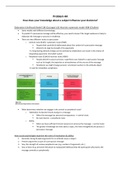
How does your knowledge about a subject influence your decisions?
Elaboration-Likelihood Model ELM (Cacioppo’s) & Heuristic-systematic model HSM (Chaiken)
Same models with different terminology
To predict if a persuasive message will be effective, you need to know if the target audience is likely to
elaborate the message or process it mindlessly
There are two different routes to persuasion
o Central route (ELM) / systematic route (HSM)
People think carefully & deliberately about the content of a persuasive message
Attend to its logic & strength of its arguments
→ a long-lasting attitude change can be achieved as elaboration can result in the chance of
integrating arguments into belief system
o Peripheral route (ELM) & heuristic route (HSM)
People attend to easy-to-process, superficial cues related to a persuasive message
such as its length, the expertise or attractiveness of the source of the message
Peripheral cue might change persons’ emotional reaction to the attitude object
→ used for immediate compliance
What determines whether we engage in the central or peripheral route?
o Motivation to devote time & energy to a message
When the message has personal consequences -> central route
No real interest -> peripheral route
o Ability
When we have sufficient time & resources to process the message -> central route
The greater knowledge we have about a topic, the more thoughtfully we process a
persuasive message
How social psychologist examine the roles of motivation & ability:
1. Generate strong & weak arguments for an attitude issue or object
2. Present arguments as part of a persuasive message
3. Vary the strength of various peripheral cues (e.g. number of arguments, etc.)
4. Vary a factor (e.g. personal relevance) to manipulate likelihood that the participant will process the
message centrally or peripherally
, Study by Cacioppo & Goldman
Varied the strength of arguments
Students had to read 8 weak & 8 strong argument for new exam regulations
Told participants new regulations would take place either next year or in 10 year
Told participants arguments were formed by high school class or Commission of Education
→ High personal relevance led par cipants to be persuaded by the strength of arguments
→ Lack of personal relevance led participants to be persuaded by the expertise of the source
Garcia-Marques & Mackie
Subjective feeling of familiarity determines whether people process information either
o Analytically (systematically)
Careful attention to details of situation
Use of criteria & rules to make judgment
Memory used to access information e.g. stimulus representations & symbolic rules
Controllable, productive & slow
o Non-analytically (heuristically)
Characterized by access to previous information
Operates outside of conscious control
Relies on complex memory structures e.g. stereotypes, schemas, heuristics
Quick decision making
Dualistic information process models function independently
Both processes can be affected differently by same variables
Input → memory → implicit feeling of familiarity → familiarity as mechanism to regulate process mode
activation
Subjective feeling of familiarity can also regulate processing of persuasive material
Experiment
o Hypothesis
if participants change attitude on strong arguments → analy c processing
if participants attitude change is unrelated to quality of arguments → non-analytic
processing
o Trial 1: familiarity operationalized by exposing participants to messages 0,1,2,4 times
o Trial 2: participants read arguments again, but listen to target message as background noise
How are you persuaded? & What makes people appear trustworthy?
Elements of Persuasion
Yale School approach by Hovland
3 W’s of a persuasive communication
1. “Who”: source of the message
2. “What”: content of the message
3. “To whom”: intended audience of the message
Factors of Attitude change
Source characteristics
Attractiveness
o Attractive communicators can promote attitude change through the peripheral route
We are inclined to like & trust physically attractive people
How does your knowledge about a subject influence your decisions?
Elaboration-Likelihood Model ELM (Cacioppo’s) & Heuristic-systematic model HSM (Chaiken)
Same models with different terminology
To predict if a persuasive message will be effective, you need to know if the target audience is likely to
elaborate the message or process it mindlessly
There are two different routes to persuasion
o Central route (ELM) / systematic route (HSM)
People think carefully & deliberately about the content of a persuasive message
Attend to its logic & strength of its arguments
→ a long-lasting attitude change can be achieved as elaboration can result in the chance of
integrating arguments into belief system
o Peripheral route (ELM) & heuristic route (HSM)
People attend to easy-to-process, superficial cues related to a persuasive message
such as its length, the expertise or attractiveness of the source of the message
Peripheral cue might change persons’ emotional reaction to the attitude object
→ used for immediate compliance
What determines whether we engage in the central or peripheral route?
o Motivation to devote time & energy to a message
When the message has personal consequences -> central route
No real interest -> peripheral route
o Ability
When we have sufficient time & resources to process the message -> central route
The greater knowledge we have about a topic, the more thoughtfully we process a
persuasive message
How social psychologist examine the roles of motivation & ability:
1. Generate strong & weak arguments for an attitude issue or object
2. Present arguments as part of a persuasive message
3. Vary the strength of various peripheral cues (e.g. number of arguments, etc.)
4. Vary a factor (e.g. personal relevance) to manipulate likelihood that the participant will process the
message centrally or peripherally
, Study by Cacioppo & Goldman
Varied the strength of arguments
Students had to read 8 weak & 8 strong argument for new exam regulations
Told participants new regulations would take place either next year or in 10 year
Told participants arguments were formed by high school class or Commission of Education
→ High personal relevance led par cipants to be persuaded by the strength of arguments
→ Lack of personal relevance led participants to be persuaded by the expertise of the source
Garcia-Marques & Mackie
Subjective feeling of familiarity determines whether people process information either
o Analytically (systematically)
Careful attention to details of situation
Use of criteria & rules to make judgment
Memory used to access information e.g. stimulus representations & symbolic rules
Controllable, productive & slow
o Non-analytically (heuristically)
Characterized by access to previous information
Operates outside of conscious control
Relies on complex memory structures e.g. stereotypes, schemas, heuristics
Quick decision making
Dualistic information process models function independently
Both processes can be affected differently by same variables
Input → memory → implicit feeling of familiarity → familiarity as mechanism to regulate process mode
activation
Subjective feeling of familiarity can also regulate processing of persuasive material
Experiment
o Hypothesis
if participants change attitude on strong arguments → analy c processing
if participants attitude change is unrelated to quality of arguments → non-analytic
processing
o Trial 1: familiarity operationalized by exposing participants to messages 0,1,2,4 times
o Trial 2: participants read arguments again, but listen to target message as background noise
How are you persuaded? & What makes people appear trustworthy?
Elements of Persuasion
Yale School approach by Hovland
3 W’s of a persuasive communication
1. “Who”: source of the message
2. “What”: content of the message
3. “To whom”: intended audience of the message
Factors of Attitude change
Source characteristics
Attractiveness
o Attractive communicators can promote attitude change through the peripheral route
We are inclined to like & trust physically attractive people