100% Zufriedenheitsgarantie Sofort verfügbar nach Zahlung Sowohl online als auch als PDF Du bist an nichts gebunden 4.2 TrustPilot
logo-home
Prüfung

PYC3703 Cognitive Psychology (2021 - Semester 1 and Semester 2 - Assignment 1)

Bewertung
4,5
(4)
Verkauft
10
seiten
11
Klasse
A+
Hochgeladen auf
17-05-2021
geschrieben in
2021/2022

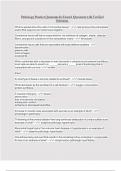
PYC3703 – Cognitive Psychology 2021 - Semester 1 and Semester 2 - Assignment 1 Question 1: Donders was interested in determining how long it takes for a person to make a decision. He determined this by measuring ... how long it takes to respond to presentation of a stimulus. 1. cognition 2. reaction time 3. processing time 4. analytical ability Question 2: The field that studies how to make machines behave in ways that are intelligent if a human were so behaving is known as ... 1. cognitive psychology 2. behaviourism 3. artificial intelligence 4. flow diagramming Question 3: Cherry’s (1953) experiment in which participants listen to two messages simultaneously, one in each ear, found that? 1. people can focus on one message and ignore the other one. 2. people can focus on the message they were repeating. 3. people can take in very little information about the ignored message. 4. even deaf individuals process auditory information, even on a non-conscious level. Question 4: The scene of a human sitting at a computer terminal, responding to stimuli flashed on the computer screen, would most likely be described as depicting a(n) ... experiment. 1. information processing 2. analytic introspection 3. operant conditioning 4. information processing Question 5: ... refers to the idea that a topic can be studies in a number of different ways, with each approach contributing its own dimension to our understanding. 1. Cognitive neuroscience 2. Levels of analysis 3. Communication and representation 4. Information processing Question 6: The investigation of how behaviour is strengthened by presentation of positive reinforcers (e.g. food) or withdrawal of negative reinforcers (e.g. shock) is best known as ... 1. classical conditioning 2. the method of savings 3. choice reaction time 4. operant conditioning Question 7: Which of the following is a criticism of an analytic introspection? 1. It infers mental processes based on objective data. 2. It produces results that are too easy to verify. 3. It produces consistent results from person to person. 4. It requires extensive training. Question 8: Damage of Wernicke’s area is in which lobe of the brain? 1. Temporal 2. Occipital 3. Parietal 4. Frontal Question 9: Paul Broca’s and Carl Wernicke’s research provided early evidence for ... 1. distributed processing 2. localization of function 3. prosopagnosia 4. neural net theory Question 10: Which part of the brain is important for touch, pressure and pain? 1. Occipital love 2. Hippocampus 3. Temporal lobe 4. Parietal lobe Question 11: The fusiform face area (FFA) in the brain is often damaged in patients with ... 1. Broca’s aphasia 2. Wernicke’s aphasia 3. Prosopagnosia 4. Alzheimer’s disease Question 12: The idea that specific cognitive functions activate many areas of the brain is known as ... 1. localization of function 2. distribute representation 3. modularity 4. aphasia Question 13: Brain-imaging techniques van determine all of the following EXCEPT ... 1. areas of the brain activated during cognitive tasks. 2. localization of brain activity in response to a specific stimulus. 3. the structure of individuals neurons. 4. patterns of blood flow in the brain. Question 14: The concept of distributed neural coding proposes that a specific object, like a face, is represented across a number of ... 1. microelectrodes 2. stimuli 3. modalities 4. neurons Question 15: The notion that every stimulus patter is seen in such a way that the resulting structure is as simple as possible is called the law of ... 1. common fate 2. similarity 3. pragnanz 4. continuity Question 16: The ability to recognise an object seen from different viewpoints is called ... 1. oblique effect 2. viewpoint invariance 3. law of good continuation 4. law of pragnanz Question 17: People perceive vertical and horizontal orientations more easily than other orientations according to the ... 1. principle of size constancy 2. oblique effect 3. law of good communication 4. law of pragnanz Question 18: Palmer’s (1975) experiment, in which he asked people to identify objects in a kitchen, showed how ... can affect perception. 1. illusory conjunctions 2. context 3. naming association 4. attention Question 19: The result of Gauthier et al.’s (1999) ‘Greeble’ experiment illustrate ... 1. that neurons specialized to respond to faces are in our brains when we are born. 2. that training a monkey to recognize the difference between common objects can influence how monkey’s neurons fire to these objects. 3. an effect of experience-dependant plasticity. 4. that our nervous systems remain fairly stable in different environments. Question 20: The perception pathway corresponds to the ... pathway, while the action pathway corresponds to the ... pathway. 1. where; what 2. what; where 3. size; distance 4. distance; size Question 21: Damage to the temporal lobe makes the ... more difficult. 1. object discrimination problem 2. landmark discrimination problem 3. double dissociation problem 4. single dissociation problem Question 22: The task of determining the object responsible for a particular image on one’s retina is called the ... 1. radiated wavelength paradox 2. inverse projection problem 3. serial location task 4. fusiform face role Question 23: The sequence of steps that includes the image on the retina, changing the image into electrical signals, and neural processing is an example of ... processing. 1. bottom-up 2. top-down 3. sequential 4. serial Question 24: The brain is changed, or ‘shaped’, by its exposure to the environment so it can perceive the environment more efficiently. The mechanism through which the structure of the brain is changed by experience, is called ... 1. theory of natural selection 2. experience-dependant plasticity 3. prior probability theory 4. scene schemas Question 25: Information remains in sensory memory for ... 1. seconds or a fraction of a second 2. 15-30 seconds 3. 1-3 minutes 4. as long as it is rehearsed Question 26: Imagine you are driving to a friend’s new house. In your mind, you say the address repeatedly until you arrive. Once you arrive, you stop thinking about the dress and start thinking about buying a housewarming gift for your friend. To remember the address, you used a(n) ... process in STM. 1. control 2. automatic 3. coding 4. iconic Question 27: When light from a flashlight is moved quickly back and forth on a wall in a darkened room, it can appear to observers that there is a trail of light moving across the wall, even though physically the light is only in one place at any given time. This experience is an affect of memory that occurs because of ... 1. a visual delay effect 2. echoic memory 3. persistence of vision 4. top-down processing Question 28: An example of a control process that operates on short-term memory is ... 1. structural features 2. rehearsals 3. modal model of memory 4. a shorter rehearsal period Question 29: Jill’s friends tell her they think she has a really good memory. She finds this interesting so she decides to purposefully test her memory. Jill receives a list of to-do tasks each day at work. Usually, she checks off each item as the day progresses, but this week, she is determined to memorize the to-do lists. On Monday, Jill is proud to find that she remembers 95 per cent of the tasks without referring to the list. On Tuesday, her memory drops to 80 per cent, and by Thursday, she is dismayed to see her performance has declined to 20 per cent. Jill’s memory is declining over the course of the week because other information she encounters is ‘competing’ with that which she memorized on Monday. This process is called ... 1. anterograde amnesia 2. episodic buffer 3. retroactive interference 4. proactive interference Question 30: Lamar has anew job and is attending a company party where he will meet his colleagues for the first time. His boss escorts him around to small groups to introduce him. At the first group, Lamar meets four people and is told only their first names. The same thing happens with a second group and a third group. At the fourth group, Lamar is told their names and that one of the women in the group is the company accountant. A little while later, Lamar realizes that while he remembers the names of the people in the fourth group, he can no longer recall the names of anyone he met earlier in the party. Lamar’s experience demonstrates ... 1. the phonological similarity effect 2. retroactive interference 3. the cocktail party phenomenon 4. the partial-report procedure

Mehr anzeigen Weniger lesen
Hochschule
Kurs


Ups! Dein Dokument kann gerade nicht geladen werden. Versuch es erneut oder kontaktiere den Support.

Verknüpftes buch

Schule, Studium & Fach

Hochschule
Kurs

Dokument Information

Hochgeladen auf
17. mai 2021
Datei zuletzt aktualisiert am
15. juli 2022
Anzahl der Seiten
11
geschrieben in
2021/2022
Typ
Prüfung
Enthält
Fragen & Antworten

Themen

Inhaltsvorschau

PYC3703/201/1/2021


Tutorial Letter 201/1/2021

PYC3703


Cognition: Memory, Thinking and
Problem Solving


Semester 1 & 2


Department of Psychology


Feedback – Assignment 01


BARCODE

3,41 €
Vollständigen Zugriff auf das Dokument erhalten:
Von 10 Studierenden gekauft

100% Zufriedenheitsgarantie
Sofort verfügbar nach Zahlung
Sowohl online als auch als PDF
Du bist an nichts gebunden

Bewertungen von verifizierten Käufern

Alle 4 Bewertungen werden angezeigt
1 Jahr vor

4 Jahr vor

4 Jahr vor

4 Jahr vor

4,5

4 rezensionen

5
3
4
0
3
1
2
0
1
0
Zuverlässige Bewertungen auf Stuvia

Alle Bewertungen werden von echten Stuvia-Benutzern nach verifizierten Käufen abgegeben.

Lerne den Verkäufer kennen

Seller avatar
Bewertungen des Ansehens basieren auf der Anzahl der Dokumente, die ein Verkäufer gegen eine Gebühr verkauft hat, und den Bewertungen, die er für diese Dokumente erhalten hat. Es gibt drei Stufen: Bronze, Silber und Gold. Je besser das Ansehen eines Verkäufers ist, desto mehr kannst du dich auf die Qualität der Arbeiten verlassen.
studentworx University of South Africa (Unisa)
Folgen Sie müssen sich einloggen, um Studenten oder Kursen zu folgen.
Verkauft
460
Mitglied seit
6 Jahren
Anzahl der Follower
313
Dokumente
0
Zuletzt verkauft
1 Jahren vor
Studentworx

4,2

69 rezensionen

5
38
4
17
3
9
2
2
1
3

Kürzlich von dir angesehen.

Warum sich Studierende für Stuvia entscheiden

on Mitstudent*innen erstellt, durch Bewertungen verifiziert

Geschrieben von Student*innen, die bestanden haben und bewertet von anderen, die diese Studiendokumente verwendet haben.

Nicht zufrieden? Wähle ein anderes Dokument

Kein Problem! Du kannst direkt ein anderes Dokument wählen, das besser zu dem passt, was du suchst.

Bezahle wie du möchtest, fange sofort an zu lernen

Kein Abonnement, keine Verpflichtungen. Bezahle wie gewohnt per Kreditkarte oder Sofort und lade dein PDF-Dokument sofort herunter.

Student with book image

“Gekauft, heruntergeladen und bestanden. So einfach kann es sein.”

Alisha Student

Häufig gestellte Fragen