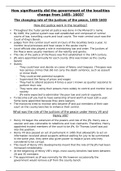
How significantly did the government of the localities
change from 1485- 1603?
The changing role of the justices of the peace, 1485-1603
How did justice work in the localities?
Throughout the Tudor period all Justice was done in the Monarch’s name.
By 1485, the judicial system was well established and composed of central
courts of law, travelling courts and local courts. The main central court was the
Court of King’s Bench.
Judges from this central court went on tours of the localities twice a year, to
monitor local processes and hear cases in the assize courts
Local officials also played a role in maintaining law and order. The Justices of
the Peace were usually members of the nobility and gentry.
The role of the Justice of the Peace was first established in the 14th century.
JPs were appointed annually for each county (this was known as the county
bench)
Duties:
- They could hear and decide on cases of felony and trespass. (Trespass was
less serious crimes that did not carry the death sentence, such as assault
or minor theft.
- They could arrest potential suspects
- Supervised the fixing of prices and wages
- They had to attend sessions 4 times a year ( known as quarter sessions) to
perform their role
- They were also using their powers more widely to control and monitor local
society
- JPs were expected to administer the poor law and control vagrants.
To become a JP you had to have ownership of land worth at least £20 a year.
Some were appointed because they were lawyers
The monarchs tried to monitor who became JP and put members of their own
court on the county benches to enhance their control.
What was the role of the justices of the peace under Henry VII and
Henry VIII?
Henry VII began the extension of the powers and role of the JPs. Henry was a
usurper and was vulnerable to rebellions and rival claimants. Therefore, Henry
appointed trusted members of the court to be JPs, Sir Thomas Lovell was put
into this position.
Henry VII also passed an act of parliament in 1495 that allowed JPs to act on
information received about suspects without waiting for jury to be summoned.
In the same year, they were also given power to replace jurors who they
considered to be corrupt.
The result of Henry VII’s developments meant that the role of the JPs had been
increased considerably.
At the beginning of Henry VIII’s reign, most county benches had been between
20 and 35 members
The appointment as JP was normally for life however occasionally the
government would remove a JP from the county bench.
, Wolsey was keen to improve local justice and the quality of JP’s
How did the role of the JPs develop under the later Tudors?
During the reigns of Edward, Mary and Elizabeth, the trend for more
responsibility on the JPs continued.
In 1552, an Act of parliament laid down that all alehouses had to be licensed by
JPs.
These also played an important role in enforcing Edward’s religious changes.
In 1549, they were ordered to take an inventory of parish goods in order to
expose those who had illegally taken them;
In 1552, they were ordered to enforce the second prayer book.
By Elizabeth’s reign, the amount of businesses conducted by JPs and the size of
the county benches had grown from 25 under Wolsey to 40 and 50 under
Elizabeth.
Members of the gentry had realized that becoming a JP was the key to social
and political advancement.
William Cecil had to keep a close eye on the membership of the benches
Government intervention was relatively limited however, royal control over the
county benches was strengthened by the appointment of leading councillors
and from 1585, Lord Lieutenants to county benches.
With the outbreak of war in 1585, JPs also acted as deputy Lieutenants and had
the duty to recruit men to fight during the war.
By 1603, there were 309 acts of parliament.
During Elizabeth’s reign JPs had acquired powers to deal with new felonies
They were also responsible for the administration of the Tudor poor laws and
minor offences such as damage to crops.
Therefore by 1603, the role of the JPs in administrating Tudor law and
controlling the regions has expanded enormously. Through them the power of
the crown had also expanded.
How effectively was the monarchy financed?
the monarch was supposed to be financially independent.
The crown had two sources of income: ‘ordinary revenue’ which came from the
royal lands and the monarch’s status as a landlord, and ‘extraordinary revenue’
which was usually taxation granted by parliament for the for the monarch’s
special needs, usually the costs of war.
‘Ordinary’ income could come from rents or the sale of land.
The monarchy rarely had enough money and was often reliant on parliamentary
taxation.
Raising money through taxation could cause problems for the monarchy
because it could lead to dangerous unrest.
Poorer regions of the country, such as the west and the north, often found it
difficult to meet the crown’s demands.
The revolts of 1489 and 1497 under Henry VII were both sparked by resentment
over high levels of taxation.
The pilgrimage of grace in 1536, took place against a background of demands
for tax and poverty in the north of England.
change from 1485- 1603?
The changing role of the justices of the peace, 1485-1603
How did justice work in the localities?
Throughout the Tudor period all Justice was done in the Monarch’s name.
By 1485, the judicial system was well established and composed of central
courts of law, travelling courts and local courts. The main central court was the
Court of King’s Bench.
Judges from this central court went on tours of the localities twice a year, to
monitor local processes and hear cases in the assize courts
Local officials also played a role in maintaining law and order. The Justices of
the Peace were usually members of the nobility and gentry.
The role of the Justice of the Peace was first established in the 14th century.
JPs were appointed annually for each county (this was known as the county
bench)
Duties:
- They could hear and decide on cases of felony and trespass. (Trespass was
less serious crimes that did not carry the death sentence, such as assault
or minor theft.
- They could arrest potential suspects
- Supervised the fixing of prices and wages
- They had to attend sessions 4 times a year ( known as quarter sessions) to
perform their role
- They were also using their powers more widely to control and monitor local
society
- JPs were expected to administer the poor law and control vagrants.
To become a JP you had to have ownership of land worth at least £20 a year.
Some were appointed because they were lawyers
The monarchs tried to monitor who became JP and put members of their own
court on the county benches to enhance their control.
What was the role of the justices of the peace under Henry VII and
Henry VIII?
Henry VII began the extension of the powers and role of the JPs. Henry was a
usurper and was vulnerable to rebellions and rival claimants. Therefore, Henry
appointed trusted members of the court to be JPs, Sir Thomas Lovell was put
into this position.
Henry VII also passed an act of parliament in 1495 that allowed JPs to act on
information received about suspects without waiting for jury to be summoned.
In the same year, they were also given power to replace jurors who they
considered to be corrupt.
The result of Henry VII’s developments meant that the role of the JPs had been
increased considerably.
At the beginning of Henry VIII’s reign, most county benches had been between
20 and 35 members
The appointment as JP was normally for life however occasionally the
government would remove a JP from the county bench.
, Wolsey was keen to improve local justice and the quality of JP’s
How did the role of the JPs develop under the later Tudors?
During the reigns of Edward, Mary and Elizabeth, the trend for more
responsibility on the JPs continued.
In 1552, an Act of parliament laid down that all alehouses had to be licensed by
JPs.
These also played an important role in enforcing Edward’s religious changes.
In 1549, they were ordered to take an inventory of parish goods in order to
expose those who had illegally taken them;
In 1552, they were ordered to enforce the second prayer book.
By Elizabeth’s reign, the amount of businesses conducted by JPs and the size of
the county benches had grown from 25 under Wolsey to 40 and 50 under
Elizabeth.
Members of the gentry had realized that becoming a JP was the key to social
and political advancement.
William Cecil had to keep a close eye on the membership of the benches
Government intervention was relatively limited however, royal control over the
county benches was strengthened by the appointment of leading councillors
and from 1585, Lord Lieutenants to county benches.
With the outbreak of war in 1585, JPs also acted as deputy Lieutenants and had
the duty to recruit men to fight during the war.
By 1603, there were 309 acts of parliament.
During Elizabeth’s reign JPs had acquired powers to deal with new felonies
They were also responsible for the administration of the Tudor poor laws and
minor offences such as damage to crops.
Therefore by 1603, the role of the JPs in administrating Tudor law and
controlling the regions has expanded enormously. Through them the power of
the crown had also expanded.
How effectively was the monarchy financed?
the monarch was supposed to be financially independent.
The crown had two sources of income: ‘ordinary revenue’ which came from the
royal lands and the monarch’s status as a landlord, and ‘extraordinary revenue’
which was usually taxation granted by parliament for the for the monarch’s
special needs, usually the costs of war.
‘Ordinary’ income could come from rents or the sale of land.
The monarchy rarely had enough money and was often reliant on parliamentary
taxation.
Raising money through taxation could cause problems for the monarchy
because it could lead to dangerous unrest.
Poorer regions of the country, such as the west and the north, often found it
difficult to meet the crown’s demands.
The revolts of 1489 and 1497 under Henry VII were both sparked by resentment
over high levels of taxation.
The pilgrimage of grace in 1536, took place against a background of demands
for tax and poverty in the north of England.