

General Business S1/11
The Role of Marketing Intermediaries
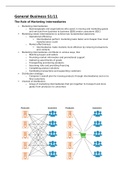
Marketing intermediaries:
o Businesspeople and organizations who assist in moving and marketing goods
and services from business to business (B2B) and/or consumers (B2C)
Marketing needs intermediaries to achieve two fundamental objectives:
o Operational efficiency:
Intermediaries perform marketing tasks faster and cheaper than most
manufacturers could
o Market effectiveness:
Intermediaries make markets more effective by reducing transactions
and contacts
Marketing intermediaries contribute in various ways, like:
o Matching buyers and sellers
o Providing market information and promotional support
o Gathering assortments of goods
o Transporting and storing products
o Assuming risks and providing financing
o Completing product solutions
o Facilitating transactions and supporting customers
Distribution strategy:
o Company’s overall plan for moving products through intermediaries and on to
final customers
Channel of distribution:
o Group of marketing intermediaries that join together to transport and store
goods from producers to consumers
, Wholesaling vs Retailing
Wholesaler:
o Intermediary that sells products to other intermediaries for resale or to
organizations for internal use
o Perform specialized accumulation and allocation functions, and it allows
producers to concentrate on developing and manufacturing products to match
consumers’ wants
o By their service for retailers, wholesalers also support retailers by helping
their customer select inventory and purchase supplies
o Perform physical distribution activities more efficiently than producers or
retailers because they buy in large quantities and deliver to customers in
smaller lots
Wholesaling:
o The intermediaries’ activity in the marketing channel between producers and
business customers to facilitate the exchange - buying and selling - of goods
o Both a service for producers and for retailers
Retailers:
o Intermediaries that sell goods and services to individuals for their own
personal use
Classifying Wholesalers
Merchant wholesaler:
o Takes titles to goods, assume the risks associated with ownership, and are
usually directly involved in buying and selling products between the parties
o Full-service merchant wholesaler:
Middleman who offers the widest possible range of wholesaling
functions
o Limited-service merchant wholesaler:
Provides only some marketing services and specializes in new
functions
Agents and Brokers:
o Functional middlemen who do not take title to products and are compensated
with commissions for negotiating exchanges between sellers and buyers
o Agent:
Represents either the buyer or the seller usually on a permanent basis
o Broker:
Brings the buyers and seller together on a temporary basis
Manufacturers’ sales branches and offices:
o Independent middlemen or distributors who represent two or more sellers and
usually offer customers complete product lines
Retailing
Retailing:
o Includes all transactions in which the buyer intends to consume the product
through personal, family or household use
o Buyers in retail transactions are the ultimate consumers
Retailer:
The Role of Marketing Intermediaries
Marketing intermediaries:
o Businesspeople and organizations who assist in moving and marketing goods
and services from business to business (B2B) and/or consumers (B2C)
Marketing needs intermediaries to achieve two fundamental objectives:
o Operational efficiency:
Intermediaries perform marketing tasks faster and cheaper than most
manufacturers could
o Market effectiveness:
Intermediaries make markets more effective by reducing transactions
and contacts
Marketing intermediaries contribute in various ways, like:
o Matching buyers and sellers
o Providing market information and promotional support
o Gathering assortments of goods
o Transporting and storing products
o Assuming risks and providing financing
o Completing product solutions
o Facilitating transactions and supporting customers
Distribution strategy:
o Company’s overall plan for moving products through intermediaries and on to
final customers
Channel of distribution:
o Group of marketing intermediaries that join together to transport and store
goods from producers to consumers
, Wholesaling vs Retailing
Wholesaler:
o Intermediary that sells products to other intermediaries for resale or to
organizations for internal use
o Perform specialized accumulation and allocation functions, and it allows
producers to concentrate on developing and manufacturing products to match
consumers’ wants
o By their service for retailers, wholesalers also support retailers by helping
their customer select inventory and purchase supplies
o Perform physical distribution activities more efficiently than producers or
retailers because they buy in large quantities and deliver to customers in
smaller lots
Wholesaling:
o The intermediaries’ activity in the marketing channel between producers and
business customers to facilitate the exchange - buying and selling - of goods
o Both a service for producers and for retailers
Retailers:
o Intermediaries that sell goods and services to individuals for their own
personal use
Classifying Wholesalers
Merchant wholesaler:
o Takes titles to goods, assume the risks associated with ownership, and are
usually directly involved in buying and selling products between the parties
o Full-service merchant wholesaler:
Middleman who offers the widest possible range of wholesaling
functions
o Limited-service merchant wholesaler:
Provides only some marketing services and specializes in new
functions
Agents and Brokers:
o Functional middlemen who do not take title to products and are compensated
with commissions for negotiating exchanges between sellers and buyers
o Agent:
Represents either the buyer or the seller usually on a permanent basis
o Broker:
Brings the buyers and seller together on a temporary basis
Manufacturers’ sales branches and offices:
o Independent middlemen or distributors who represent two or more sellers and
usually offer customers complete product lines
Retailing
Retailing:
o Includes all transactions in which the buyer intends to consume the product
through personal, family or household use
o Buyers in retail transactions are the ultimate consumers
Retailer:


