

Sob2929
En esta página, encontrarás todos los documentos, paquetes y tarjetas que ofrece el vendedor sob2929.
- 6
- 0
- 0
Community
- Seguidores
- Siguiendo
6 artículos
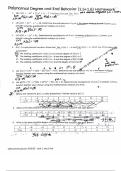
AP Pre Calc Unit 1 D 3 - Polynomial Degree and End Behavior
This set of Unit 1 Day 3 Precalculus notes and homework focuses on polynomial structure, end behavior, and determining degree from tables of values. Students learn how leading coefficients and polynomial degree influence the left- and right-hand behavior of graphs, how to express end behavior using limit notation, and how to recognize whether a polynomial has odd or even degree based on its long-term behavior. The packet also includes guided problems on evaluating limits of polynomial functio...
- Notas de lectura
- • 3 páginas •
This set of Unit 1 Day 3 Precalculus notes and homework focuses on polynomial structure, end behavior, and determining degree from tables of values. Students learn how leading coefficients and polynomial degree influence the left- and right-hand behavior of graphs, how to express end behavior using limit notation, and how to recognize whether a polynomial has odd or even degree based on its long-term behavior. The packet also includes guided problems on evaluating limits of polynomial functio...
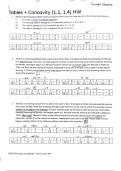
AP Pre- Calculus Unit 1 D2 - Tables & Concavity
These Unit 1 Pre-Calculus notes provide clear, organized explanations of concavity, increasing/decreasing behavior, and points of inflection using multiple graphs and examples. The notes walk through how to identify where a function is concave up or concave down, how the rate of change affects the shape of the graph, and how to recognize inflection points both visually and conceptually. Several worked-out graphs are included, along with tables of function values and diagrams illustrating how inc...
- Notas de lectura
- • 4 páginas •
These Unit 1 Pre-Calculus notes provide clear, organized explanations of concavity, increasing/decreasing behavior, and points of inflection using multiple graphs and examples. The notes walk through how to identify where a function is concave up or concave down, how the rate of change affects the shape of the graph, and how to recognize inflection points both visually and conceptually. Several worked-out graphs are included, along with tables of function values and diagrams illustrating how inc...
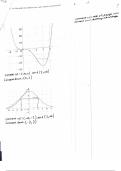
Class notes AP Pre-Calculus for Concavity
These Unit 1 Pre-Calculus notes provide clear, organized explanations of concavity, increasing/decreasing behavior, and points of inflection using multiple graphs and examples. The notes walk through how to identify where a function is concave up or concave down, how the rate of change affects the shape of the graph, and how to recognize inflection points both visually and conceptually. Several worked-out graphs are included, along with tables of function values and diagrams illustrating how inc...
- Notas de lectura
- • 4 páginas •
These Unit 1 Pre-Calculus notes provide clear, organized explanations of concavity, increasing/decreasing behavior, and points of inflection using multiple graphs and examples. The notes walk through how to identify where a function is concave up or concave down, how the rate of change affects the shape of the graph, and how to recognize inflection points both visually and conceptually. Several worked-out graphs are included, along with tables of function values and diagrams illustrating how inc...
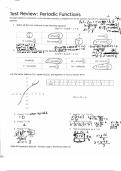
AP Pre- Calc Unit 3 Periodic Functions Test Review
AP Precalculus – Unit 3 Periodic Functions Topics 1. Solving Trigonometric Equations • Solving equations involving sin, cos, tan • Using inverse trig expressions (arcsin, arccos, arctan) • Finding all solutions in a given interval 2. Evaluating Functions Using Tables, Graphs & Compositions • Using tables to find values of f(x), f^{-1}(x) • Evaluating compositions: f(g(x)), g(f(x)) 3. Inverse Functions • Algebraic inverses • Graphical inverses • Domain &...
- Reseña del libro
- • 10 páginas •
AP Precalculus – Unit 3 Periodic Functions Topics 1. Solving Trigonometric Equations • Solving equations involving sin, cos, tan • Using inverse trig expressions (arcsin, arccos, arctan) • Finding all solutions in a given interval 2. Evaluating Functions Using Tables, Graphs & Compositions • Using tables to find values of f(x), f^{-1}(x) • Evaluating compositions: f(g(x)), g(f(x)) 3. Inverse Functions • Algebraic inverses • Graphical inverses • Domain &...
AP Pre-Calculus Unit 1 Concavity, end behavior & function notes
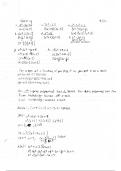
These notes cover the foundations of polynomial behavior in precalculus. They begin with several factoring examples, including difference of squares, factoring by grouping, and breaking down higher-degree expressions. After the warm-up factoring problems, the notes explain how zeros of a polynomial function work: plugging a root into the function results in zero, and an n-degree polynomial has n total zeros when counted with multiplicity. A key idea highlighted here is multiplicity—roots with ...
- Notas de lectura
- • 5 páginas •
These notes cover the foundations of polynomial behavior in precalculus. They begin with several factoring examples, including difference of squares, factoring by grouping, and breaking down higher-degree expressions. After the warm-up factoring problems, the notes explain how zeros of a polynomial function work: plugging a root into the function results in zero, and an n-degree polynomial has n total zeros when counted with multiplicity. A key idea highlighted here is multiplicity—roots with ...
Class notes AP Pre-Calculus Unit 1, Day 1. Topics 1.1-1.3
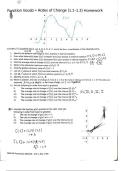
The worksheet focuses on understanding how a function behaves by analyzing its graph. The first page shows a smooth curve labeled f(x) with key points A through G marking peaks, valleys, and turning points. The problems ask you to describe the graph using formal vocabulary: the domain (all x-values shown on the graph) and the range (all y-values the graph reaches). You also identify where the graph is increasing—sections where the curve moves upward from left to right—and where it is decreas...
- Notas de lectura
- • 2 páginas •
The worksheet focuses on understanding how a function behaves by analyzing its graph. The first page shows a smooth curve labeled f(x) with key points A through G marking peaks, valleys, and turning points. The problems ask you to describe the graph using formal vocabulary: the domain (all x-values shown on the graph) and the range (all y-values the graph reaches). You also identify where the graph is increasing—sections where the curve moves upward from left to right—and where it is decreas...