
- Guías de estudio, Notas de estudios & Resúmenes
¿Buscas las mejores guías de estudio, notas de estudio y resúmenes para ? En esta página encontrarás 10 documentos de estudio para .
Examen
WGU Data Driven Decision Making - C207 questions with correct answers
Activities (RBM stage) CORRECT ANSWER second step involves the process that converts inputs to outputs (actions necessary to produces results - training, evaluating, developing) Alternative hypothesis CORRECT ANSWER The argument that either a sample is not equal to, greater than, or less than the hypothesized null sample Analysis of Variance (ANOVA) CORRECT ANSWER a technique used to determine if there is a sufficient evidence from sample data of three or more populations to conclude that ...
 cracker
Examen
WGU Data Driven Decision Making - C207 Questions and Verified Answers
PopularWGU Data Driven Decision Making - C207 Questions and Verified Answers
 Ivie
Examen
WGU C207 Data-Driven Decision Making 2026/2027 | Study Guide, Practice Questions & Exam Prep
NuevoWGU C207 Data-Driven Decision Making 2026/2027 | Study Guide, Practice Questions & Exam Prep
 passnursingnow
Examen
WGU Data Driven Decision Making - C207 | Study Material for Exams
WGU Data Driven Decision Making - C207 | Study Material for Exams
 Teachme2oo
Examen
WGU Data Driven Decision Making Pre- Assessment with Guaranteed Accurate Answers
Analytics is a broad term that refers to a variety of tools that inform managerial decisions. Which term can be used to describe managerial decisions? - correct answer Prescriptive What are two reasons for increasing the use of analytics in organizational decision making? - correct answer 1. Relatively lower cost of computer storage 2. Higher computer processing power How does probability theory inform decision making for managers? - correct answer By quantifying risk Which type of dat...
 GRADEUNITS
Examen
WGU Data Driven Decision Making Complete Solution
WGU Data Driven Decision Making Complete Solution Activities (RBM stage) - second step involves the process that converts inputs to outputs (actions necessary to produces results - training, evaluating, developing) Alternative hypothesis - The argument that either a sample is not equal to, greater than, or less than the hypothesized null sample Analysis of Variance (ANOVA) - a technique used to determine if there is a sufficient evidence from sample data of three or...
Examset

Examen
WGU Data Driven Decision Making - C207 | Study Material for Exams
WGU Data Driven Decision Making - C207 | Study Material for Exams 1. Activities (RBM stage) -----Right Answer-------second step involves the process that converts inputs to outputs (actions necessary to produces results - training, evaluating, developing) 2. Alternative hypothesis -----Right Answer-------The argument that either a sample is not equal to, greater than, or less than the hypothesized null sample 3. Analysis of Variance (ANOVA) -----Right Answer-------a technique used to dete...
 nevilletadayo
Lote
Wgu Data Driven Decision Making - C207 Bundle
Wgu Data Driven Decision Making - C207 Bundle
cracker
Examen
WGU Data Driven Decision Making - C207 (with complete solutions)
Activities (RBM stage) correct answers second step involves the process that converts inputs to outputs (actions necessary to produces results - training, evaluating, developing) Alternative hypothesis correct answers The argument that either a sample is not equal to, greater than, or less than the hypothesized null sample Analysis of Variance (ANOVA) correct answers a technique used to determine if there is a sufficient evidence from sample data of three or more populations to conclude th...
 SirAnton
Examen
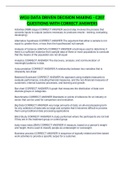
Wgu Data Driven Decision Making - C207 Questions With Correct Answers
Activities (RBM stage) CORRECT ANSWER second step involves the process that converts inputs to outputs (actions necessary to produces results - training, evaluating, developing) Alternative hypothesis CORRECT ANSWER The argument that either a sample is not equal to, greater than, or less than the hypothesized null sample Analysis of Variance (ANOVA) CORRECT ANSWER a technique used to determine if there is a sufficient evidence from sample data of three or more populations to conclude that ...
cracker