
- Guías de estudio, Notas de estudios & Resúmenes
¿Buscas las mejores guías de estudio, notas de estudio y resúmenes para ? En esta página encontrarás 8 documentos de estudio para .
Examen
CHM1045L Already Passed Exam Questions and CORRECT Answers
What was the purpose of the "properties and changes of matter" lab?To examine and describe physical and chemical properties of various substances, and to cause physical and chemical changes within these substances. What is matter?Any and all material of which the universe is composed of. Anything that has mass and occupies space. Matter exists in:three different states: solid, liquids, and gas What is a pure substance?A sample of matter that has identical properties and fixed composi...
 STANFORDGRADESS
Examen
CHM1045L UPDATED Exam Questions and CORRECT Answers
PopularAccurancy how close close a measurement is to a true value. (how close the darts are to the bulls-eye) Error describes the accuracy of a measurement. =I true value-measured value I Percent error =(Error X 100%)/True Value Precision refer to the agreement among a series of measurements of the same quantity. (how close the measurements are to each other) Standard deviation the precision of a series of measurements. s=k(A-B) s- standard deviation A- highest measured value B- lowest m...
STANFORDGRADESS
Examen
CHM1045L Certification Exam Questions and CORRECT Answers
Describe the step by step method one should use to measure out 5.00 grams of calcium chlorideMeasuring out Measure outPlace weighing paper then TARE. Add calcium until obtaining 5.00 grams Sep by step to determine the mass of 25 mL of orange juiceMeasure mass of container , then add 25 mL of OJ and subtract the difference Determine mass of a nickle byMeasuring directly Determine the mass of NaCl crystalsMeasuring out Direct or measuring out?Direct is more accurate, less error
 WIZGrades
Examen
CHM1045L UPDATED Exam Questions and CORRECT Answers
Accurancy how close close a measurement is to a true value. (how close the darts are to the bulls-eye) Error describes the accuracy of a measurement. =I true value-measured value I Percent error =(Error X 100%)/True Value Precision refer to the agreement among a series of measurements of the same quantity. (how close the measurements are to each other) Standard deviation the precision of a series of measurements.
WIZGrades
Examen
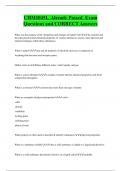
CHM1045L Already Passed Exam Questions and CORRECT Answers
What was the purpose of the "properties and changes of matter" lab?To examine and describe physical and chemical properties of various substances, and to cause physical and chemical changes within these substances. What is matter?Any and all material of which the universe is composed of. Anything that has mass and occupies space. Matter exists in:three different states: solid, liquids, and gas What is a pure substance?A sample of matter that has identical properties and fixed composi...
WIZGrades
Examen
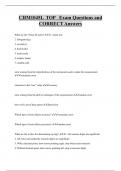
CHM1045L TOP Exam Questions and CORRECT Answers
What are the 7 basic SI units? 1. meter (m) 2. kilogram (kg) 3. second (s) 4. Kelvin (K) 5. mole (mol) 6. ampere (amp) 7. candela (cd) error arising from the imperfections of the instrument used to make the measurement systematic error closeness to the "true" value accuracy
WIZGrades
Examen
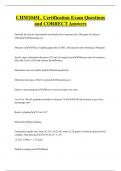
CHM1045L Certification Exam Questions and CORRECT Answers
Describe the step by step method one should use to measure out 5.00 grams of calcium chlorideMeasuring out Measure outPlace weighing paper then TARE. Add calcium until obtaining 5.00 grams Sep by step to determine the mass of 25 mL of orange juiceMeasure mass of container , then add 25 mL of OJ and subtract the difference Determine mass of a nickle byMeasuring directly Determine the mass of NaCl crystalsMeasuring out Direct or measuring out?Direct is more accurate, less error
STANFORDGRADESS
Examen
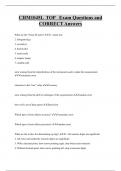
CHM1045L TOP Exam Questions and CORRECT Answers
What are the 7 basic SI units? 1. meter (m) 2. kilogram (kg) 3. second (s) 4. Kelvin (K) 5. mole (mol) 6. ampere (amp) 7. candela (cd) error arising from the imperfections of the instrument used to make the measurement systematic error closeness to the "true" value accuracy error arising from the skill or technique of the experimenter random error how well a set of data agrees precision
STANFORDGRADESS