
- Guías de estudio, Notas de estudios & Resúmenes
¿Buscas las mejores guías de estudio, notas de estudio y resúmenes para ? En esta página encontrarás 134 documentos de estudio para .

Examen
ASPEN Adult Nutrition Support Core Curriculum - Chapter Questions with Correct Answers
ASPEN Adult Nutrition Support Core Curriculum - Chapter Questions with Correct Answers which of the following nutrition interventions have been shown to improve clinical outcomes and quality of life in institutionalized older adults? A. diet modification and liberalization B. modification of dining environment C. provision of aides to improve functional status and increased independence at meals D. honoring food preference and providing snacks and fortified foods E. All of the above - A...
 EmillyCharlotte

Examen
ASPEN Self-Study CNSC Questions and Correct Answers | Latest Update
 Passit
Examen
ASPEN Practice Test Questions Questions and Correct Answers | Latest Update
Medicare approved indications for home parenteral nutrition include which of the following? a. supplement to enteral nutrition b. end-stage renal disease c. long-term loss of gastrointestinal function d. delayed gastric emptying → -:- c. long-term loss of gastrointestinal function Which of the following is true concerning manganese and patients on long-term parenteral nutrition? a. manganese deficiency occurs in patients on PN for greater than 1 year b. hypermanganesemia has bee...
Passit

Examen
ASPEN Practice Test Questions and Correct Answers | Latest Update
Which of the following acute changes in the serum chemistry profile would be expected in a patient who is experiencing tumor lysis syndrome(TLS)? 1: Hypercalcemia and hypomagnesemia2: Hyperkalemia and hyperphosphatemia3: Hypernatremia and hypermagnesemia4: Hypocalcemia and hyperphosphatemia → -:- 2 A patient with acute respiratory distress syndrome (ARDS) receiving enteral nutrition will benefit most from 1: supplemental arginine.2: formulas containing omega-6 fatty acids.3: formulas...
Passit

Examen
ASPEN Modules Questions and Correct Answers | Latest Update
Which of the following is the inpatient glycemic target for critically ill patients? 1: 80-110 mg/dL 2: 140-180 mg/dL 3: 181-210 mg/dL 4: 211-240 mg/dL → -:- 2: 140-180 mg/dL For the critically ill patient, blood glucose levels should be maintained between 140-180 mg/dL. Lower glucose targets may be appropriate for selected patients, but targets <110 mg/dL are not recommended Under conditions of sepsis and stress, which of the following metabolic alterations most likely occur?...
Passit

Examen
ASPEN Malnutrition Questions and Correct Answers | Latest Update
6 characteristics for malnutrition diagnosis → -:- Insufficient energy intake, weight loss, loss of muscle mass, subcutaneous fat loss, fluid accumulation, hand grip strength Dx if inflammation is present → -:- Mild or moderate- chronic disease related malnutrition; severe- acute disease or injury related malnutrition Dx is inflammation not present → -:- Starvation related malnutrition Pre albumin and albumin as markers of inflammation → -:- Acute phase proteins- reflect infla...
Passit

Examen
Aspen Dental Questions and Correct Answers | Latest Update
What does every new patient chart contain? → -:- A medical history form, Patient Information Form, Patient Acknowledgements, Authorization form, X-ray envelope, insurance information, and treatment plan records. What is on the right side of a patient chart? → -:- Contains medical history, treatment plans, and records of treatment with most recent at the top. Everything else goes on the left. What are the four most common types of X-rays used in a dental office? → -:- Panoramic Fil...
Passit
Examen
ASPEN Adult Nutrition Support Core Curriculum - Chapter Third edition. Mueller, Lord, Marian, McClave, Miller Questions and Correct Answers | Latest Update
which of the following nutrition interventions have been shown to improve clinical outcomes and quality of life in institutionalized older adults? A. diet modification and liberalization B. modification of dining environment C. provision of aides to improve functional status and increased independence at meals D. honoring food preference and providing snacks and fortified foods E. All of the above → -:- E. all of the above which of the following nutrition support interventions has dem...
Passit
Examen
Aspen University (Nursing Test) Questions and Correct Answers | Latest Update
King Theory of Goal Attainment → -:- -Nursing assist individuals to attain, maintain, or restore their health -Nurse and client engage in interactions of verbal and nonverbal communication where information is exchanged and interpreted -Transactions leads to values, needs, and wants are shared -Interactive process between clients and nursing is essential -Nurse and client communicate and set mutual goals, and attain those goals Neuman Systems Model → -:- -Uses person, environment,...
Passit
Lote
Aspen Exam Package Deal!!
Aspen Exam Package Deal!!
 ACADEMICMATERIALS
Examen
ASPEN Practice Test Questions And Answers Graded A+
A seven month-old infant fed reconstituted infant formula and other age-appropriate complementary foods may be at risk of over-supplementation with which of the following? a. Vitamin A b. Fluoride c. Vitamin E d. Iron - ️️b. Fluoride Zinc supplementation should be considered for patients: a. with chronic wounds b. with unexplained skin rashes and alopecia c. who are elderly d. who have below normal zinc levels - ️️b. with unexplained skin rashes and alopecia Which of the fol...
ACADEMICMATERIALS
Examen
ASPEN Practice Test Questions And Answers Graded A+
A 24-year-old, 10 week pregnant woman presented with persistent nausea and vomiting for the past 6 weeks associated with a 10% weight loss. Her symptoms were refractory to a 48 hour trial of anti-emetics and IV fluids. Given mother's nutritional status, decision was made to initiate nutrition support. What vitamin should be supplemented in this patient before providing nutrition support? 1: Vitamin B122: Thiamin3: Vitamin E4: Vitamin C - ️️2 Which of the following describes an optimal...
ACADEMICMATERIALS
Examen
ASPEN Modules Latest Update with complete solution
In pulmonary insufficiency, excessive calorie administration may cause increased blood pCO2 resulting in 1: metabolic acidosis 2: metabolic alkalosis 3: respiratory acidosis 4: respiratory alkalosis - ️️3: respiratory acidosis Respiratory acidosis results from disorders producing alterations in ventilatory control, increased production of CO2, and respiratory muscle weakness. The increased CO2 production is greatest when overfeeding occurs (2 x REE) due to an excess generation of CO...
ACADEMICMATERIALS
Examen
ASPEN Self-Study CNSC UPDATED Exam Questions and CORRECT Answers
ASPEN Self-Study CNSC UPDATED Exam Questions and CORRECT Answers Modular products are used to enhance the nutrient profile of a feeding regimen. Which of the following combinations represents modular products? 1. Safflower oil, protein, glucose and selenium 2. Glucose, glutamine, water and MCT oil 3. Protein, cholecalciferol, fiber and safflower oil 4. MCT oil, glucose, fiber and protein - CORRECT ANSWER- 4. MCT oil, glucose, fiber and protein Protein powders, carbohydrate powders, f...
 STANFORDGRADESS
Examen
Aspen Questions and Answers 2024
Aspen Questions and Answers 2024 sheet that goes left of Pt. file chart and is taped in Body Composition sheet sheets on the right of Pt file (in order) 2. Dr. Comments (license) 3. Med Hx 4. Reverse System 5. Consent (always witness it) 6. Wt. Loss/Gain (HIPPA) 7. Comment sheet (flipped around) Aspen's Mission Statement The Aspen Clinic is comprised of highly motivated and experienced individuals that are dedicated to help you live a healthy, active life. Our goal is ...
 Pogba119
Examen
ASPEN Self-Assessment Questions from Workgroup Questions and Answers
ASPEN Self-Assessment Questions from Workgroup Questions and Answers A long term PN patient presents with involuntary movements, tremor and rigidity. Which of the following etiologies may explain these symptoms? A. Manganese deficiency B. Manganese toxicity C. Selenium deficiency D. Selenium toxicity B. Manganese toxicity The early phase of manganese toxicity is characterized by weakness, anorexia, headache and apathy followed by Parkinson-like features including muscle rigidity, mask...
Pogba119
Examen
ASPEN Chapter Questions
ASPEN Chapter Questions Which of the following practices is most likely to succeed in improving oral nutrient intake in patients with a prolonged history of weight loss due to poor intake, nausea, and depressed appetite? A. Providing a high-energy oral liquid supplement 3 times daily B. Offering 6 small, low-fat meals daily C. Ordering fiber-supplemented snacks 3 times daily D. Planning primarily solid meals and limiting fluids - B. Offering 6 small, low-fat meals daily Prolonged nega...
 ExcellentScores
Examen
ASPEN Practice Test Questions
ASPEN Practice Test Questions Medicare approved indications for home parenteral nutrition include which of the following? a. supplement to enteral nutrition b. end-stage renal disease c. long-term loss of gastrointestinal function d. delayed gastric emptying - c. long-term loss of gastrointestinal function Which of the following is true concerning manganese and patients on long-term parenteral nutrition? a. manganese deficiency occurs in patients on PN for greater than 1 year b. hyp...
ExcellentScores
Examen
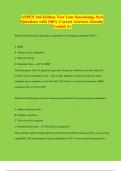
ASPEN 3rd Edition Test Your Knowledge New Questions with 100% Correct Answers Already Graded A+
ASPEN 3rd Edition Test Your Knowledge New Questions with 100% Correct Answers Already Graded A+ Which of the following is the largest component of total energy expenditure (TEE)? A. RMR B. Thermic effect of digestion C. Physical Activity D. Metabolic Stress - *A. RMR* The thermogenic effect of digestion is generally thought to contribute to no more than 10% to TEE. Activity contributes to 5% - 30% to TEE. With the exceptions of burn and sepsis, metabolic stress contributes to less than...
 yalegrades
Examen
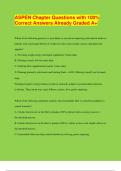
ASPEN Chapter Questions with 100% Correct Answers Already Graded A+
ASPEN Chapter Questions with 100% Correct Answers Already Graded A+ Which of the following practices is most likely to succeed in improving oral nutrient intake in patients with a prolonged history of weight loss due to poor intake, nausea, and depressed appetite? A. Providing a high-energy oral liquid supplement 3 times daily B. Offering 6 small, low-fat meals daily C. Ordering fiber-supplemented snacks 3 times daily D. Planning primarily solid meals and limiting fluids - B. Offering 6 ...
yalegrades