CH 101 (CH101)
Boston University
All 10 resultados
Ordenador por
-
CH 101 Unit 5 Notes
- Notas de lectura • 16 páginas • 2025
- $6.49
- + aprende más y mejor
These are notes from pre lecture videos and class lecture notes for unit 5 of gen chem. This covers redox reactions, acids and bases, ideal gas law and has lots of worked out practice problems in it.
-
CH101 Unit 3 Notes
- Notas de lectura • 17 páginas • 2025
- $6.49
- + aprende más y mejor
An overview of unit 3 of general chemistry includes lewis structure, VSPER theory, orbitals, hybridization, polar vs nonpolar, molecular orbital diagrams, and coulumb's law. Studied these for my quiz and got an A!
-
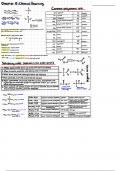
Chemical Reactivity
- Resumen • 3 páginas • 2024
- $8.39
- + aprende más y mejor
Chemical reactivity in general chemistry refers to how different substances interact and undergo transformations during chemical reactions. It is influenced by factors such as the nature of the reactants, the conditions of the reaction (temperature, pressure, concentration), and the presence of catalysts. Understanding chemical reactivity is key to predicting reaction outcomes and designing efficient processes in various chemical industries.
-
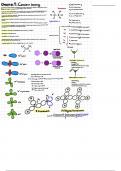
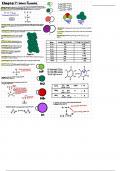
Covalent Bonding
- Resumen • 2 páginas • 2024
- $8.39
- + aprende más y mejor
Covalent bonding occurs when two atoms share electrons to achieve a more stable electron configuration, typically forming molecules. This type of bond usually happens between nonmetals and results in the formation of strong, stable compounds. The shared electrons allow each atom to attain a full outer electron shell, following the octet rule (or duet rule for hydrogen).
-
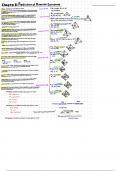
Prediction of Molecular Geometries
- Resumen • 1 páginas • 2024
- $8.39
- + aprende más y mejor
Understanding molecular geometries is essential in general chemistry for predicting how atoms are arranged in a molecule, influencing its properties and reactions. Using models like VSEPR (Valence Shell Electron Pair Repulsion), students can predict the three-dimensional shapes of molecules based on electron pair repulsions around a central atom. This concept is crucial for explaining molecular polarity, reactivity, and interactions with other molecules.

¿Miedo a perderte algo? Pues no lo hagas.

-
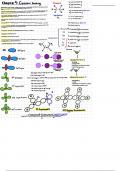
Lewis Formulas
- Resumen • 2 páginas • 2024
- $8.39
- + aprende más y mejor
Lewis formulas, or Lewis structures, are diagrams that represent the bonding between atoms in a molecule and show lone pairs of electrons. They help illustrate how atoms share or transfer electrons to achieve a stable electron configuration, usually following the octet rule. These structures are essential for predicting molecular geometry, reactivity, and properties.
-
Covalent Bonding
- Resumen • 2 páginas • 2024
- $8.39
- + aprende más y mejor
Covalent bonding occurs when two atoms share electrons to achieve a stable electron configuration, usually fulfilling the octet rule. This type of bond typically forms between nonmetal atoms, where the shared electrons create a strong connection that holds the atoms together. Covalent bonds can be single, double, or triple, depending on the number of shared electron pairs, influencing the molecule’s structure and properties.
-
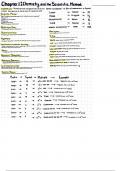
Chemistry and the Scientific Method
- Resumen • 2 páginas • 2024
- $8.39
- + aprende más y mejor
The scientific method in chemistry is a systematic approach to exploring chemical questions and phenomena. It involves making observations, forming hypotheses, conducting experiments, and analyzing results to draw conclusions. This process helps chemists develop reliable, evidence-based knowledge and refine theories about matter and its interactions.
-
Properties of Gases
- Resumen • 3 páginas • 2024
- $8.39
- + aprende más y mejor
The properties of gases cover their behavior and characteristics, including pressure, volume, temperature, and amount of gas particles. These properties are interrelated by the ideal gas law (PV = nRT), which helps predict how gases will respond to changes in conditions. Additionally, gas properties are influenced by concepts such as kinetic molecular theory, diffusion, effusion, and real gas behavior under non-ideal conditions.
-
Survival Guide to Gen Chem
- Notas de lectura • 48 páginas • 2023
- $10.49
- + aprende más y mejor
Picture perfect, satisfying to look at notes. Wether you use them to catch up in material or to study these notes are sure to have it all. From discussion worksheet solutions, in class practice problems to detailed and clear notes.