NURSING MA278

Rasmussen College

Here are the best resources to pass NURSING MA278. Find NURSING MA278 study guides, notes, assignments, and much more.

All 8 results

Sort by:

Module 06 Case Study:Articulations and Nerve Tissue
  • Case

    Module 06 Case Study:Articulations and Nerve Tissue

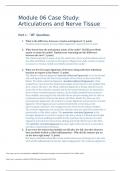
  • Part I—"Harry" Questions 1. What condition or conditions (disease/diseases) could Harry have as described in this case? Which one would be your primary diagnosis? In a very general explanation, describe this condition/disease. (1 point) My best guess is that Harry has ALS. ALS or amyotrophic lateral sclerosis, is a progressive neurodegenerative disease that affects nerve cells in the brain and the spinal cord. Muscles do not get enough nourishment and begin to atrophy. 2. Which patien...
  • greatsolutions
    $9.99 More Info
Module 08 Case Study: CNS Movement Disorders 100% Correct 2023
  • Case

    Module 08 Case Study: CNS Movement Disorders 100% Correct 2023

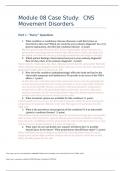
  • Part I—"Harry" Questions 1. What condition or conditions (disease/diseases) could Harry have as described in this case? Which one would be your primary diagnosis? In a very general explanation, describe this condition/disease. (1 point) My best guess is that Harry has ALS. ALS or amyotrophic lateral sclerosis, is a progressive neurodegenerative disease that affects nerve cells in the brain and the spinal cord. Muscles do not get enough nourishment and begin to atrophy. 2. Which patien...
  • greatsolutions
    $8.99 More Info
 NURSING MA278 Module 04 Case Study: Bone Tissue Exam with 100% verified2023
  • Other

    NURSING MA278 Module 04 Case Study: Bone Tissue Exam with 100% verified2023

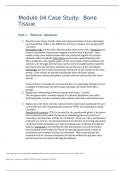
  • Part I— “Marissa” Questions 1. Describe bone tissue and the role each component plays in bone physiology and remodeling. What is the difference between compact and spongy bone? (2 points) Osteogenic cells are the stem cells that make other bone cells. Osteocytes are former osteoblasts that become trapped in matrix they deposited. They reside in tiny caves called lacunae that are connected together by narrow channels called canaliculi. Osteoblasts are the bone matrix forming cells. ...
  • greatsolutions
    $11.99 More Info
 NURSING MA278 Module 02 Case Study:Integumentary System
  • Exam (elaborations)

    NURSING MA278 Module 02 Case Study:Integumentary System

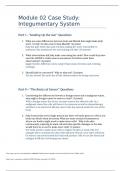
  • Part I—"Soaking Up the Sun" Questions 1. What are some differences between Judy and Mariah that might make Judy more "at risk" for skin cancer than Mariah? (2 points) Judy has pale white skin and red hair, making her more susceptible to sunburns. She mentioned she was looking red after 30 minutes. 2. What observations did Judy make concerning her mole? How could they have used the ABCDE’s of skin cancer assessment to further assist their observations? (2 points) Jagged border, di...
  • greatsolutions
    $9.99 More Info
 NURSING MA278 Module 04 Case Study: Bone Tissue
  • Other

    NURSING MA278 Module 04 Case Study: Bone Tissue

  • Part I— “Marissa” Questions 1. Describe bone tissue and the role each component plays in bone physiology and remodeling. What is the difference between compact and spongy bone? (2 points) Osteogenic cells are the stem cells that make other bone cells. Osteocytes are former osteoblasts that become trapped in matrix they deposited. They reside in tiny caves called lacunae that are connected together by narrow channels called canaliculi. Osteoblasts are the bone matrix forming cells. ...
  • Studygreatsolutions
    $10.99 More Info
 NURSING MA278 Module 08 Case Study: CNS Movement Disorders
  • Other

    NURSING MA278 Module 08 Case Study: CNS Movement Disorders

  • Part I—"Harry" Questions 1. What condition or conditions (disease/diseases) could Harry have as described in this case? Which one would be your primary diagnosis? In a very general explanation, describe this condition/disease. (1 point) My best guess is that Harry has ALS. ALS or amyotrophic lateral sclerosis, is a progressive neurodegenerative disease that affects nerve cells in the brain and the spinal cord. Muscles do not get enough nourishment and begin to atrophy. 2. Which patien...
  • Studygreatsolutions
    $10.99 More Info
Articulations and Nerve Tissue /Module 06 Case Study:Articulations and Nerve Tissue
  • Case

    Articulations and Nerve Tissue /Module 06 Case Study:Articulations and Nerve Tissue

  • Part I— “Jill” Questions 1. What is the difference between a tendon and ligament? (1 point) Tendons attach muscle to bone while Ligaments connect bone to bone 2. What bones form the articulation (joint) of the ankle? Did Jill most likely sprain or strain her ankle? Explain your reasoning and the difference between the two? (1 point) The Talocrural joint is made of up the talus bone (heel) and the distal ends of the tibia and fibula. A sprain is the injury of ligaments while a strain...
  • Studygreatsolutions
    $10.99 More Info
Module 02 Case Study: Integumentary System Case Study
  • Case

    Module 02 Case Study: Integumentary System Case Study

  • Part I—"Soaking Up the Sun" Questions 1. What are some differences between Judy and Mariah that might make Judy more "at risk" for skin cancer than Mariah? (2 points) Judy has pale white skin and red hair, making her more susceptible to sunburns. She mentioned she was looking red after 30 minutes. 2. What observations did Judy make concerning her mole? How could they have used the ABCDE’s of skin cancer assessment to further assist their observations? (2 points) Jagged border, di...
  • Studygreatsolutions
    $9.99 More Info
Make study stress less painful
Study stress? For sellers on Stuvia, these are actually golden times. KA-CHING! Earn from your study resources too and start uploading now.