
AQA
Las últimas cargas en AQA. ¿Buscando notas en AQA? Tenemos muchas notas, guias de estudio y notas de estudio disponsible para tu escuela.
-
34287
-
403
-
5860
Estudios @ AQA
Notas disponibles para los estudios siguiente en AQA
-
A Level Biology
-
A Level Chemistry
-
A level English Literature B
-
Business - Marketing
-
Engineering - Design
-
Engineering - Mechatronics
-
Engineering - Power networks
-
English Literature
-
History
-
IT - Cyber Security
-
IT - Networking
-
IT - Programming
-
IT - User support
-
Psychology
-
Video Games
Libros populares AQA

David Ferry, Angela Anderson • ISBN 9781471837586

Sally Waller, Chris Rowe • ISBN 9780198354604

Cara Flanagan, Dave Berry, Matt Jarvis, Rob Liddle • ISBN 9781908682413

Margaret Atwood, Margaret Atwood • ISBN 9781784874872

Carl Atherton, Sue Young • ISBN 9781510473478
Dan Cardinal, Gerald Jones • ISBN 9781510451995
David Ferry, Tony Imperato • ISBN 9781471837500
CGP Books • ISBN 9781847623232
Anthony Webster, Robert J. Carr • ISBN 9780198354635
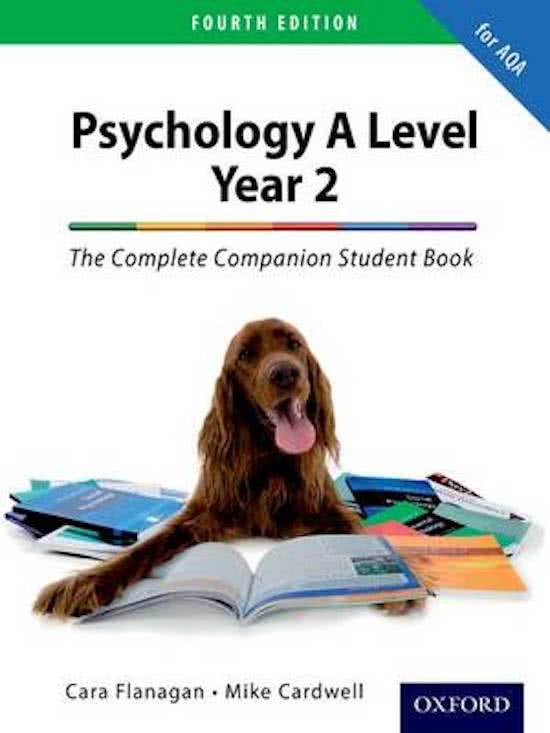
Mark Cardwell, Cara Flanagan • ISBN 9780198338680
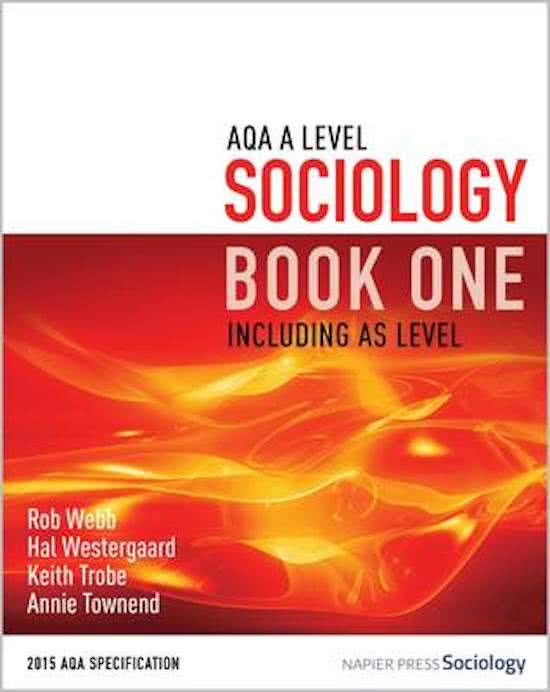
Rob Webb, Hal Westergaard • ISBN 9780954007911

J Daniels, Kat Kearey • ISBN 9780198354727

William Shakespeare • ISBN 9781853260186
Último contenido AQA
In English law, Necessity is a controversial and strictly limited common law defence where a defendant argues that they committed a crime to prevent a greater evil from occurring. Unlike self-defence, which is a response to an external threat from a person, necessity usually arises from a choice between two unavoidable harms. For many years, the courts were reluctant to recognize it at all, famously ruling in Re A (Conjoined Twins) that for the defence to succeed, the act must be necessary to av...
- Resumen
- • 6 páginas's •
-
AQA•Unit 3 LAW03 - Criminal Law or Contract Law
In English law, Murder is a common law offence defined by Lord Coke as the unlawful killing of a reasonable creature in being and under the King's (or Queen's) peace, with malice aforethought. The actus reus requires that the defendant’s conduct was the factual and legal cause of the victim's death. The mens rea, known as malice aforethought, is unique because it can be satisfied by either an express intent to kill or an implied intent to cause grievous bodily harm (GBH) (R v Vickers)...
- Resumen
- • 3 páginas's •
-
AQA•Unit 3 LAW03 - Criminal Law or Contract Law
In criminal law, Mens Rea (the "guilty mind") refers to the mental element required at the time of the actus reus to establish criminal liability. It ensures that individuals are punished for their intentions or recklessness rather than for mere accidents. The levels of mens rea exist on a hierarchy of culpability: Direct Intent is the highest form, where the prohibited consequence is the defendant's specific objective (R v Mohan), while Oblique Intent applies when a result is a virtual...
- Resumen
- • 2 páginas's •
-
AQA•Unit 3 LAW03 - Criminal Law or Contract Law
ross Negligence Manslaughter (GNM) is an involuntary manslaughter offence where a defendant causes death through an extreme level of negligence, despite lacking the specific intent to kill or cause GBH. As established in R v Adomako (1994), the prosecution must prove four key elements: the existence of a duty of care (based on the "neighbor principle" from Donoghue v Stevenson), a breach of that duty which creates a serious and obvious risk of death, and that this breach actually caused th...
- Resumen
- • 4 páginas's •
-
AQA•Unit 3 LAW03 - Criminal Law or Contract Law
In English law, the coincidence of actus reus and mens rea (also known as the contemporaneity rule) dictates that for a crime to be committed, the physical act and the guilty mind must occur at the same time. However, to prevent defendants from escaping liability on technicalities, the courts have developed two key doctrines to "stretch" this timing. The first is the continuing act theory, where the actus reus is viewed as a single, ongoing event; if the defendant develops the mens rea ...
- Resumen
- • 1 páginas's •
-
AQA•Unit 3 LAW03 - Criminal Law or Contract Law
While often grouped under the single label of "Common Assault," Assault and Battery are distinct legal concepts distinguished by the presence or absence of physical contact. Assault is a non-physical offence where the defendant's actions or words cause the victim to fear the imminent application of unlawful force; the harm is purely psychological, rooted in the victim’s apprehension of an attack. In contrast, Battery is defined by the actual application of unlawful physical force, whi...
- Resumen
- • 1 páginas's •
-
AQA•Unit 3 LAW03 - Criminal Law or Contract Law
In criminal law, breaking the chain of causation (also known as novus actus interveniens) refers to an intervening event that is so significant it relieves the defendant of legal responsibility for the ultimate consequence. While the defendant may satisfy factual causation—the "but for" test—the chain of legal causation must remain unbroken from the initial act to the final prohibited result. For an event to break the chain, it must be "free, deliberate, and informed" (R v Pagett...
- Resumen
- • 3 páginas's •
-
AQA•Unit 3 LAW03 - Criminal Law or Contract Law
The defendant must prove that this defect caused them to either not know the nature and quality of their act (they didn't understand what they were physically doing) or, if they did know, that they did not know what they were doing was wrong in the legal sense (R v Windle). Unlike most criminal defences where the prosecution must disprove it, the burden of proof for insanity rests on the defence on the balance of probabilities. If successful, the verdict is "Not Guilty by Reason of Insanit...
- Resumen
- • 5 páginas's •
-
AQA•Unit 3 LAW03 - Criminal Law or Contract Law
In English law, Attempted Offences are governed by Section 1(1) of the Criminal Attempts Act 1981, which defines an attempt as an act that is "more than merely preparatory" to the commission of a full offence. This legal framework allows the justice system to intervene before a crime is completed, provided the defendant has moved beyond the planning stage and into the execution phase. The actus reus requires a significant step toward the crime—such as standing outside a door with a lo...
- Resumen
- • 3 páginas's •
-
AQA•Unit 3 LAW03 - Criminal Law or Contract Law
This summary defines Assault and Battery as the two least serious non-fatal offences against the person, collectively categorized as "Common Assault" under Section 39 of the Criminal Justice Act 1988. Assault is a summary offence committed when a defendant intentionally or recklessly causes a victim to apprehend immediate, unlawful personal violence; notably, no physical contact is required, as the harm lies in the psychological fear of imminent force. In contrast, Battery involves the ...
- Resumen
- • 2 páginas's •
-
AQA•Unit 3 LAW03 - Criminal Law or Contract Law
Occupiers' Liability is a branch of negligence that deals with the duty of care owed by those who occupy land or premises to those who enter them. In the UK, this is governed by two separate statutes: the 1957 Act (for lawful visitors) and the 1984 Act (for trespassers). The core of any claim depends on identifying the Occupier (the person with "sufficient control" over the premises, per Wheat v E Lacon & Co) and the Premises (any fixed or moveable structure, including vessels, vehic...
- Resumen
- • 4 páginas's •
-
AQA•Unit 4 LAW04 - Criminal Law or Tort, and Concepts of Law
In general tort law (including Negligence and Private Nuisance), defendants can rely on several "General Defences." These are distinct from the specific statutory protections found in Occupiers' Liability, though they share the same underlying legal logic.
- Resumen
- • 3 páginas's •
-
AQA•Unit 4 LAW04 - Criminal Law or Tort, and Concepts of Law
ULTIMATE A* ALEVEL NOTES. This in-depth summary of MBIT from the AQA philosophy A-level syllabus follows the specification. The summary provides general tips and how to structure and include these details in an essay. Summary also includes some other philosophers off the spec but included in textbooks. (for higher marks)
- Package deal
- Resumen
- • 5 páginas's •
-
AQA•Metaphysics of mind
-
Metaphysics of Mind - ULTIMATE A* ALEVEL NOTES• Poreholgate
ULTIMATE A* ALEVEL NOTES. This in-depth summary of EM from the AQA philosophy A-level syllabus follows the specification. The summary provides general tips and how to structure and include these details in an essay. Summary also includes some other philosophers off the spec but included in textbooks. (for higher marks)
- Package deal
- Resumen
- • 4 páginas's •
-
AQA•Metaphysics of mind
-
Metaphysics of Mind - ULTIMATE A* ALEVEL NOTES• Poreholgate
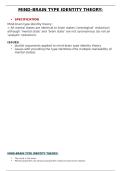
ULTIMATE A* ALEVEL NOTES. This in-depth summary of MBIT from the AQA philosophy A-level syllabus follows the specification. The summary provides general tips and how to structure and include these details in an essay. Summary also includes some other philosophers off the spec but included in textbooks. (for higher marks)
- Package deal
- Resumen
- • 3 páginas's •
-
AQA•Metaphysics of mind
-
Metaphysics of Mind - ULTIMATE A* ALEVEL NOTES• Poreholgate
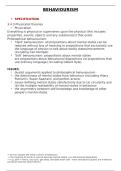
ULTIMATE A* ALEVEL NOTES. This in-depth summary of behaviourism from the AQA philosophy A-level syllabus follows the specification. The summary provides general tips and how to structure and include these details in an essay. Summary also includes some other philosophers off the spec but included in textbooks. (for higher marks)
- Package deal
- Resumen
- • 4 páginas's •
-
AQA•Metaphysics of mind
-
Metaphysics of Mind - ULTIMATE A* ALEVEL NOTES• Poreholgate
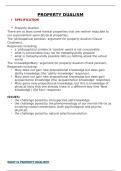
ULTIMATE A* ALEVEL NOTES. This in-depth summary of property dualism from the AQA philosophy A-level syllabus follows the specification. The summary provides general tips and how to structure and include these details in an essay. Summary also includes some other philosophers off the spec but included in textbooks. (for higher marks)
- Package deal
- Resumen
- • 5 páginas's •
-
AQA•Metaphysics of mind
-
Metaphysics of Mind - ULTIMATE A* ALEVEL NOTES• Poreholgate
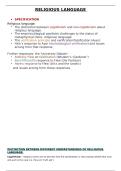
ULTIMATE A* ALEVEL NOTES. This in-depth summary of religious language arguments from the AQA philosophy A-level syllabus follows the specification: Cognitivism vs non-cognitivism, logical positivism, verification principle, eschatological verification, flew falsification, Mitchell's response - Partisan, Hare's response - bliks. The summary provides general tips and how to structure and include these details in an essay. Summary also includes some other philosophers off the spec but included in t...
- Package deal
- Resumen
- • 11 páginas's •
-
AQA•Metaphysics of God
-
Metaphysics of God - ULTIMATE A* ALEVEL NOTES• Poreholgate
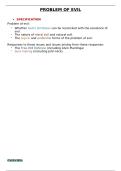
ULTIMATE A* ALEVEL NOTES. This in-depth summary of problem of evil arguments from the AQA philosophy A-level syllabus follows the specification: Can God's attributes be reconciled, moral evil/natural evil, logical and evidential forms, freewill defence and soul-making - Hick. The summary provides general tips and how to structure and include these details in an essay. Summary also includes some other philosophers off the spec but included in textbooks. (for higher marks)
- Package deal
- Resumen
- • 10 páginas's •
-
AQA•Metaphysics of God
-
Metaphysics of God - ULTIMATE A* ALEVEL NOTES• Poreholgate
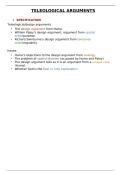
This in-depth summary of teleological arguments from the AQA philosophy A-level syllabus follows the specification: Hume, Paley and Swinburne's design argument, Hume's objections from analogy, spatial disorder, unique case and if God is best or only explanation. The summary provides general tips and how to structure and include these details in an essay. Summary also includes some other philosophers off the spec but included in textbooks. (for higher marks)
- Package deal
- Resumen
- • 8 páginas's •
-
AQA•Metaphysics of God
-
Metaphysics of God - ULTIMATE A* ALEVEL NOTES• Poreholgate