

Biochemistry
Las últimas cargas en Biochemistry. ¿Buscando notas en Biochemistry? Tenemos muchas notas, guias de estudio y notas de estudio disponsible para tu escuela.
-
3249
-
2
-
212
All courses for Biochemistry
-
Biochemistry 3204
-
Biochemistry ( 1
-
Biochemistry / 2
-
Biochemistry | 1
-
BIOCHEMISTRY, 10
-
Biochemistry: 2
-
Biochemistry//// 1
Último contenido Biochemistry
Major Classes of Biological molecules carbohydrates, lipids, proteins, nucleic acids Elements found in biological molecules H, Na, Mg, K, Ca, C, N, O, P, S, Cl, V, Cr, Mn, Fe, Co, Ni, Cu, Zn, Se, I, Mo, W Common functional groups in biological molecules -Methyl -Ethyl -Phenyl -Carbonyl -Ether -Ester -Acetyl -Anhydride -Guanidinium -Imidazole -Sulfhydryl -Disulfide Name common linkages in biological molecules Structural features of carbohydrates Linear but most of the times for...
- Examen
- • 13 páginas's •
-
BIOCHEMISTRY•BIOCHEMISTRY
Conversion of CO2 to organic compounds by a wide variety of living organisms is referred to as A. photoablation. B. ossification. C. photosynthesis. D. sequestration. E. carbon fixation E. carbon fixation Reduced molecules become _____ upon donating an electron in a redox reaction. A. saturated B. bound to oxygen C. oxidized D. reduced C. oxidized Given equal masses (the same number of moles of a compound), which phase of matter has the greatest entropy? Gas Which of the follo...
- Examen
- • 22 páginas's •
-
BIOCHEMISTRY•BIOCHEMISTRY
weaker the higher the dielectric constant, the (stronger/weaker) the interaction between charges stronger alcohol causes dehydration, which leads to (stronger/weaker) charges in the body cooling high heat capacity of water has what affect on the body? high heat of vaporization what property of water helps prevent dehydration? high does water have a high or low dielectric constant? clathrate molecules of one component are physically trapped within the crystal structure of another (ex. ...
- Package deal
- Examen
- • 16 páginas's •
-
BIOCHEMISTRY•BIOCHEMISTRY
-
BIOCHEMISTRY LATEST COMPILED QUESTIONS AND ANSWERS• PorAcademicSuperStore
In a bacterial cell, the DNA is in the: A) cell envelope. B) cell membrane. C) nucleoid. D) nucleus. E) ribosomes. C) nucleoid. A major change occurring in the evolution of eukaryotes from prokaryotes was the development of: A) DNA. B) photosynthetic capability. C) plasma membranes. D) ribosomes. E) the nucleus. E) the nucleus. In eukaryotes, the nucleus is enclosed by a double membrane called the: A) cell membrane. B) nuclear envelope. C) nucleolus. D) nucleoplasm. E) nucleos...
- Package deal
- Examen
- • 29 páginas's •
-
BIOCHEMISTRY•BIOCHEMISTRY
-
BIOCHEMISTRY LATEST COMPILED QUESTIONS AND ANSWERS• PorAcademicSuperStore
Thermodynamics the study of energy transformations first law of thermodynamics -Interconverted -Energy is conserved second law of thermodynamics Universe tends towards maximum disorder -All physical and chemical processes -Maintain homeostasis Entropy -Change in randomness or disorder of reactants to products Enthalpy the heat content of a system Bioenergetics The field of bio chem concerned with energy free energy energy that is available to do work - Approaches 0 as equilibriu...
- Package deal
- Examen
- • 17 páginas's •
-
BIOCHEMISTRY•BIOCHEMISTRY
-
BIOCHEMISTRY LATEST COMPILED QUESTIONS AND ANSWERS• PorAcademicSuperStore
When delta G is negative, which of the following is not true? A) it favors products B) it gives off heat C) it is spontaneous D) it is instantaneous E) it is exergonic it is not instantaneous Which of the following does not contain a carbonyl? A) ester B) carboxylic acid C) ketone D) ether E) amide ether Which of the following is not a protein? A) albumin B) collagen C) cellulose D) peptide hormones E) enzymes cellulose What is hydrolysis? breakdown of large molecules...
- Package deal
- Examen
- • 22 páginas's •
-
BIOCHEMISTRY•BIOCHEMISTRY
-
BIOCHEMISTRY LATEST COMPILED QUESTIONS AND ANSWERS• PorAcademicSuperStore
How are biochemicals and organic compounds related? All biochemicals are organic compounds, but not all organic compounds are biochemicals What elements do biochemicals contain? C, H, O, N, P, S What is the broad role of biochemicals in the human body? Regulating our bodies to maintain homeostasis What is homeostasis? A biochemical process by which the internal steady state between the different chemical and physical processes When the body is maintaining homeostasis, what is normal.... ...
- Package deal
- Examen
- • 22 páginas's •
-
BIOCHEMISTRY•BIOCHEMISTRY
-
BIOCHEMISTRY LATEST COMPILED QUESTIONS AND ANSWERS• PorAcademicSuperStore
prokaryotes include how many domains of life? what are they? two, archaea and bacteria 95% of the cell is made up of what elements? O,C,H,N what are prokaryotes exclusively? single cell organisms why are prokaryotes more adaptable to changing environments? what does this allow them to do? simplicity and rapid cell division allows them to evolve to colonize extreme environments 4 classes of monomers? 1. amino acids 2. monosaccharides 3. nucleotides 4. lipids amino acids components? p...
- Package deal
- Examen
- • 27 páginas's •
-
BIOCHEMISTRY•BIOCHEMISTRY
-
BIOCHEMISTRY LATEST COMPILED QUESTIONS AND ANSWERS• PorAcademicSuperStore
BIOCHEMISTRY Study Guides compiled () 2. 2. Enzymes that digest the triacylglycerols into 2 free fatty acids and monoa- cylglycerol are called a. hydrolyases. b. peptidases. c. reductases. d. lipases. e. glycolyases.: d 3. 3. Caloric homeostasis or the ability to maintain adequate energy stores is regulated by different hormones. What is the function of glucagon-like peptide (GLP-1) in this process? GLP-1 a. is produced and released by the
- Examen
- • 95 páginas's •
-
Biochemistry•Biochemistry

Nucleoid - Correct Answers: The region in a bacterial cell where the DNA is located, not enclosed by a membrane. Eukaryotes - Correct Answers: Organisms with cells containing a true nucleus enclosed by a nuclear envelope. Nuclear envelope - Correct Answers: The double membrane structure that encloses the nucleus in eukaryotic cells. Cell dimensions - Correct Answers: Living cells usually have lengths and diameters in the range of 0.1 μm to 100 μm. Archaea - Correct Answers: A ...
- Examen
- • 8 páginas's •
-
Biochemistry•Biochemistry

Unlock the secrets of the Krebs cycle with our comprehensive, easy-to-read notes! Our notes offer: - Clear, concise explanations simplifying each step. - Highly reliable, up-to-date information. - Neat, professional formatting for optimal learning. - Detailed insights into key enzymes, intermediates, and energy yield. - Bonus mnemonics and real-life applications to aid understanding. Perfect for students and exam preparation, these notes provide a thorough understanding of the Krebs cy...
- Notas de lectura
- • 8 páginas's •
-
Biochemistry•Biochemistry

Unlock the secrets of the Electron Transport Chain with our comprehensive, easy-to-read notes! Our notes offer: - Clear, concise explanations simplifying each step. - Highly reliable, up-to-date information. - Neat, professional formatting for optimal learning. - Detailed insights into key components and energy production. - Bonus coverage of glycogen metabolism, the HMP shunt, and gluconeogenesis. Perfect for students and exam preparation, these notes provide a thorough understanding ...
- Notas de lectura
- • 24 páginas's •
-
Biochemistry•Biochemistry
Biochemistry Questions - Principles of Biochemistry by Lehninger| Revision exam fall 2024 Which of the following functional groups is specific to an alcohol? **** -OH The main difference between prokaryotic and eukaryotic cells is the existence of _______ in eukaryotes. **** the nucleus Which of the following organelles does not have a double membrane?
- Examen
- • 5 páginas's •
-
Biochemistry•Biochemistry
BIOCHEMISTRY CHAPTER 18 EXAM QUESTIONS WITH CORRECT ANSWERS 100% 2024
- Package deal
- Examen
- • 6 páginas's •
-
BIOCHEMISTRY•BIOCHEMISTRY
-
Package deal for BMAT SECTION 3 CASE STUDIES EXAM WITH CORRECT ANSWERS 100% 2024• PorElitaa
PORTAGE LEARNING BIOCHEM MODULE 5 EXAM LATEST QUESTIONS AND ANSWERS GRADED A+ 1. glycerol contains how many carbon atoms?: 3 2. fatty acids contain how many carbons?: 8-30 3. which of the following are derived from or made from fatty acids? a. cholesterol b. carotenoids c. phosphoglycerides d. A and B e. A and C: c. phosphoglycerides 4. what lipids are derived from fatty acids?: phosphoglycerides sphingolipids triacylglycerols
- Examen
- • 6 páginas's •
-
Biochemistry•Biochemistry

Biochemistry SHELF Revised Questions and Correct Answers Graded A++ branched amino acids Val, leu, ile essential amino acids PVT TIM HALL -OH amino acids Tyr, Ser, Thr Maple syrup urine disease: deficiency of Alpha-keto acid dehydrogenase Lesch-Nyhan syndrome Deficiency in hypoxanthine-guanine phosphoribosyl transferase. Defect in purine salvage reactions. Orange sand urine, self-mutilation and mental retardation. PKU Phe hydroxylase deficiency. Need cofactor BH4; mental retardatio...
- Examen
- • 17 páginas's •
-
Biochemistry•Biochemistry

Amino acid metabolism is a complex and essential process in the human body that involves the interconversion of amino acids for various physiological functions. Amino acids serve as the building blocks of proteins, neurotransmitters, and other important molecules. Through processes like transamination and deamination, amino acids can be modified to produce energy, synthesize new proteins, or generate other important compounds. The liver plays a central role in amino acid metabolism by regula...
- Resumen
- • 69 páginas's •
-
Biochemistry•Biochemistry
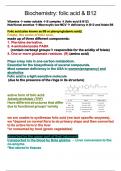
Introduction: Folic acid and vitamin B12, two water-soluble vitamins, are integral components of human nutrition, playing crucial roles in various biochemical pathways essential for cellular health and function. Their interdependent relationship underscores the complexity of one-carbon metabolism and underscores the significance of maintaining adequate levels of these vitamins for overall well-being. This summary aims to provide a comprehensive overview of the biochemistry of folic acid and v...
- Resumen
- • 6 páginas's •
-
biochemistry•biochemistry
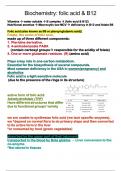
Introduction: Folic acid and vitamin B12, two water-soluble vitamins, are integral components of human nutrition, playing crucial roles in various biochemical pathways essential for cellular health and function. Their interdependent relationship underscores the complexity of one-carbon metabolism and underscores the significance of maintaining adequate levels of these vitamins for overall well-being. This summary aims to provide a comprehensive overview of the biochemistry of folic acid and v...
- Resumen
- • 6 páginas's •
-
biochemistry•biochemistry
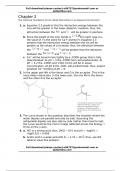
name:solution manual for Biochemistry: Concepts and Connections 2nd Global Edition by Dean R. Appling Edition:2nd Global Edition author:by Dean R. Appling ISBN: 9781292267203 type:solution manual format:word/zip All chapter include
- Resumen
- • 4 páginas's •
-
Biochemistry•Biochemistry