

12 class
Las últimas cargas en 12 class. ¿Buscando notas en 12 class? Tenemos muchas notas, guias de estudio y notas de estudio disponsible para tu escuela.
-
237
- 0
-
5
All courses for 12 class
Último contenido 12 class
Interstitial compounds form when small atoms, such as hydrogen, boron, nitrogen, or carbon, occupy the spaces (interstices) between metal atoms in a lattice. These compounds, often involving transition metals, retain the host metal’s structure but gain enhanced hardness, strength, and conductivity. Examples include titanium carbide (TiC) and vanadium hydride (VHₓ), widely used in cutting tools, coatings, and hydrogen storage. Interstitial compounds exhibit high melting points, chemical stabi...
- Book
- Notas de lectura
- • 1 páginas's •
-
12 class•12 class
-
NCERT Examplar Chemistry Class 12th • Ramashish Paul• ISBN 9789351764649
Alloy formation occurs when two or more metals, or a metal and a nonmetal, are combined to enhance properties like strength, corrosion resistance, and conductivity. Alloys are classified as substitutional (atoms of similar size replace each other, e.g., brass) or interstitial (smaller atoms fit between metal atoms, e.g., steel). Common alloys include steel (iron and carbon), bronze (copper and tin), and aluminum alloys (with magnesium or silicon). Alloying alters hardness, malleability, and ther...
- Book
- Notas de lectura
- • 1 páginas's •
-
12 class•12 class
-
NCERT Examplar Chemistry Class 12th • Ramashish Paul• ISBN 9789351764649
Transition element compounds are formed by d-block elements, known for their variable oxidation states, colored compounds, and catalytic properties. These metals, like iron, copper, and chromium, form ionic and coordination compounds with ligands, leading to complex structures. Their ability to exhibit multiple oxidation states makes them essential in redox reactions and industrial catalysis (e.g., vanadium in sulfuric acid production). Many transition metal compounds display vibrant colors due ...
- Book
- Notas de lectura
- • 1 páginas's •
-
12 class•12 class
-
NCERT Examplar Chemistry Class 12th • Ramashish Paul• ISBN 9789351764649
Metal oxides and oxyanions are compounds containing metal cations bonded with oxygen. Metal oxides can be basic (reacting with acids), acidic (reacting with bases), or amphoteric (reacting with both). They are widely used in catalysis, ceramics, and electronics. Oxyanions are negatively charged ions containing oxygen and a central metal or nonmetal, such as chromate (CrO₄²⁻) or permanganate (MnO₄⁻). These play key roles in redox reactions, corrosion processes, and environmental chemistr...
- Book
- Notas de lectura
- • 1 páginas's •
-
12 class•12 class
-
NCERT Examplar Chemistry Class 12th • Ramashish Paul• ISBN 9789351764649
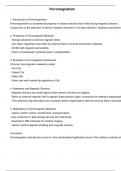
Ferromagnetism is a property of materials like iron, cobalt, and nickel, where atomic magnetic moments align in the same direction, creating strong, permanent magnetism. This alignment occurs due to exchange interactions between electrons. Ferromagnetic materials retain their magnetism even after an external magnetic field is removed, making them useful in magnets, transformers, and data storage devices. The magnetization decreases above the Curie temperature, where thermal energy disrupts align...
- Book
- Notas de lectura
- • 1 páginas's •
-
12 class•12 class
-
NCERT Examplar Chemistry Class 12th • Ramashish Paul• ISBN 9789351764649
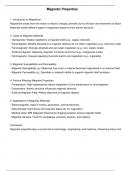
Magnetic properties describe how materials respond to a magnetic field. They are classified into five main types: ferromagnetic, paramagnetic, antiferromagnetic, ferrimagnetic, and diamagnetic. Ferromagnetic materials, like iron and nickel, exhibit strong, permanent magnetism. Paramagnetic materials, such as aluminum, show weak attraction to magnetic fields but do not retain magnetism. Antiferromagnetic materials, like manganese oxide, have opposing magnetic moments that cancel out. Ferrimagneti...
- Book
- Notas de lectura
- • 1 páginas's •
-
12 class•12 class
-
NCERT Examplar Chemistry Class 12th • Ramashish Paul• ISBN 9789351764649
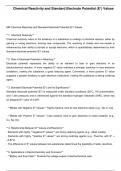
Chemical reactivity and electrode potential of elements are influenced by ionization energy, oxidation states, and hydration energy. Transition metals exhibit variable reactivity due to their d-orbitals and multiple oxidation states. Their standard electrode potentials (E° values) determine their tendency to gain or lose electrons in redox reactions. Metals with negative E° values (e.g., Zn, Fe) are strong reducing agents, while those with positive E° values (e.g., Cu, Ag) are less reactive. ...
- Book
- Notas de lectura
- • 2 páginas's •
-
12 class•12 class
-
NCERT Examplar Chemistry Class 12th • Ramashish Paul• ISBN 9789351764649
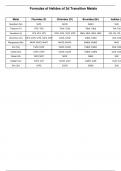
The halides of 3d transition metals exhibit variable oxidation states and bonding characteristics. Lower oxidation states (e.g., FeCl₂, CuCl) form predominantly ionic halides, while higher oxidation states (e.g., TiCl₄, VF₅) lead to covalent halides. Fluorides tend to be more ionic due to fluorine’s high electronegativity, whereas chlorides, bromides, and iodides show increasing covalent character. Stability of higher oxidation states decreases across the series, with later elements favo...
- Book
- Notas de lectura
- • 1 páginas's •
-
12 class•12 class
-
NCERT Examplar Chemistry Class 12th • Ramashish Paul• ISBN 9789351764649
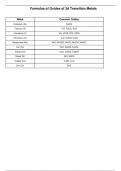
The oxides of 3d transition metals exhibit variable oxidation states, leading to diverse chemical and physical properties. Lower oxidation states (e.g., TiO, FeO) are typically basic, while higher oxidation states (e.g., Mn₂O₇, CrO₃) are acidic. Intermediate oxides, such as Fe₃O₄ and Mn₃O₄, show amphoteric behavior. The stability of oxidation states increases across the series, with early metals favoring higher oxidation states (e.g., TiO₂) and later metals preferring lower ones ...
- Book
- Notas de lectura
- • 1 páginas's •
-
12 class•12 class
-
NCERT Examplar Chemistry Class 12th • Ramashish Paul• ISBN 9789351764649
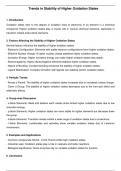
Higher oxidation states in elements show systematic trends across the periodic table. In transition metals, oxidation states increase across a period due to higher availability of valence electrons but decrease down a group as heavier elements favor lower oxidation states due to inert pair effect. The highest oxidation states are found in the middle transition metals (e.g., Mn⁷⁺ in MnO₄⁻). p-block elements also show variable oxidation states, with heavier elements like Pb and Bi preferri...
- Book
- Notas de lectura
- • 2 páginas's •
-
12 class•12 class
-
NCERT Examplar Chemistry Class 12th • Ramashish Paul• ISBN 9789351764649