
The Urinary System
Wednesday, 26 November 2025 15:12
Kidney functions
• The kidneys have multiple homeostatic roles beyond simply excreting water and electrolytes:
1. Excretion of metabolic wastes and foreign substances
○ Urea, creatinine, uric acid, bilirubin, drugs, and toxins.
2. Regulation of water and electrolytes
○ Adjusting excretion to match intake and maintaining balance even with large fluctuations in sodium or water
intake.
3. Regulation of body fluid osmolality and electrolyte concentrations.
4. Regulation of arterial pressure.
○ Long term regulation through sodium and water excretion.
○ Short term regulation through secreting hormones or vasoactive substances (such as renin).
5. Acid-base balance.
○ Excreting acids and regulating buffers.
6. Hormone metabolism and production.
○ Including 1,25-dihydroxyvitamin D3 (calcitriol) for calcium regulation, erythroprotein and renin.
7. Gluconeogenesis.
○ Producing glucose during prolonged fasting.
-------------------------------------------------------------------------------------------------------------------------------------
Anatomy of the kidney
--------------------------------------------------------------------------------------------------------------------------------------
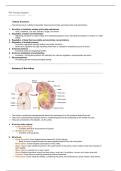
• The kidney is positioned retroperitoneal (behind the peritoneum) on the posterior abdominal wall.
• They have a paravertrebral position (next to vertebrae/spine) and are protected by the lowest two ribs.
• They are connected to the bladder, via the ureter.
► It has two main regions:
1. Cortex (outer layer)
§ Contains glomeruli and portions of tubules.
2. Medulla (inner layer)
§ Contains renal pyramids.
► Structures:
→ Renal Pyramids: cone-shaped tissue masses (8–10 per kidney).
→ Base at cortex-medulla border and apex (papilla) projects into the renal pelvis.
→ Renal pelvis: Funnel-shaped continuation of the ureter.
→ Major calyse: open ended pouches on the outer border of the pelvis, which collect urines from tubules of
each papilla.
→ Minor calyce: extends from major calyce.
→ Hilum: Medial indentation where the renal artery, renal vein, lymphatics, nerves, and ureter enter/exit.
→ Capsule: Tough fibrous covering protecting internal structures.
→ Renal sinus: cavity inside the kidney, containing the pelvis, the intrarenal fat, lymph vessel s and nerves.
→ Walls of calyces, pelvis and ureter have contractile elements to propel urine toward the bladder.
• Kidneys are connected to the abdominal aorta and inferior vena cava.
, → Minor calyce: extends from major calyce.
→ Hilum: Medial indentation where the renal artery, renal vein, lymphatics, nerves, and ureter enter/exit.
→ Capsule: Tough fibrous covering protecting internal structures.
→ Renal sinus: cavity inside the kidney, containing the pelvis, the intrarenal fat, lymph vessel s and nerves.
→ Walls of calyces, pelvis and ureter have contractile elements to propel urine toward the bladder.
• Kidneys are connected to the abdominal aorta and inferior vena cava.
► Blood Supply:
• Renal blood flow is about 22% of cardiac output (~1100 mL/min).
• The renal artery enters the kidney through the hilum.
• Blood flow from renal artery to:
○ Interlobar arteries → segmental arteries → arcuate arteries → interlobular (radial) arteries → afferent arterioles
→ glomerular capillaries.
○ Branches of the interlobular arteries are the afferent arterioles which enter the glomerulus at the vascular
pole.
○ There may be more than one renal artery per kidney.
• Venous return:
○ Peritubular capillaries → interlobular veins → arcuate veins → interlobar veins → renal vein → inferior vena
cava.
○ There are no segmental veins.
• Unique feature: two capillary beds in series
○ The distal ends of the capillaries of each glomerulus merge to form the efferent arteriole, which leads to a
second capillary network, the peritubular capillaries, that surrounds the renal tubules.
○ Glomerular capillaries: High hydrostatic pressure (~60 mmHg) for filtration.
○ Peritubular capillaries: Low pressure (~13 mmHg) for reabsorption.
○ Efferent arteriole separates the two beds and regulates hydrostatic pressures.
§ Arteriolar resistance adjustments allow kidneys to control filtration and reabsorption based on
homeostatic needs.
• Glomerular capillary beds are special due to:
1. High Mean Hydrostatic Pressure
• The glomerulus is located between two arterioles (afferent and efferent), rather than between an arteriole
and venule like most capillaries.
• This maintains a consistently high hydrostatic pressure throughout the capillary bed.
2. Filtration Pressure Stays Positive Along the Entire Capillary Length
• Because hydrostatic pressure remains high and does not fall significantly along the glomerular
capillaries,
the net filtration pressure stays positive from the beginning to the end of the capillary.
• This means filtration occurs along the entire length of the glomerular capillary—not absorption.
3. Extremely High Permeability (Kf)
• Due to filtration barrier properties.
• Renal microvasculature has two points of resistance control; the afferent arteriole and the efferent arteriole.
→ This, in addition with the 2 capillary beds in series results in a steep pressure drop in both arterioles.
→ Constriction of afferent vs efferent arterioles:
Change RBF P_gc GFR
Afferent constriction ↓↓↓ ↓ ↓↓↓
Mild efferent constriction ↓ ↑ ↑
Severe efferent constriction ↓↓↓ ↓ (oncotic ↑) ↓
→ With mild efferent constriction: blood backs up in the glomerulus → increased pressure → more filtration.
→ With severe efferent constriction: severely reduced flow, plasma proteins become concentrated → ↑
oncotic pressure opposing filtration → GFR falls.
, -------------------------------------------------------------------------------------------------------------------
Nephrons
• Nephrons are the functional unit of the kidney.
• Each kidney contains 800,000–1,000,000 nephrons.
• Each nephron contains:
• Renal Corpuscle: tuft of fenestrated capillaries called glomerulus, with high hydrostatic pressure (~60 mmHg) for
filtration of blood.
○ Encased in Bowman’s capsule.
• Tubule system: filtered fluid is converted into urine on its way to the pelvis from the kidney.
○ Proximal tubule: reabsorbs most filtered fluid and solutes (65–70% of Na⁺, water., and all glucose and
amino acids).
§ In cortex.
§ Many mitochondria.
○ Loop of Henle: has a descending and ascending limbs; thin segment (low walls) and thick ascending limb.
§ Dips into renal medulla
§ Thin segment: the descending limb and lower end of the ascending limb (walls are thin).
§ Thick segment: after the ascending limb of the loop returns to the cortex, its wall becomes much
thicker.
○ Macula densa: specialized cells at end of thick ascending limb, regulating nephron function.
○ Distal tubule: continues in cortex, leads to connecting tubule → cortical collecting tubule → cortical
collecting duct.
○ Collecting ducts: merge into medullary collecting ducts → renal papilla → renal pelvis.
§ Each collecting duct drains urine from ~4000 nephrons.
• There are two types of nephrons, depending on how deep it lies within the kidney:
1. Cortical nephrons: glomeruli in outer cortex
○ Have short loops of Henle
○ Surrounded by peritubular capillaries.
○ Make up 85% of nephrons.
2. Juxtamedullary nephrons: glomeruli that lie deep in the cortex, near the medulla.
○ Long loops of Henle.
○ Efferent arterioles extend from the glomeruli down into the outer medulla and divide into vasa recta
(specialized peritubular capillaries).
○ Crucial for concentrated urine formation.
○ Make up 15% of nephrons.
, -------------------------------------------------------------------------------------------------------------------
Renal blood flow and renal plasma flow
► Renal blood flow (RBF)
• Kidneys make up ~0.5% of total body weight, but receive ~20% of cardiac output.
• RBF includes plasma and red cells.
• Average cardiac output ≈ 6 L/min.
→ Therefore renal blood flow (RBF) ≈ 1.2 L/min.
► Renal plasma flow (RPF)
Wednesday, 26 November 2025 15:12
Kidney functions
• The kidneys have multiple homeostatic roles beyond simply excreting water and electrolytes:
1. Excretion of metabolic wastes and foreign substances
○ Urea, creatinine, uric acid, bilirubin, drugs, and toxins.
2. Regulation of water and electrolytes
○ Adjusting excretion to match intake and maintaining balance even with large fluctuations in sodium or water
intake.
3. Regulation of body fluid osmolality and electrolyte concentrations.
4. Regulation of arterial pressure.
○ Long term regulation through sodium and water excretion.
○ Short term regulation through secreting hormones or vasoactive substances (such as renin).
5. Acid-base balance.
○ Excreting acids and regulating buffers.
6. Hormone metabolism and production.
○ Including 1,25-dihydroxyvitamin D3 (calcitriol) for calcium regulation, erythroprotein and renin.
7. Gluconeogenesis.
○ Producing glucose during prolonged fasting.
-------------------------------------------------------------------------------------------------------------------------------------
Anatomy of the kidney
--------------------------------------------------------------------------------------------------------------------------------------
• The kidney is positioned retroperitoneal (behind the peritoneum) on the posterior abdominal wall.
• They have a paravertrebral position (next to vertebrae/spine) and are protected by the lowest two ribs.
• They are connected to the bladder, via the ureter.
► It has two main regions:
1. Cortex (outer layer)
§ Contains glomeruli and portions of tubules.
2. Medulla (inner layer)
§ Contains renal pyramids.
► Structures:
→ Renal Pyramids: cone-shaped tissue masses (8–10 per kidney).
→ Base at cortex-medulla border and apex (papilla) projects into the renal pelvis.
→ Renal pelvis: Funnel-shaped continuation of the ureter.
→ Major calyse: open ended pouches on the outer border of the pelvis, which collect urines from tubules of
each papilla.
→ Minor calyce: extends from major calyce.
→ Hilum: Medial indentation where the renal artery, renal vein, lymphatics, nerves, and ureter enter/exit.
→ Capsule: Tough fibrous covering protecting internal structures.
→ Renal sinus: cavity inside the kidney, containing the pelvis, the intrarenal fat, lymph vessel s and nerves.
→ Walls of calyces, pelvis and ureter have contractile elements to propel urine toward the bladder.
• Kidneys are connected to the abdominal aorta and inferior vena cava.
, → Minor calyce: extends from major calyce.
→ Hilum: Medial indentation where the renal artery, renal vein, lymphatics, nerves, and ureter enter/exit.
→ Capsule: Tough fibrous covering protecting internal structures.
→ Renal sinus: cavity inside the kidney, containing the pelvis, the intrarenal fat, lymph vessel s and nerves.
→ Walls of calyces, pelvis and ureter have contractile elements to propel urine toward the bladder.
• Kidneys are connected to the abdominal aorta and inferior vena cava.
► Blood Supply:
• Renal blood flow is about 22% of cardiac output (~1100 mL/min).
• The renal artery enters the kidney through the hilum.
• Blood flow from renal artery to:
○ Interlobar arteries → segmental arteries → arcuate arteries → interlobular (radial) arteries → afferent arterioles
→ glomerular capillaries.
○ Branches of the interlobular arteries are the afferent arterioles which enter the glomerulus at the vascular
pole.
○ There may be more than one renal artery per kidney.
• Venous return:
○ Peritubular capillaries → interlobular veins → arcuate veins → interlobar veins → renal vein → inferior vena
cava.
○ There are no segmental veins.
• Unique feature: two capillary beds in series
○ The distal ends of the capillaries of each glomerulus merge to form the efferent arteriole, which leads to a
second capillary network, the peritubular capillaries, that surrounds the renal tubules.
○ Glomerular capillaries: High hydrostatic pressure (~60 mmHg) for filtration.
○ Peritubular capillaries: Low pressure (~13 mmHg) for reabsorption.
○ Efferent arteriole separates the two beds and regulates hydrostatic pressures.
§ Arteriolar resistance adjustments allow kidneys to control filtration and reabsorption based on
homeostatic needs.
• Glomerular capillary beds are special due to:
1. High Mean Hydrostatic Pressure
• The glomerulus is located between two arterioles (afferent and efferent), rather than between an arteriole
and venule like most capillaries.
• This maintains a consistently high hydrostatic pressure throughout the capillary bed.
2. Filtration Pressure Stays Positive Along the Entire Capillary Length
• Because hydrostatic pressure remains high and does not fall significantly along the glomerular
capillaries,
the net filtration pressure stays positive from the beginning to the end of the capillary.
• This means filtration occurs along the entire length of the glomerular capillary—not absorption.
3. Extremely High Permeability (Kf)
• Due to filtration barrier properties.
• Renal microvasculature has two points of resistance control; the afferent arteriole and the efferent arteriole.
→ This, in addition with the 2 capillary beds in series results in a steep pressure drop in both arterioles.
→ Constriction of afferent vs efferent arterioles:
Change RBF P_gc GFR
Afferent constriction ↓↓↓ ↓ ↓↓↓
Mild efferent constriction ↓ ↑ ↑
Severe efferent constriction ↓↓↓ ↓ (oncotic ↑) ↓
→ With mild efferent constriction: blood backs up in the glomerulus → increased pressure → more filtration.
→ With severe efferent constriction: severely reduced flow, plasma proteins become concentrated → ↑
oncotic pressure opposing filtration → GFR falls.
, -------------------------------------------------------------------------------------------------------------------
Nephrons
• Nephrons are the functional unit of the kidney.
• Each kidney contains 800,000–1,000,000 nephrons.
• Each nephron contains:
• Renal Corpuscle: tuft of fenestrated capillaries called glomerulus, with high hydrostatic pressure (~60 mmHg) for
filtration of blood.
○ Encased in Bowman’s capsule.
• Tubule system: filtered fluid is converted into urine on its way to the pelvis from the kidney.
○ Proximal tubule: reabsorbs most filtered fluid and solutes (65–70% of Na⁺, water., and all glucose and
amino acids).
§ In cortex.
§ Many mitochondria.
○ Loop of Henle: has a descending and ascending limbs; thin segment (low walls) and thick ascending limb.
§ Dips into renal medulla
§ Thin segment: the descending limb and lower end of the ascending limb (walls are thin).
§ Thick segment: after the ascending limb of the loop returns to the cortex, its wall becomes much
thicker.
○ Macula densa: specialized cells at end of thick ascending limb, regulating nephron function.
○ Distal tubule: continues in cortex, leads to connecting tubule → cortical collecting tubule → cortical
collecting duct.
○ Collecting ducts: merge into medullary collecting ducts → renal papilla → renal pelvis.
§ Each collecting duct drains urine from ~4000 nephrons.
• There are two types of nephrons, depending on how deep it lies within the kidney:
1. Cortical nephrons: glomeruli in outer cortex
○ Have short loops of Henle
○ Surrounded by peritubular capillaries.
○ Make up 85% of nephrons.
2. Juxtamedullary nephrons: glomeruli that lie deep in the cortex, near the medulla.
○ Long loops of Henle.
○ Efferent arterioles extend from the glomeruli down into the outer medulla and divide into vasa recta
(specialized peritubular capillaries).
○ Crucial for concentrated urine formation.
○ Make up 15% of nephrons.
, -------------------------------------------------------------------------------------------------------------------
Renal blood flow and renal plasma flow
► Renal blood flow (RBF)
• Kidneys make up ~0.5% of total body weight, but receive ~20% of cardiac output.
• RBF includes plasma and red cells.
• Average cardiac output ≈ 6 L/min.
→ Therefore renal blood flow (RBF) ≈ 1.2 L/min.
► Renal plasma flow (RPF)



