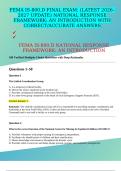
FEMA IS-800.D FINAL EXAM: (LATEST 2026–
2027 UPDATE) NATIONAL RESPONSE
FRAMEWORK: AN INTRODUCTION WITH
CORRECT/ACCURATE ANSWERS
FEMA IS-800.D NATIONAL RESPONSE
FRAMEWORK: AN INTRODUCTION
100 Verified Multiple-Choice Questions with Deep Rationales
Questions 1–50
Question 1
The Unified Coordination Group:
A. Is a temporary Federal facility.
B. Directs the tactics employed at the incident site.
C. Provides coordination leadership at the Joint Field Office.
D. Is a state-level group comprised of the heads of each Emergency Support Function (ESF).
Correct Answer: C
Rationale: The Unified Coordination Group (UCG) is responsible for providing strategic coordination and
leadership at the Joint Field Office (JFO). It does not direct on-scene tactics (that is the role of Incident
Command) and is not itself a facility or a state-only group.
Question 2
What is the correct function of the National Center for Missing & Exploited Children (NCMEC)?
A. Provides volunteers with proper training for emergency preparedness.
B. Facilitates the identification of children and their reunification.
C. Shares knowledge and resources throughout the disaster cycle.
D. Provides relief to survivors and helps people prevent, prepare, and respond to emergencies.
,Correct Answer: B
Rationale: NCMEC plays a specialized role in disasters by assisting with the identification, location, and
reunification of missing children. The other options describe functions of other organizations such as FEMA
or the American Red Cross.
Question 3
What is the definition of the Mitigation mission area?
A. Reduce loss of life and property by lessening the impact of disasters.
B. Secure the homeland against terrorism and manmade or natural disasters.
C. Avoid, prevent, or stop threatened or actual acts of terrorism.
D. Assist communities affected by an incident to recover effectively.
Correct Answer: A
Rationale: Mitigation focuses on reducing or eliminating long-term risk to life and property from hazards.
The other options align with Protection, Prevention, and Recovery mission areas.
Question 4
Critical infrastructure such as utilities and banking are which partner’s responsibility?
A. Federal government
B. Private sector
C. Local government
D. State government
Correct Answer: B
Rationale: The majority of the Nation’s critical infrastructure is owned and operated by the private sector,
making them key partners in preparedness, response, and recovery.
Question 5
Which core capability makes it possible to manage the life cycle of a potential crisis, determine
capability requirements, and help stakeholders learn their roles?
A. Mitigation
B. Public Information and Warning
,C. Operational Coordination
D. Planning
Correct Answer: D
Rationale: Planning is a cross-cutting core capability that supports all mission areas by identifying roles,
responsibilities, and resource requirements before, during, and after incidents.
Question 6
All agencies with jurisdictional authority and/or functional responsibility for the incident provide joint
support through mutually developed incident objectives and strategies. This is an example of:
A. Area Command
B. Unified Command
C. A response handled at the highest possible level
D. Rigid/Fixed Operational Capabilities
Correct Answer: B
Rationale: Unified Command allows agencies with different authorities to work together to establish
common objectives and strategies without relinquishing their individual authority.
Questions 7–50
Question 7
Which statement best describes the National Response Framework (NRF)?
A. A Federal-only operational plan for major disasters
B. A guide for how the Nation responds to all types of incidents
C. A tactical incident command manual
D. A document that replaces State and local emergency plans
Correct Answer: B
Rationale: The NRF is a comprehensive guide describing how the Nation responds to all hazards. It does not
replace State or local plans, nor does it focus on tactical operations, which are covered by the Incident
Command System (ICS).
Question 8
, Which principle of the National Response Framework emphasizes that incidents should be managed at
the lowest possible jurisdictional level?
A. Unity of Effort
B. Tiered Response
C. Readiness to Act
D. Scalable Operations
Correct Answer: B
Rationale: Tiered response ensures incidents are managed locally whenever possible, with State and Federal
support provided only when capabilities are exceeded.
Question 9
Who has the primary responsibility for responding to incidents?
A. Federal Government
B. State Government
C. Local Government
D. Private Sector
Correct Answer: C
Rationale: Local governments have primary responsibility for incident response, with States and the Federal
Government providing support as needed.
Question 10
Which mission area includes the core capability of Public Information and Warning?
A. Mitigation
B. Response
C. Recovery
D. Protection
Correct Answer: B
Rationale: Public Information and Warning is a Response core capability focused on delivering timely and
accurate information to affected populations.
Question 11
2027 UPDATE) NATIONAL RESPONSE
FRAMEWORK: AN INTRODUCTION WITH
CORRECT/ACCURATE ANSWERS
FEMA IS-800.D NATIONAL RESPONSE
FRAMEWORK: AN INTRODUCTION
100 Verified Multiple-Choice Questions with Deep Rationales
Questions 1–50
Question 1
The Unified Coordination Group:
A. Is a temporary Federal facility.
B. Directs the tactics employed at the incident site.
C. Provides coordination leadership at the Joint Field Office.
D. Is a state-level group comprised of the heads of each Emergency Support Function (ESF).
Correct Answer: C
Rationale: The Unified Coordination Group (UCG) is responsible for providing strategic coordination and
leadership at the Joint Field Office (JFO). It does not direct on-scene tactics (that is the role of Incident
Command) and is not itself a facility or a state-only group.
Question 2
What is the correct function of the National Center for Missing & Exploited Children (NCMEC)?
A. Provides volunteers with proper training for emergency preparedness.
B. Facilitates the identification of children and their reunification.
C. Shares knowledge and resources throughout the disaster cycle.
D. Provides relief to survivors and helps people prevent, prepare, and respond to emergencies.
,Correct Answer: B
Rationale: NCMEC plays a specialized role in disasters by assisting with the identification, location, and
reunification of missing children. The other options describe functions of other organizations such as FEMA
or the American Red Cross.
Question 3
What is the definition of the Mitigation mission area?
A. Reduce loss of life and property by lessening the impact of disasters.
B. Secure the homeland against terrorism and manmade or natural disasters.
C. Avoid, prevent, or stop threatened or actual acts of terrorism.
D. Assist communities affected by an incident to recover effectively.
Correct Answer: A
Rationale: Mitigation focuses on reducing or eliminating long-term risk to life and property from hazards.
The other options align with Protection, Prevention, and Recovery mission areas.
Question 4
Critical infrastructure such as utilities and banking are which partner’s responsibility?
A. Federal government
B. Private sector
C. Local government
D. State government
Correct Answer: B
Rationale: The majority of the Nation’s critical infrastructure is owned and operated by the private sector,
making them key partners in preparedness, response, and recovery.
Question 5
Which core capability makes it possible to manage the life cycle of a potential crisis, determine
capability requirements, and help stakeholders learn their roles?
A. Mitigation
B. Public Information and Warning
,C. Operational Coordination
D. Planning
Correct Answer: D
Rationale: Planning is a cross-cutting core capability that supports all mission areas by identifying roles,
responsibilities, and resource requirements before, during, and after incidents.
Question 6
All agencies with jurisdictional authority and/or functional responsibility for the incident provide joint
support through mutually developed incident objectives and strategies. This is an example of:
A. Area Command
B. Unified Command
C. A response handled at the highest possible level
D. Rigid/Fixed Operational Capabilities
Correct Answer: B
Rationale: Unified Command allows agencies with different authorities to work together to establish
common objectives and strategies without relinquishing their individual authority.
Questions 7–50
Question 7
Which statement best describes the National Response Framework (NRF)?
A. A Federal-only operational plan for major disasters
B. A guide for how the Nation responds to all types of incidents
C. A tactical incident command manual
D. A document that replaces State and local emergency plans
Correct Answer: B
Rationale: The NRF is a comprehensive guide describing how the Nation responds to all hazards. It does not
replace State or local plans, nor does it focus on tactical operations, which are covered by the Incident
Command System (ICS).
Question 8
, Which principle of the National Response Framework emphasizes that incidents should be managed at
the lowest possible jurisdictional level?
A. Unity of Effort
B. Tiered Response
C. Readiness to Act
D. Scalable Operations
Correct Answer: B
Rationale: Tiered response ensures incidents are managed locally whenever possible, with State and Federal
support provided only when capabilities are exceeded.
Question 9
Who has the primary responsibility for responding to incidents?
A. Federal Government
B. State Government
C. Local Government
D. Private Sector
Correct Answer: C
Rationale: Local governments have primary responsibility for incident response, with States and the Federal
Government providing support as needed.
Question 10
Which mission area includes the core capability of Public Information and Warning?
A. Mitigation
B. Response
C. Recovery
D. Protection
Correct Answer: B
Rationale: Public Information and Warning is a Response core capability focused on delivering timely and
accurate information to affected populations.
Question 11