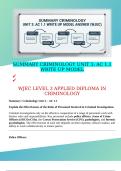
SUMMARY CRIMINOLOGY UNIT 3: AC 1.1
WRITE UP MODEL
WJEC LEVEL 3 APPLIED DIPLOMA IN
CRIMINOLOGY
Summary: Criminology Unit 3 – AC 1.1
Explain the Effectiveness of the Roles of Personnel Involved in Criminal Investigations
Criminal investigations rely on the effective cooperation of a range of personnel, each with
distinct roles and responsibilities. Key personnel include police officers, Scene of Crime
Officers (SOCOs/CSIs), the Crown Prosecution Service (CPS), pathologists, and forensic
psychologists. The effectiveness of each role depends on their expertise, ethical conduct, and
ability to work collaboratively to ensure justice.
Police Officers
, Police officers are typically the first responders at crime scenes. One of their most important
responsibilities is using the ‘golden hour’, the critical early period after a crime in which
vital evidence can be lost or contaminated if not secured promptly. Police officers secure the
scene, protect the public, and coordinate emergency services where necessary.
Strengths
All police officers receive specialist training, enabling them to respond effectively to
a wide range of crimes.
Police operate on a 24-hour basis, ensuring rapid attendance at crime scenes.
Their authority allows them to secure scenes, preserve evidence, and begin
investigations immediately.
Limitations
Police have been criticised for mishandling evidence and failing to protect crime
scenes adequately.
Allegations of institutional racism and discrimination have undermined public
confidence.
Ethical concerns exist regarding certain investigative tactics.
Case Examples
The Stephen Lawrence case exposed serious failures in policing. The Macpherson Report
concluded that the investigation was affected by institutional racism, professional
incompetence, and poor leadership. This led to 70 recommendations, 67 of which resulted
in changes to policing practices, improving police effectiveness and accountability.
Another example is Colin Stagg, who was wrongfully targeted for the murder of Rachel
Nickell. Police used an unethical ‘honeytrap’ technique involving an undercover officer
attempting to elicit a confession. The judge ruled this as “deceptive conduct of the grossest
kind,” highlighting how unethical policing methods can undermine investigations and result
in evidence being ruled inadmissible.
Scene of Crime Officers (SOCOs / CSIs)
SOCOs, also known as Crime Scene Investigators, are specialists responsible for collecting,
preserving, and documenting physical evidence. They may be employed directly by police
forces or private forensic companies and are available 24/7.
Strengths
WRITE UP MODEL
WJEC LEVEL 3 APPLIED DIPLOMA IN
CRIMINOLOGY
Summary: Criminology Unit 3 – AC 1.1
Explain the Effectiveness of the Roles of Personnel Involved in Criminal Investigations
Criminal investigations rely on the effective cooperation of a range of personnel, each with
distinct roles and responsibilities. Key personnel include police officers, Scene of Crime
Officers (SOCOs/CSIs), the Crown Prosecution Service (CPS), pathologists, and forensic
psychologists. The effectiveness of each role depends on their expertise, ethical conduct, and
ability to work collaboratively to ensure justice.
Police Officers
, Police officers are typically the first responders at crime scenes. One of their most important
responsibilities is using the ‘golden hour’, the critical early period after a crime in which
vital evidence can be lost or contaminated if not secured promptly. Police officers secure the
scene, protect the public, and coordinate emergency services where necessary.
Strengths
All police officers receive specialist training, enabling them to respond effectively to
a wide range of crimes.
Police operate on a 24-hour basis, ensuring rapid attendance at crime scenes.
Their authority allows them to secure scenes, preserve evidence, and begin
investigations immediately.
Limitations
Police have been criticised for mishandling evidence and failing to protect crime
scenes adequately.
Allegations of institutional racism and discrimination have undermined public
confidence.
Ethical concerns exist regarding certain investigative tactics.
Case Examples
The Stephen Lawrence case exposed serious failures in policing. The Macpherson Report
concluded that the investigation was affected by institutional racism, professional
incompetence, and poor leadership. This led to 70 recommendations, 67 of which resulted
in changes to policing practices, improving police effectiveness and accountability.
Another example is Colin Stagg, who was wrongfully targeted for the murder of Rachel
Nickell. Police used an unethical ‘honeytrap’ technique involving an undercover officer
attempting to elicit a confession. The judge ruled this as “deceptive conduct of the grossest
kind,” highlighting how unethical policing methods can undermine investigations and result
in evidence being ruled inadmissible.
Scene of Crime Officers (SOCOs / CSIs)
SOCOs, also known as Crime Scene Investigators, are specialists responsible for collecting,
preserving, and documenting physical evidence. They may be employed directly by police
forces or private forensic companies and are available 24/7.
Strengths