

Lecture 1 – April 14 – Chapter 2 – Methods and techniques
Chapter 2: methods of cognitive neuroscience.
sites.sinauer.com/cogneuro2e → Site met samenvatting, flashcards etc.
Cognitive neuroscience = The aim to develop neuro-biologically grounded models of mental function
and (human) behavior.
- Cognitive neuroscientists are interested in: Human behavior in relation to the task
environment and the underlying neural processes. Stabilizing the relationship.
- Combines cognitive science and neuroscience.
o Cognitive science → Seeks to understand information processing associated with
cognitive functions like perception, memory and (planning and) decision making. →
Focused on understanding processes directed to understand the world around us.
o Neuroscience → Seeks to characterize the structure and function (and structure) of
the nervous system. → Focused on understanding brain processes underlying
behavior.
o Cognitive neuroscience is a new discipline that applies research methods from
neuroscience to the functions and behaviors studies by cognitive science.
o Cognitive neuroscientists use diverse research methods and experimental paradigms
to develop models of mental function and behavior.
Cognition = The set of (mental) functions that allow us to perceive external stimuli, to extract key
information and hold it in memory, and ultimately to generate thoughts and actions that help to
reach desired goals.
Neuroscience techniques
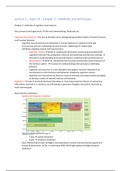
- Spatial and temporal resolution
-
o Y-axis → spatial resolution
o X-axis → temporal resolution
- Each method had its own strengths and weaknesses, mainly characterized by spatial and
temporal dimensions. So far, no technique offers both high spatial and high temporal
resolution.
, o Because of this the main question you want to answer in your research is very
important, it helps decide which method/technique is best to use. Sometimes spatial
is more important, other times temporal.
o No best technique, only a best technique for your research question.
Combining research methods → provides more information and strength.
- Convergence = Combining results from multiple experimental paradigms to clarify a single
theoretical concept.
- Complementarity = Different methods provide a different sort of information about brain
function.
Combining data: Meta-analysis (more info? Chapter 1 box 1A)
- Improve the power and precision of experimental findings. → Main advantage
- Qualitative meta-analysis
o Examine similarities in results of different studies investigating the same cognitive
function.
o Dus gefocust op één cognitive functie
- Quantitative meta-analysis
o Combine results from multiple studies into a single statistical framework.
- Semantic meta-analysis
o Combine studies based on similarity in underlying concepts.
Introductie↑
Chapter 2↓
Functional activity = brain activity related to task performance.
The structure of the brain is also important in relation to human behavior.
Research methods
-
Brain perturbation approach
Naturally occurring perturbations
- Brain damage
o E.g. Stroke
o E.g. Trauma (induced by an accident)
o E.g. Disease
▪ Alzheimer’s disease
▪ Famous study: Nun study by David Snowdon.
, • Weinig derde variabelen
• Sister Mary: Until death very good cognitive performance, after
death it was discovered she had severe Alzheimer’s.
• → Illustration that changes in the structure of the brain and changes
in cognitions don’t have a 1 to 1 relationship.
o Size and site of lesions are not under the control of the experimenter and might
differ between patients.
▪ → Substantial inter-individual variation.
• in lesions/damage
• in brain activity supporting cognitive functions
o Diaschisis = A change of function in a portion of the brain connected to a distant, but
damaged brain area might occur. This happens because brain areas don’t function in
isolations, the function in networks. So you might measure disfunction in a specific
brain area which is connected to the damaged area, but is not damaged itself.
- Used to be examined post mortem and related to behavior shown during life.
- Not possible to induce lesions in humans, it is possible to do so in animals. An advantage of
this is it can be done in a more controlled way.
Dynamics of the brain
- Brain changes over time, related to age. Left is 80 right is 30 years old.
o
- Structural changes aren’t always accompanied by changes in performance (e.g. Sister Mary).
- We don’t receive changes in the brain passively, our brain is dynamic and able to use
different strategies and compensate.
- Mental fatigue had a effect on the dynamics of the brain.
o Mental fatigue is related to reversable changes and aging is related to irreversible
changes. In both cases, people are able to compensate the changes in the brain.
- Cabeza 2002
o Episodic memory retrieval task
o fMRI
o Young pp showed right lateralized brain activations
o Older group: Division between low and high performing subjects.
▪ Old low → similar pattern to young pps, different intensity
▪ Old high → bilateral pattern of brain activation. Argued that bilateral pattern
in activation might illustrate a specific compensation mechanism.
- Recovery of post stroke proximal arm function (Pundik et al., 2015)
o Stroke lesions in function of arm
▪
, o In post-rehab: Increase of brain activation in control lesions and bilateral primary
motor regions. Which means intense therapy can change brain activation patterns.
▪
Experimentally occurring perturbations
- Pharmacological perturbations
o Drawback: Effects not very specific
o Possible to include healthy humans in research (e.g. in research into coffee and tea).
- Intracranial brain stimulation
o Invasive → limited usefulness.
▪ Limited in humans, mostly done in animals
o Stimulating brain regions with electrodes placed upon the brain through surgery.
- Transcranial brain stimulation (TMS)
o
o Strong changing magnetic field is created over a region of the brain which is eliciting
an electric field in aligning brain tissue, which influences neuroprocessing in this
area.
o Effects relative large areas.
o Only superficial brain regions can be reached. (1,5 cm deep)
o Non invasive
o Side effects are rare
o Can result in activation or nearby muscle (possibility, not always the case)
- Optogenetics
o Relatively new technique.
o Ability to modulate activity in certain neurons by shining light on them.
o https://www.youtube.com/watch?v=I64X7vHSHOE
o High neuronal specificity
o High temporal resolution
o Restoring and enhancing functions
o Foreign agents will be attacked by our immune system
o Ethical issues
Chapter 2: methods of cognitive neuroscience.
sites.sinauer.com/cogneuro2e → Site met samenvatting, flashcards etc.
Cognitive neuroscience = The aim to develop neuro-biologically grounded models of mental function
and (human) behavior.
- Cognitive neuroscientists are interested in: Human behavior in relation to the task
environment and the underlying neural processes. Stabilizing the relationship.
- Combines cognitive science and neuroscience.
o Cognitive science → Seeks to understand information processing associated with
cognitive functions like perception, memory and (planning and) decision making. →
Focused on understanding processes directed to understand the world around us.
o Neuroscience → Seeks to characterize the structure and function (and structure) of
the nervous system. → Focused on understanding brain processes underlying
behavior.
o Cognitive neuroscience is a new discipline that applies research methods from
neuroscience to the functions and behaviors studies by cognitive science.
o Cognitive neuroscientists use diverse research methods and experimental paradigms
to develop models of mental function and behavior.
Cognition = The set of (mental) functions that allow us to perceive external stimuli, to extract key
information and hold it in memory, and ultimately to generate thoughts and actions that help to
reach desired goals.
Neuroscience techniques
- Spatial and temporal resolution
-
o Y-axis → spatial resolution
o X-axis → temporal resolution
- Each method had its own strengths and weaknesses, mainly characterized by spatial and
temporal dimensions. So far, no technique offers both high spatial and high temporal
resolution.
, o Because of this the main question you want to answer in your research is very
important, it helps decide which method/technique is best to use. Sometimes spatial
is more important, other times temporal.
o No best technique, only a best technique for your research question.
Combining research methods → provides more information and strength.
- Convergence = Combining results from multiple experimental paradigms to clarify a single
theoretical concept.
- Complementarity = Different methods provide a different sort of information about brain
function.
Combining data: Meta-analysis (more info? Chapter 1 box 1A)
- Improve the power and precision of experimental findings. → Main advantage
- Qualitative meta-analysis
o Examine similarities in results of different studies investigating the same cognitive
function.
o Dus gefocust op één cognitive functie
- Quantitative meta-analysis
o Combine results from multiple studies into a single statistical framework.
- Semantic meta-analysis
o Combine studies based on similarity in underlying concepts.
Introductie↑
Chapter 2↓
Functional activity = brain activity related to task performance.
The structure of the brain is also important in relation to human behavior.
Research methods
-
Brain perturbation approach
Naturally occurring perturbations
- Brain damage
o E.g. Stroke
o E.g. Trauma (induced by an accident)
o E.g. Disease
▪ Alzheimer’s disease
▪ Famous study: Nun study by David Snowdon.
, • Weinig derde variabelen
• Sister Mary: Until death very good cognitive performance, after
death it was discovered she had severe Alzheimer’s.
• → Illustration that changes in the structure of the brain and changes
in cognitions don’t have a 1 to 1 relationship.
o Size and site of lesions are not under the control of the experimenter and might
differ between patients.
▪ → Substantial inter-individual variation.
• in lesions/damage
• in brain activity supporting cognitive functions
o Diaschisis = A change of function in a portion of the brain connected to a distant, but
damaged brain area might occur. This happens because brain areas don’t function in
isolations, the function in networks. So you might measure disfunction in a specific
brain area which is connected to the damaged area, but is not damaged itself.
- Used to be examined post mortem and related to behavior shown during life.
- Not possible to induce lesions in humans, it is possible to do so in animals. An advantage of
this is it can be done in a more controlled way.
Dynamics of the brain
- Brain changes over time, related to age. Left is 80 right is 30 years old.
o
- Structural changes aren’t always accompanied by changes in performance (e.g. Sister Mary).
- We don’t receive changes in the brain passively, our brain is dynamic and able to use
different strategies and compensate.
- Mental fatigue had a effect on the dynamics of the brain.
o Mental fatigue is related to reversable changes and aging is related to irreversible
changes. In both cases, people are able to compensate the changes in the brain.
- Cabeza 2002
o Episodic memory retrieval task
o fMRI
o Young pp showed right lateralized brain activations
o Older group: Division between low and high performing subjects.
▪ Old low → similar pattern to young pps, different intensity
▪ Old high → bilateral pattern of brain activation. Argued that bilateral pattern
in activation might illustrate a specific compensation mechanism.
- Recovery of post stroke proximal arm function (Pundik et al., 2015)
o Stroke lesions in function of arm
▪
, o In post-rehab: Increase of brain activation in control lesions and bilateral primary
motor regions. Which means intense therapy can change brain activation patterns.
▪
Experimentally occurring perturbations
- Pharmacological perturbations
o Drawback: Effects not very specific
o Possible to include healthy humans in research (e.g. in research into coffee and tea).
- Intracranial brain stimulation
o Invasive → limited usefulness.
▪ Limited in humans, mostly done in animals
o Stimulating brain regions with electrodes placed upon the brain through surgery.
- Transcranial brain stimulation (TMS)
o
o Strong changing magnetic field is created over a region of the brain which is eliciting
an electric field in aligning brain tissue, which influences neuroprocessing in this
area.
o Effects relative large areas.
o Only superficial brain regions can be reached. (1,5 cm deep)
o Non invasive
o Side effects are rare
o Can result in activation or nearby muscle (possibility, not always the case)
- Optogenetics
o Relatively new technique.
o Ability to modulate activity in certain neurons by shining light on them.
o https://www.youtube.com/watch?v=I64X7vHSHOE
o High neuronal specificity
o High temporal resolution
o Restoring and enhancing functions
o Foreign agents will be attacked by our immune system
o Ethical issues



