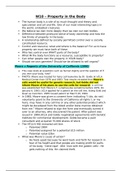
W10 – Property in the Body
The human body is a site of so much thought and theory and
speculation and art and life. One of our most interesting topics in
the world, embodied creatures.
We believe we own more deeply than we own our own bodies.
Difference between profound sense of body ownership and how the
law thinks of property in the body.
A relationship defined by socially permitted control over a socially
constituted resource.
Control and resource; what and where is the balance? For us to have
property we must have both of these.
Who has control over WHAT parts of the body?
What IN the body functions as a resource, susceptible to property?
Can other people own the property in YOUR body?
Should we own gametes? Should we be allowed to sell organs?
Moore v Regents of the University of California (1990)
This case looks at questions such as human dignity and the question of if
you own your body, how?
FACTS: Moore was treated for hairy cell leukemia by Dr. Golde at UCLA
Medical Center from 1976 and 1983. Test results revealed that Moore’s
cells would be useful for genetic research, but Golde did not
inform Moore of his plans to use the cells for research. A cell line
was established from Moore’s T- lymphocytes sometime before 1979. On
January 6, 1983, UCLA applied for a patent on the cell line, listing Gold and
Quan as inventors. USPO issued patent on March 20, 1984.
In 1983, Moore was given a consent form indicating “I (do, do not)
voluntarily grant to the University of California all rights I, or my
heirs, may have in any cell line or any other potential product which
might be developed from the blood and/or bone marrow obtained
from me.” Moore refused to sign the form and eventually turned it
over to an attorney, who discovered the patent. After patent was
issued in 1984,UCLA and Golde negotiated agreements with Genetic
Institute for commercial development. Golde became a paid
consultant and acquired 75,000 shares of stock.
The HTLV-II MO immortal cell line:
o Patented 1984
o Patented assigned for a potential $15 million
o Potential value $3bn
What was Moore’s cause of action?
o He feels upset because he went back and forth for research in
fear of his health and that people are making profit for parts
of his body. ‘Gene-rape’. AKA ‘man with the golden cells’. He
gets nothing of this. He claimed theft.
, o The tort of conversion – what are the limits of this cause of
action? The fact that ownership in the body is an ambiguous
concept!
o Breach of fiduciary duty (consent form) (you breach this if you
do not have a consent form.
What was the object of property?
o Natural product or technical artefact?
o Locke: if it is a technical artefact in someone’s body you have
done labour on it and it basically belongs to you…? The
doctors might say we cultivated and laboured and let you
recover and you did nothing in this process.
o The essential ingredient of invention: transformation through
human ingenuity
Yearworth v North Bristol NHS Trust [2009]
6 ish defendants (men) had testicular cancer. Before surgery they
froze sperm so they have genetic material if anything goes wrong.
Gave it to NBT who had fertility clinic. The fertility act oversees this
clinic. Tragically, malfunction of frozen sperm. The sperm destroyed.
S. Harmon, “Yearworth v North Bristol NHS Trust: A Property/Medical
Case of
Uncertain Significance?” (2010) 13(4) Medicine, Health Care &
Philosophy 343-350.
Yearworth plaintiffs’ causes of action:
o (1) tortious personal injury
o (2) tortious damage to property
o (3) losses resulting from breach of bailment conditions
o (This lecture focuses on 1 and 2)
Tortious personal injury dismissed:
o ‘…[I]t would be a fiction to hold that damage to a
substance generated by a person’s body, inflicted after
its removal for storage purposes, constituted a bodily
or “personal injury” to him.’ [23]
Tortious damage to property considered:
o ‘”In order to enable a person to claim in negligence for loss
caused to him by reason of loss of or damage to property, he
must have had either the legal ownership of or a
possessory title to the property concerned at the time
when the loss or damage occurred.” …’ [25] (emphasis added)
o ‘A decision whether something is capable of being owned…
must be reached in context; and in this section of our
judgment the context is whether an action in tort may be
brought for loss of the sperm consequent upon breach of the
Trust’s duty to take reasonable care of it.’ [28]
The human body is a site of so much thought and theory and
speculation and art and life. One of our most interesting topics in
the world, embodied creatures.
We believe we own more deeply than we own our own bodies.
Difference between profound sense of body ownership and how the
law thinks of property in the body.
A relationship defined by socially permitted control over a socially
constituted resource.
Control and resource; what and where is the balance? For us to have
property we must have both of these.
Who has control over WHAT parts of the body?
What IN the body functions as a resource, susceptible to property?
Can other people own the property in YOUR body?
Should we own gametes? Should we be allowed to sell organs?
Moore v Regents of the University of California (1990)
This case looks at questions such as human dignity and the question of if
you own your body, how?
FACTS: Moore was treated for hairy cell leukemia by Dr. Golde at UCLA
Medical Center from 1976 and 1983. Test results revealed that Moore’s
cells would be useful for genetic research, but Golde did not
inform Moore of his plans to use the cells for research. A cell line
was established from Moore’s T- lymphocytes sometime before 1979. On
January 6, 1983, UCLA applied for a patent on the cell line, listing Gold and
Quan as inventors. USPO issued patent on March 20, 1984.
In 1983, Moore was given a consent form indicating “I (do, do not)
voluntarily grant to the University of California all rights I, or my
heirs, may have in any cell line or any other potential product which
might be developed from the blood and/or bone marrow obtained
from me.” Moore refused to sign the form and eventually turned it
over to an attorney, who discovered the patent. After patent was
issued in 1984,UCLA and Golde negotiated agreements with Genetic
Institute for commercial development. Golde became a paid
consultant and acquired 75,000 shares of stock.
The HTLV-II MO immortal cell line:
o Patented 1984
o Patented assigned for a potential $15 million
o Potential value $3bn
What was Moore’s cause of action?
o He feels upset because he went back and forth for research in
fear of his health and that people are making profit for parts
of his body. ‘Gene-rape’. AKA ‘man with the golden cells’. He
gets nothing of this. He claimed theft.
, o The tort of conversion – what are the limits of this cause of
action? The fact that ownership in the body is an ambiguous
concept!
o Breach of fiduciary duty (consent form) (you breach this if you
do not have a consent form.
What was the object of property?
o Natural product or technical artefact?
o Locke: if it is a technical artefact in someone’s body you have
done labour on it and it basically belongs to you…? The
doctors might say we cultivated and laboured and let you
recover and you did nothing in this process.
o The essential ingredient of invention: transformation through
human ingenuity
Yearworth v North Bristol NHS Trust [2009]
6 ish defendants (men) had testicular cancer. Before surgery they
froze sperm so they have genetic material if anything goes wrong.
Gave it to NBT who had fertility clinic. The fertility act oversees this
clinic. Tragically, malfunction of frozen sperm. The sperm destroyed.
S. Harmon, “Yearworth v North Bristol NHS Trust: A Property/Medical
Case of
Uncertain Significance?” (2010) 13(4) Medicine, Health Care &
Philosophy 343-350.
Yearworth plaintiffs’ causes of action:
o (1) tortious personal injury
o (2) tortious damage to property
o (3) losses resulting from breach of bailment conditions
o (This lecture focuses on 1 and 2)
Tortious personal injury dismissed:
o ‘…[I]t would be a fiction to hold that damage to a
substance generated by a person’s body, inflicted after
its removal for storage purposes, constituted a bodily
or “personal injury” to him.’ [23]
Tortious damage to property considered:
o ‘”In order to enable a person to claim in negligence for loss
caused to him by reason of loss of or damage to property, he
must have had either the legal ownership of or a
possessory title to the property concerned at the time
when the loss or damage occurred.” …’ [25] (emphasis added)
o ‘A decision whether something is capable of being owned…
must be reached in context; and in this section of our
judgment the context is whether an action in tort may be
brought for loss of the sperm consequent upon breach of the
Trust’s duty to take reasonable care of it.’ [28]