International Administration
Week 1: Introduction to International Administration
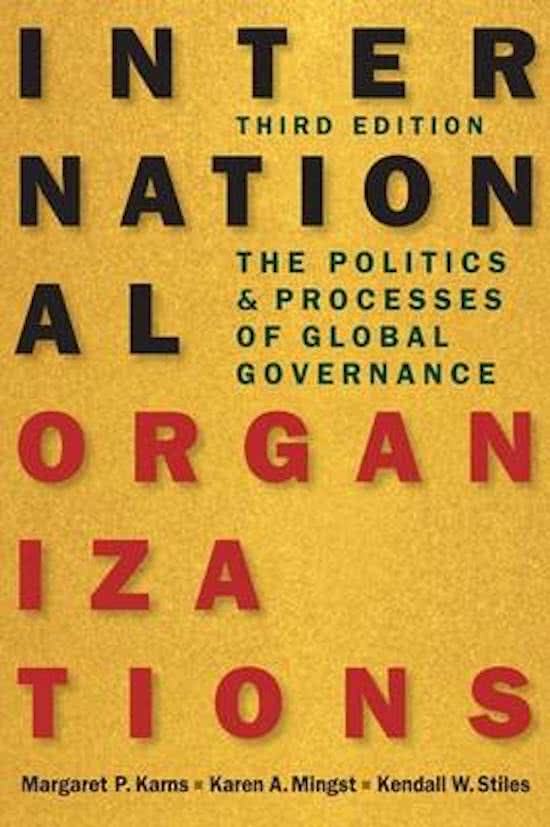
Karns et al. Hoofdstuk 1 en 2. + Barnett & Finnemore 1999
Karns et al. Hoofdstuk 1: The Challenges of Global Governance
There is a wide variety of cross-border issues and problems that require
governance.
What is Global Governance?
Governance: the sum of the many ways individuals and institutions, public
and private, manage their common affairs.
It is a continuing process through which conflicting or diverse interests may be
accommodated and cooperative action may be taken. It includes formal and
informal arrangements that people and institutions have agreed to or perceive to
be in their interest. (Commission on Global Governance 1995: 2)
Global governance is not global government; it is not a single world order; there
is no top-down, hierarchical structure of authority, but both power and authority
in global governance are present in varying ways and to varying degrees.
Global governance encompasses international law and international organizations
created by states, but goes well beyond them, because today’s world is far more
complex and far less state-centric, with a wide variety of actors and governance
mechanisms.
The concept of global governance has ancient roots, but contemporary
conceptions are very much a product of developments since the Cold War’s end.
Why the growing need for Global Governance now?
Globalization, technological advances, the Cold War’s end, and the growth of
transnationalism have separately and collectively fundamentally altered global
politics at the same time that they have contributed to the increases need for
global governance.
Globalization: a historical process involving fundamental shift or
transformation in the spatial scale of human social organization that links
distant communities and expands the reach of power relations across regions
and continents.
- Globalization has contributed to the homogenization of culture with the
global spread of ideas and popular culture. It has also contributed to
heterogeneity, with the reassertion of ethnicity and nationalism.
- The effects of globalization change the significance of the borders of states
and the very nature of world politics. They mean that states no longer
have a monopoly on power and authority.
- Globalization has both coincided with and contributed to the growth of
transnationalism and the deregulation and privatization shift, all of which
can be linked to the revolution in global communications and transport.
Technological changes: in both transport and communications that permit
the movement of people and goods rapidly over great distances and move
information by telephone, internet, television networks, and various forms of
social media.
, - both the transportation revolution and the communications revolution have
aided the formation of transnational groups, social movements such as
those on behalf of women, and networks.
Cold war’s end: brought about by the collapse of Soviet-supported
communist governments in Central Europe, symbolized by the fall of the
Berlin Wall in 1989, and the disintegration two years later of the Soviet Union
itself into fifteen separate, independent states.
- The Cold war’s end marked the ending of one historical era and the
beginning of another. The international system shifted from a bipolar
structure to a post-Cold War structure that was simultaneously unipolar,
dominated by a single superpower (United States), and a nonpolar,
networked system of a globalized world.
- It produced a series of new governance challenges as well as possibilities
for developing new forms of governance.
Expanding Transnationalism: the processes through which individuals and
various types of nonstate actors work together across state borders. It is
exhibited in the activities of global civil society, NGOs, transnational advocacy
networks, and transnational social movements.
- Increased democratization, accelerating globalization, and the advances in
technology and transport.
- The key distinction between NGOs and civil society groups is their links to
citizens. Many NGOs are elite-run groups with tenuous links to citizens on
whose behalf they claim to act.
- The spread of democracy has bolstered the growth of civil society in
countries where restriction on citizens’ groups have been lifted. Civil
society groups communicate with each other domestically and cross-
nationally, creating new coalitions from the local to the global.
- The increased need for global governance magnifies the importance and
different strategies used by state and nonstate actors.
Actors in Global Governance
States and their subnational and local jurisdictions
- States alone have sovereignty, which has historically given them authority
not only over their own territory and people. But also over powers
delegated to international institutions.
- They create international law and norms and determine their effectiveness
through their compliance or failure to comply. States are also still a primary
locus of people’s identities.
- Middle-power states have traditionally played a particularly important role
in international institutions, often acting in concert in the UN and other
IGOs, taking initiatives on arms control, human rights, and other issues.
The essence of the role of middle powers lies in the importance of
secondary players as both followers and leaders.
- For the large number of less developed, small, and weak states, power and
influence generally come only insofar as they are able to form coalitions
that enlarge their voices and offer opportunities to set global agendas and
link issues of importance to them.
- States themselves may not act with one voice in global governance.
Increasingly, provincial, state, and local government, are involved in
international economic negotiations, and in implementing environmental
regulations and human rights initiatives, acting independently and
occasionally at odds with their respective national governments.
, IGOs and their bureaucracies (InterGovernmental Organizations)
- Organizations that include at least three states as members, that have
activities in several states, and that are created through a formal
intergovernmental agreement such as a treaty, charter, or statute. They
also have headquarters, executive heads, bureaucracies, and budgets.
(Example: UN, WTO, ASEAN, EU, GCC, WHO)
- IGOs are recognized subjects of international law, with separate standing
from their member states. They are formed by states, and states grant
IGOs responsibilities and authority to act.
- IGO bureaucracies are not just tools of states. They are also purposive
actors that have power to influence world events. Their authority, and that
of bureaucracies in generally, lies in their ability to present themselves as
impersonal and neutral, as not exercising power but instead serving
others.
- IGOs may act against the interest and preferences of strong or weak
states. They may form partnerships with nonstate actors, other IGOs, and
select states to pursue or protect certain policies, and they may attempt to
persuade states to change their behaviour.
- The autonomous influence of the international secretariats of both IGOs
and treaty regimes varies widely, as it does with all bureaucracies.
NGOs (Non-Governmental Organizations)
- Private voluntary organizations whose members are individuals or
associations that come together to achieve a common purpose.
- NGOs are key sources of information and technical expertise on a wide
variety of international issues. They frequently are key actors in raising
awareness of and helping to frame issues. They lobby for policy changes
by states, IGOs, and corporations.
Experts and epistemic communities
- Experts have increasingly been drawn into international efforts to deal with
various issues.
- Scholars have coined the phrase ‘epistemic communities’ to identify
networks of knowledge-based experts.
Networks and partnerships
- Networks can be examined as both actors and structures. As actors, they
may be defined as an organizational form consciously created by any set
of actors that pursue ‘repeated, enduring exchange relations with one
another yet lack a legitimate organization authority to arbitrate and
resolve disputes that may arise during the exchange’.
- Networks are distinguished by their voluntary nature, the central role of
information and learning, their ability to generate trust among participants,
and their lack of hierarchy.
- Partnership functions range from advocacy, developing standards of
conduct, and business development in less developed countries (LDCs), to
providing funding, goods, and services.
Multinational corporations (MNC)
- A particular form of nonstate actor organized to conduct for-profit business
transactions and operations across the borders of three or more states.
They are companies based in one state with affiliated branches or
, subsidiaries and activities in other states and can take many different
forms.
- MNCs shape the economic development opportunities of individual
communities, countries, and entire regions.
- They control resources far greater than those of many states and have
taken an active and often direct role in influencing international
environmental decision making.
Private foundations
Processes of Global Governance: Multilateralism matters
Multilateral negotiations are a key part of global governance, constituting the
diplomatic bargaining processes through which the international community
confers political legitimacy or comes to accept (generalized) principles.
John Ruggie: “At its core, multilateralism refers to coordinating relations among
three or more states in accordance with certain principles. Thus, relationships are
defined by agreed-upon rules and principles, and perhaps by organizations.
What makes multilateralism in the 21st century different from multilateralism at
the end of World War II is its complexity.
- There are now literally scores of participants.
- States alone have almost quadrupled in number since 1945.
- First sessions of the UN General Assembly now look like cozy, intimate
gatherings.
How do decisions get made?
- Since the 1980s, much of the decision making in multilateral settings has
taken the form of consensus that does not require unanimity.
- Leadership in multilateral diplomacy can come from diverse sources:
states, coalitions, NGOs, skilful individual diplomat, IGO bureaucrat.
- The nature of multilateral arenas means that actors cannot just present
their individual positions on an issue and then sit down. Delegates must
actively engage in efforts to discern the flexibility or rigidity of their
respective positions.
- One actor strategy that is a hallmark of multilateral diplomacy is the
formation of groups or coalitions of states. States can pool their votes,
power, and resources to try to obtain better outcome. A variation on
coalition building, especially for nonstate actors, is the creation of
networks to expand their reach and link diverse groups with shared
concerns and awareness that common goals cannot be achieved on their
own.
The Varieties of Global Governance
Global governance encompasses a variety of cooperative problem-solving
arrangements and activities that states and other actors create in an effort to
resolve conflicts, serve common purposes, and overcome inefficiencies in
situations of interdependent choice. These forms include IGOs and NGOs.
Week 1: Introduction to International Administration
Karns et al. Hoofdstuk 1 en 2. + Barnett & Finnemore 1999
Karns et al. Hoofdstuk 1: The Challenges of Global Governance
There is a wide variety of cross-border issues and problems that require
governance.
What is Global Governance?
Governance: the sum of the many ways individuals and institutions, public
and private, manage their common affairs.
It is a continuing process through which conflicting or diverse interests may be
accommodated and cooperative action may be taken. It includes formal and
informal arrangements that people and institutions have agreed to or perceive to
be in their interest. (Commission on Global Governance 1995: 2)
Global governance is not global government; it is not a single world order; there
is no top-down, hierarchical structure of authority, but both power and authority
in global governance are present in varying ways and to varying degrees.
Global governance encompasses international law and international organizations
created by states, but goes well beyond them, because today’s world is far more
complex and far less state-centric, with a wide variety of actors and governance
mechanisms.
The concept of global governance has ancient roots, but contemporary
conceptions are very much a product of developments since the Cold War’s end.
Why the growing need for Global Governance now?
Globalization, technological advances, the Cold War’s end, and the growth of
transnationalism have separately and collectively fundamentally altered global
politics at the same time that they have contributed to the increases need for
global governance.
Globalization: a historical process involving fundamental shift or
transformation in the spatial scale of human social organization that links
distant communities and expands the reach of power relations across regions
and continents.
- Globalization has contributed to the homogenization of culture with the
global spread of ideas and popular culture. It has also contributed to
heterogeneity, with the reassertion of ethnicity and nationalism.
- The effects of globalization change the significance of the borders of states
and the very nature of world politics. They mean that states no longer
have a monopoly on power and authority.
- Globalization has both coincided with and contributed to the growth of
transnationalism and the deregulation and privatization shift, all of which
can be linked to the revolution in global communications and transport.
Technological changes: in both transport and communications that permit
the movement of people and goods rapidly over great distances and move
information by telephone, internet, television networks, and various forms of
social media.
, - both the transportation revolution and the communications revolution have
aided the formation of transnational groups, social movements such as
those on behalf of women, and networks.
Cold war’s end: brought about by the collapse of Soviet-supported
communist governments in Central Europe, symbolized by the fall of the
Berlin Wall in 1989, and the disintegration two years later of the Soviet Union
itself into fifteen separate, independent states.
- The Cold war’s end marked the ending of one historical era and the
beginning of another. The international system shifted from a bipolar
structure to a post-Cold War structure that was simultaneously unipolar,
dominated by a single superpower (United States), and a nonpolar,
networked system of a globalized world.
- It produced a series of new governance challenges as well as possibilities
for developing new forms of governance.
Expanding Transnationalism: the processes through which individuals and
various types of nonstate actors work together across state borders. It is
exhibited in the activities of global civil society, NGOs, transnational advocacy
networks, and transnational social movements.
- Increased democratization, accelerating globalization, and the advances in
technology and transport.
- The key distinction between NGOs and civil society groups is their links to
citizens. Many NGOs are elite-run groups with tenuous links to citizens on
whose behalf they claim to act.
- The spread of democracy has bolstered the growth of civil society in
countries where restriction on citizens’ groups have been lifted. Civil
society groups communicate with each other domestically and cross-
nationally, creating new coalitions from the local to the global.
- The increased need for global governance magnifies the importance and
different strategies used by state and nonstate actors.
Actors in Global Governance
States and their subnational and local jurisdictions
- States alone have sovereignty, which has historically given them authority
not only over their own territory and people. But also over powers
delegated to international institutions.
- They create international law and norms and determine their effectiveness
through their compliance or failure to comply. States are also still a primary
locus of people’s identities.
- Middle-power states have traditionally played a particularly important role
in international institutions, often acting in concert in the UN and other
IGOs, taking initiatives on arms control, human rights, and other issues.
The essence of the role of middle powers lies in the importance of
secondary players as both followers and leaders.
- For the large number of less developed, small, and weak states, power and
influence generally come only insofar as they are able to form coalitions
that enlarge their voices and offer opportunities to set global agendas and
link issues of importance to them.
- States themselves may not act with one voice in global governance.
Increasingly, provincial, state, and local government, are involved in
international economic negotiations, and in implementing environmental
regulations and human rights initiatives, acting independently and
occasionally at odds with their respective national governments.
, IGOs and their bureaucracies (InterGovernmental Organizations)
- Organizations that include at least three states as members, that have
activities in several states, and that are created through a formal
intergovernmental agreement such as a treaty, charter, or statute. They
also have headquarters, executive heads, bureaucracies, and budgets.
(Example: UN, WTO, ASEAN, EU, GCC, WHO)
- IGOs are recognized subjects of international law, with separate standing
from their member states. They are formed by states, and states grant
IGOs responsibilities and authority to act.
- IGO bureaucracies are not just tools of states. They are also purposive
actors that have power to influence world events. Their authority, and that
of bureaucracies in generally, lies in their ability to present themselves as
impersonal and neutral, as not exercising power but instead serving
others.
- IGOs may act against the interest and preferences of strong or weak
states. They may form partnerships with nonstate actors, other IGOs, and
select states to pursue or protect certain policies, and they may attempt to
persuade states to change their behaviour.
- The autonomous influence of the international secretariats of both IGOs
and treaty regimes varies widely, as it does with all bureaucracies.
NGOs (Non-Governmental Organizations)
- Private voluntary organizations whose members are individuals or
associations that come together to achieve a common purpose.
- NGOs are key sources of information and technical expertise on a wide
variety of international issues. They frequently are key actors in raising
awareness of and helping to frame issues. They lobby for policy changes
by states, IGOs, and corporations.
Experts and epistemic communities
- Experts have increasingly been drawn into international efforts to deal with
various issues.
- Scholars have coined the phrase ‘epistemic communities’ to identify
networks of knowledge-based experts.
Networks and partnerships
- Networks can be examined as both actors and structures. As actors, they
may be defined as an organizational form consciously created by any set
of actors that pursue ‘repeated, enduring exchange relations with one
another yet lack a legitimate organization authority to arbitrate and
resolve disputes that may arise during the exchange’.
- Networks are distinguished by their voluntary nature, the central role of
information and learning, their ability to generate trust among participants,
and their lack of hierarchy.
- Partnership functions range from advocacy, developing standards of
conduct, and business development in less developed countries (LDCs), to
providing funding, goods, and services.
Multinational corporations (MNC)
- A particular form of nonstate actor organized to conduct for-profit business
transactions and operations across the borders of three or more states.
They are companies based in one state with affiliated branches or
, subsidiaries and activities in other states and can take many different
forms.
- MNCs shape the economic development opportunities of individual
communities, countries, and entire regions.
- They control resources far greater than those of many states and have
taken an active and often direct role in influencing international
environmental decision making.
Private foundations
Processes of Global Governance: Multilateralism matters
Multilateral negotiations are a key part of global governance, constituting the
diplomatic bargaining processes through which the international community
confers political legitimacy or comes to accept (generalized) principles.
John Ruggie: “At its core, multilateralism refers to coordinating relations among
three or more states in accordance with certain principles. Thus, relationships are
defined by agreed-upon rules and principles, and perhaps by organizations.
What makes multilateralism in the 21st century different from multilateralism at
the end of World War II is its complexity.
- There are now literally scores of participants.
- States alone have almost quadrupled in number since 1945.
- First sessions of the UN General Assembly now look like cozy, intimate
gatherings.
How do decisions get made?
- Since the 1980s, much of the decision making in multilateral settings has
taken the form of consensus that does not require unanimity.
- Leadership in multilateral diplomacy can come from diverse sources:
states, coalitions, NGOs, skilful individual diplomat, IGO bureaucrat.
- The nature of multilateral arenas means that actors cannot just present
their individual positions on an issue and then sit down. Delegates must
actively engage in efforts to discern the flexibility or rigidity of their
respective positions.
- One actor strategy that is a hallmark of multilateral diplomacy is the
formation of groups or coalitions of states. States can pool their votes,
power, and resources to try to obtain better outcome. A variation on
coalition building, especially for nonstate actors, is the creation of
networks to expand their reach and link diverse groups with shared
concerns and awareness that common goals cannot be achieved on their
own.
The Varieties of Global Governance
Global governance encompasses a variety of cooperative problem-solving
arrangements and activities that states and other actors create in an effort to
resolve conflicts, serve common purposes, and overcome inefficiencies in
situations of interdependent choice. These forms include IGOs and NGOs.