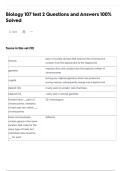
Biology 107 test 2 Questions and Answers 100%
Solved
Save
Terms in this set (91)
type of nuclear division that reduces the chromosome
meiosis
number from the diploid (2n) to the haploid (n)
reproductive cells usually have the haploid number of
gametes
chromosomes
during sex, haploid gametes which are produced
zygote
during meiosis, subsequently merge into a diploid cell
diploid (2n) 2 sets; seen in somatic cell of animals
haploid (1n) 1 sets; seen in animal gametes
humans have ___ pairs of 23; homologous
chromosomes; members
of each pair are called ____
chromosomes
these chromosomes different
contain genes in the same
location that code for the
same type of traits, but
individual traits could be
____ for each
, there are 22 pairs of autosomes; sex chromsomes
chromosomes called _____
and one pair of
chromosomes called ____
the sex chromosomes in XY; XX
males are __ and __; the sex
chromosomes in females
are __ and __
when chromosomes sister chromatids
replicate, each of the
replicates are called ___
these ____ are exact copies sister chromatids; same
of each other and contain
the same genes in the
same locations with the ___
traits
members of each pair that look alike; they have the
homologous chromsomes
same length and centromere position
meiosis I homologous pairs synapse and then separate
sister chromatids separate, becoming daughter
meiosis II
chromosomes
-relies on mutations to generate variation
-offspring are genetically identical to parents
asexual reproduction
-necessary when cells need to be genetically
identical, such as skin or blood cells
-reproduction itself generate genetic variation
-offspring are genetic combinations of both parents
-variation occurs because of crossing over during
sexual reproduction
synapsis and independent assortment
-necessary when genetic variation is beneficial, such
as a sudden shift in environmental conditions
Solved
Save
Terms in this set (91)
type of nuclear division that reduces the chromosome
meiosis
number from the diploid (2n) to the haploid (n)
reproductive cells usually have the haploid number of
gametes
chromosomes
during sex, haploid gametes which are produced
zygote
during meiosis, subsequently merge into a diploid cell
diploid (2n) 2 sets; seen in somatic cell of animals
haploid (1n) 1 sets; seen in animal gametes
humans have ___ pairs of 23; homologous
chromosomes; members
of each pair are called ____
chromosomes
these chromosomes different
contain genes in the same
location that code for the
same type of traits, but
individual traits could be
____ for each
, there are 22 pairs of autosomes; sex chromsomes
chromosomes called _____
and one pair of
chromosomes called ____
the sex chromosomes in XY; XX
males are __ and __; the sex
chromosomes in females
are __ and __
when chromosomes sister chromatids
replicate, each of the
replicates are called ___
these ____ are exact copies sister chromatids; same
of each other and contain
the same genes in the
same locations with the ___
traits
members of each pair that look alike; they have the
homologous chromsomes
same length and centromere position
meiosis I homologous pairs synapse and then separate
sister chromatids separate, becoming daughter
meiosis II
chromosomes
-relies on mutations to generate variation
-offspring are genetically identical to parents
asexual reproduction
-necessary when cells need to be genetically
identical, such as skin or blood cells
-reproduction itself generate genetic variation
-offspring are genetic combinations of both parents
-variation occurs because of crossing over during
sexual reproduction
synapsis and independent assortment
-necessary when genetic variation is beneficial, such
as a sudden shift in environmental conditions