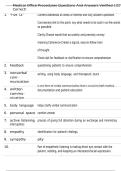
Medical Office Procedures Questions And Answers Verified 100%
Correct!
1. "Five Cs" Content-Addresses all areas of interest and fully answers questions
Conciseness-Get to the point; say what needs to be said in as few words
as possible
Clarity-Choose words that accurately and precisely convey
meaning Coherence-Create a logical, easy-to-follow train
of thought
Check-Ask for feedback or clarification to ensure comprehension
2. Feedback questioning patients to ensure comprehension
3. nonverbal writing, using body language, and therapeutic touch
com-
munication
is one form of verbal communication that is crucial to both medical
4. written documentation and patient education
commu-
nication
5. body language helps clarify verbal communication
6. personal space comfort zone
7. active listening process of giving full attention during an exchange and minimizing
interruptions
8. empathy identification for patient's feelings,
9. sympathy pity
10. Part of empathetic listening is making direct eye contact with the
patient, nodding, and keeping an interested facial expression.
1/
24
, Medical Office Procedures Questions And Answers Verified 100%
Correct!
11. open- appropriate when more than a ye or no response is needed
ended
questions
2/
24
, Medical Office Procedures Questions And Answers Verified 100%
Correct!
12. close- can be answered with yes or no
ended
questions
13. relecting the practice of repeating the patients statement so the patient
knows they have been understood. allows you to clarify parts of a
conversation
14. indirect question considered polite
15. direct question sample where is your son
16. Step 1 Smile and introduce yourself to the patient.
Step 2 Identify the patient verifying the patient's birth
date. Step 3 Verify that you have the correct patient
chart.
Step 4 Maintain a professional
persona. Step 5 Maintain eye contact
with the patient.
Step 6 Ask the patient open-ended
questions. Step 7 Do not interrupt the
patient.
Step 8 Paraphrase the patient's statements to verify
comprehension. Step 9 Watch for the patient's nonverbal
3/
24
Correct!
1. "Five Cs" Content-Addresses all areas of interest and fully answers questions
Conciseness-Get to the point; say what needs to be said in as few words
as possible
Clarity-Choose words that accurately and precisely convey
meaning Coherence-Create a logical, easy-to-follow train
of thought
Check-Ask for feedback or clarification to ensure comprehension
2. Feedback questioning patients to ensure comprehension
3. nonverbal writing, using body language, and therapeutic touch
com-
munication
is one form of verbal communication that is crucial to both medical
4. written documentation and patient education
commu-
nication
5. body language helps clarify verbal communication
6. personal space comfort zone
7. active listening process of giving full attention during an exchange and minimizing
interruptions
8. empathy identification for patient's feelings,
9. sympathy pity
10. Part of empathetic listening is making direct eye contact with the
patient, nodding, and keeping an interested facial expression.
1/
24
, Medical Office Procedures Questions And Answers Verified 100%
Correct!
11. open- appropriate when more than a ye or no response is needed
ended
questions
2/
24
, Medical Office Procedures Questions And Answers Verified 100%
Correct!
12. close- can be answered with yes or no
ended
questions
13. relecting the practice of repeating the patients statement so the patient
knows they have been understood. allows you to clarify parts of a
conversation
14. indirect question considered polite
15. direct question sample where is your son
16. Step 1 Smile and introduce yourself to the patient.
Step 2 Identify the patient verifying the patient's birth
date. Step 3 Verify that you have the correct patient
chart.
Step 4 Maintain a professional
persona. Step 5 Maintain eye contact
with the patient.
Step 6 Ask the patient open-ended
questions. Step 7 Do not interrupt the
patient.
Step 8 Paraphrase the patient's statements to verify
comprehension. Step 9 Watch for the patient's nonverbal
3/
24