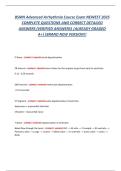
BSM week 4 , BSM week 3, BSM Week 2,
BSM 100 Week 1+5 Answered Questions
(Latest 2026)
Environment
Business environment:
Types of business environment - Correct Answers
✅Environment: everything which surrounds a system
Business Environment: Anything which surrounds the
business organization that either
help or hinder the development of businesses
Types of Business Environment
Internal environment: all functions within a firm (e.g.
marketing, finance, R&D)
External environment: all forces and events outside
organization affect on its activities
Micro environment: directly affect the firm's activities (ex.
customers, suppliers, competitors, other stakeholder,
intermediaries )
Macro environment: not immediately affect firm's activities
(ex. political/legal, economic, technological, social/cultural
Why is the business environment important? - Correct
Answers ✅If the firm failed to respond to changes in the
environment, it might have a decline in its profitability,
business failure, loss of jobs, and a low standard of living and
quality of life.
,BSM week 4 , BSM week 3, BSM Week 2,
BSM 100 Week 1+5 Answered Questions
(Latest 2026)
On the other hand, it could be an opportunity for the firm to
succeed in which it always adjusts itself with the current
business trends and environment.
What is capitalism, does it guarantee success - Correct
Answers ✅Capitalism AKA "Free-market" Or "Free Market
Capitalism" is an economic system in which all or most of the
factors of production and distribution are privately owned and
operated for profit
Market not controlled by government
Business people decide:
• What to produce
• How much to pay workers
• (Government does set minimum wage so no country is
purely capitalist)
• Prices for goods/services
• Whether to import or export goods/services
Capitalism goes not guarantee success, but it does provide
the opportunity to create new businesses (success or failure).
Capitalism has drawbacks, including income inequality.
,BSM week 4 , BSM week 3, BSM Week 2,
BSM 100 Week 1+5 Answered Questions
(Latest 2026)
state capitalism: - Correct Answers ✅A combination of
freer markets and some government control for rapid growth,
as seen in China.
Four Basic Rights Under "Free Market Capitalism": - Correct
Answers ✅• The right to private property
• The right to own a business and to keep all of the business's
profits
• The right to freedom of competition
• The right to freedom of choice (e.g., Freedom to choose
where to work, where to live, what to buy, what to say, etc.
who to worship)
How Free Markets Work? what are the benefits (4) and
limitations (5)? - Correct Answers ✅Decisions are made by
buyers and sellers negotiating prices for goods and services,
although they are influenced by government regulations
(laws, taxes, regulation, etc.). For example, a farmer's market
demonstrates a free-market system where consumers help
determine production.
Benefits of Free Markets:
1. Open competition among companies ensures quality
products, fair prices, and good service for customers.
2. Free-market capitalism creates opportunities for poor
people to escape poverty.
, BSM week 4 , BSM week 3, BSM Week 2,
BSM 100 Week 1+5 Answered Questions
(Latest 2026)
3. Encourages businesses to become more efficient and
compete on price and quality.
4. Enables rich people to donate to charities (though it
doesn't always happen)
Limitations:
1. Income Inequality: Free-market capitalism has led to
wealth disparities, with business owners and managers
earning significantly more than lower-level workers.
2. It has also resulted in societal issues like poverty,
unemployment, and homelessness.
3. The North American professional sport industry operates as
a monopoly, hindering market competition.
4. Greed-driven actions by some business people have led to
criminal charges and unethical behavior.
5. Government rules and regulations are necessary to protect
stakeholders and provide for those unable to support
themselves.
How Prices Are Determined (supply, demand, etc)
"Price Signal" - Correct Answers ✅• Buyers (Demand) and
sellers (Supply) negotiate in the marketplace
Supply (Supply Curve)
BSM 100 Week 1+5 Answered Questions
(Latest 2026)
Environment
Business environment:
Types of business environment - Correct Answers
✅Environment: everything which surrounds a system
Business Environment: Anything which surrounds the
business organization that either
help or hinder the development of businesses
Types of Business Environment
Internal environment: all functions within a firm (e.g.
marketing, finance, R&D)
External environment: all forces and events outside
organization affect on its activities
Micro environment: directly affect the firm's activities (ex.
customers, suppliers, competitors, other stakeholder,
intermediaries )
Macro environment: not immediately affect firm's activities
(ex. political/legal, economic, technological, social/cultural
Why is the business environment important? - Correct
Answers ✅If the firm failed to respond to changes in the
environment, it might have a decline in its profitability,
business failure, loss of jobs, and a low standard of living and
quality of life.
,BSM week 4 , BSM week 3, BSM Week 2,
BSM 100 Week 1+5 Answered Questions
(Latest 2026)
On the other hand, it could be an opportunity for the firm to
succeed in which it always adjusts itself with the current
business trends and environment.
What is capitalism, does it guarantee success - Correct
Answers ✅Capitalism AKA "Free-market" Or "Free Market
Capitalism" is an economic system in which all or most of the
factors of production and distribution are privately owned and
operated for profit
Market not controlled by government
Business people decide:
• What to produce
• How much to pay workers
• (Government does set minimum wage so no country is
purely capitalist)
• Prices for goods/services
• Whether to import or export goods/services
Capitalism goes not guarantee success, but it does provide
the opportunity to create new businesses (success or failure).
Capitalism has drawbacks, including income inequality.
,BSM week 4 , BSM week 3, BSM Week 2,
BSM 100 Week 1+5 Answered Questions
(Latest 2026)
state capitalism: - Correct Answers ✅A combination of
freer markets and some government control for rapid growth,
as seen in China.
Four Basic Rights Under "Free Market Capitalism": - Correct
Answers ✅• The right to private property
• The right to own a business and to keep all of the business's
profits
• The right to freedom of competition
• The right to freedom of choice (e.g., Freedom to choose
where to work, where to live, what to buy, what to say, etc.
who to worship)
How Free Markets Work? what are the benefits (4) and
limitations (5)? - Correct Answers ✅Decisions are made by
buyers and sellers negotiating prices for goods and services,
although they are influenced by government regulations
(laws, taxes, regulation, etc.). For example, a farmer's market
demonstrates a free-market system where consumers help
determine production.
Benefits of Free Markets:
1. Open competition among companies ensures quality
products, fair prices, and good service for customers.
2. Free-market capitalism creates opportunities for poor
people to escape poverty.
, BSM week 4 , BSM week 3, BSM Week 2,
BSM 100 Week 1+5 Answered Questions
(Latest 2026)
3. Encourages businesses to become more efficient and
compete on price and quality.
4. Enables rich people to donate to charities (though it
doesn't always happen)
Limitations:
1. Income Inequality: Free-market capitalism has led to
wealth disparities, with business owners and managers
earning significantly more than lower-level workers.
2. It has also resulted in societal issues like poverty,
unemployment, and homelessness.
3. The North American professional sport industry operates as
a monopoly, hindering market competition.
4. Greed-driven actions by some business people have led to
criminal charges and unethical behavior.
5. Government rules and regulations are necessary to protect
stakeholders and provide for those unable to support
themselves.
How Prices Are Determined (supply, demand, etc)
"Price Signal" - Correct Answers ✅• Buyers (Demand) and
sellers (Supply) negotiate in the marketplace
Supply (Supply Curve)