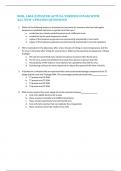
HESI A2 CRITICAL THINKING ACTUAL EXAM
PAPER 2026 QUESTIONS WITH SOLUTIONS
GRADED A+
◉ 1. In an interview, the nurse may find it necessary to take notes to aid
his or her memory later. Which statement is true regarding note-taking?
A) Note-taking may impede the nurse's observation of the patient's
nonverbal behaviors.
B) Note-taking allows the patient to continue at his or her own pace as
the nurse records what is said.
C) Note-taking allows the nurse to shift attention away from the patient,
resulting in an increased comfort level.
D) Note-taking allows the nurse to break eye contact with the patient,
which may increase his or her level of comfort. Answer: A) Note-taking
may impede the nurse's observation of the patient's nonverbal behaviors.
Page: 31 Some use of history forms and note-taking may be
unavoidable. But be aware that note-taking during the interview has
disadvantages. It breaks eye contact too often, and it shifts attention
away from the patient, which diminishes his or her sense of importance.
It also may interrupt the patient's narrative flow, and it impedes the
observation of the patient's nonverbal behavior.
,◉ 2. The 8-year-old client diagnosed with a vaso-occlusive sickle cell
crisis is complaining of a severe headache. Which intervention should
the nurse implement first?
1. Administer 6 L of oxygen via nasal cannula.
2. Assess the client's neurological status.
3. Administer a narcotic analgesic by intravenous push (IVP). 4. Increase
the client's intravenous (IV) rate. Answer: Rationale
Correct - 2-Because the client is complaining of a headache, the nurse
should first rule out cerebrovascular accident (CVA) by assess- ing the
client's neurological status and then determine whether it is a headache
that can be treated with medication.
◉ 2. During an interview, the nurse states, "You mentioned shortness of
breath. Tell me more about that." Which verbal skill is used with this
statement?
A) Reflection
B) Facilitation
C) Direct question
D) Open-ended question. Answer: D) Open-ended question
Page: 32 The open-ended question asks for narrative information. It
states the topic to be discussed but only in general terms. The nurse
,should use it to begin the interview, to introduce a new section of
questions, and whenever the person introduces a new topic.
◉ 3. The 6-year-old client who has undergone abdominal surgery is
attempting to make a pinwheel spin by blowing on it with the nurse's
assistance. The child starts crying because the pinwheel won't spin.
Which action should the nurse implement first?
1. Praise the child for the attempt to make the pinwheel spin.
2. Notify the respiratory therapist to implement incentive spirometry. 3.
Encourage the child to turn from side to side and cough.
4. Demonstrate how to make the pinwheel spin by blowing on it.
Answer: Rationale
Correct -1. The nurse should always praise the child for attempts at
cooperation even if the child did not accomplish what the nurse asked.
◉ 3. A nurse is taking complete health histories on all of the patients
attending a wellness workshop. On the history form, one of the written
questions asks, "You don't smoke, drink, or take drugs, do you?" This
question is an example of:
A) talking too much.
B) using confrontation.
C) using biased or leading questions.
, D) using blunt language to deal with distasteful topics. Answer: C) using
biased or leading questions.
Page: 36 This is an example of using leading or biased questions.
Asking, "You don't smoke, do you?" implies that one answer is "better"
than another. If the person wants to please someone, he or she is either
forced to answer in a way corresponding to their implied values or is
made to feel guilty when admitting the other answer.
◉ 4. The nurse is caring for clients on the pediatric medical unit. Which
client should the nurse assess first?
1. The child diagnosed with type 1 diabetes who has a blood glucose
level
of 180 mg/dL.
2. The child diagnosed with pneumonia who is coughing and has a
temperature of
100°F.
3. The child diagnosed with gastroenteritis who has a potassium (K+)
level
of 3.9 mEq/L.
4. The child diagnosed with cystic fibrosis who has a pulse oximeter
reading of 90%. Answer: Rationale
PAPER 2026 QUESTIONS WITH SOLUTIONS
GRADED A+
◉ 1. In an interview, the nurse may find it necessary to take notes to aid
his or her memory later. Which statement is true regarding note-taking?
A) Note-taking may impede the nurse's observation of the patient's
nonverbal behaviors.
B) Note-taking allows the patient to continue at his or her own pace as
the nurse records what is said.
C) Note-taking allows the nurse to shift attention away from the patient,
resulting in an increased comfort level.
D) Note-taking allows the nurse to break eye contact with the patient,
which may increase his or her level of comfort. Answer: A) Note-taking
may impede the nurse's observation of the patient's nonverbal behaviors.
Page: 31 Some use of history forms and note-taking may be
unavoidable. But be aware that note-taking during the interview has
disadvantages. It breaks eye contact too often, and it shifts attention
away from the patient, which diminishes his or her sense of importance.
It also may interrupt the patient's narrative flow, and it impedes the
observation of the patient's nonverbal behavior.
,◉ 2. The 8-year-old client diagnosed with a vaso-occlusive sickle cell
crisis is complaining of a severe headache. Which intervention should
the nurse implement first?
1. Administer 6 L of oxygen via nasal cannula.
2. Assess the client's neurological status.
3. Administer a narcotic analgesic by intravenous push (IVP). 4. Increase
the client's intravenous (IV) rate. Answer: Rationale
Correct - 2-Because the client is complaining of a headache, the nurse
should first rule out cerebrovascular accident (CVA) by assess- ing the
client's neurological status and then determine whether it is a headache
that can be treated with medication.
◉ 2. During an interview, the nurse states, "You mentioned shortness of
breath. Tell me more about that." Which verbal skill is used with this
statement?
A) Reflection
B) Facilitation
C) Direct question
D) Open-ended question. Answer: D) Open-ended question
Page: 32 The open-ended question asks for narrative information. It
states the topic to be discussed but only in general terms. The nurse
,should use it to begin the interview, to introduce a new section of
questions, and whenever the person introduces a new topic.
◉ 3. The 6-year-old client who has undergone abdominal surgery is
attempting to make a pinwheel spin by blowing on it with the nurse's
assistance. The child starts crying because the pinwheel won't spin.
Which action should the nurse implement first?
1. Praise the child for the attempt to make the pinwheel spin.
2. Notify the respiratory therapist to implement incentive spirometry. 3.
Encourage the child to turn from side to side and cough.
4. Demonstrate how to make the pinwheel spin by blowing on it.
Answer: Rationale
Correct -1. The nurse should always praise the child for attempts at
cooperation even if the child did not accomplish what the nurse asked.
◉ 3. A nurse is taking complete health histories on all of the patients
attending a wellness workshop. On the history form, one of the written
questions asks, "You don't smoke, drink, or take drugs, do you?" This
question is an example of:
A) talking too much.
B) using confrontation.
C) using biased or leading questions.
, D) using blunt language to deal with distasteful topics. Answer: C) using
biased or leading questions.
Page: 36 This is an example of using leading or biased questions.
Asking, "You don't smoke, do you?" implies that one answer is "better"
than another. If the person wants to please someone, he or she is either
forced to answer in a way corresponding to their implied values or is
made to feel guilty when admitting the other answer.
◉ 4. The nurse is caring for clients on the pediatric medical unit. Which
client should the nurse assess first?
1. The child diagnosed with type 1 diabetes who has a blood glucose
level
of 180 mg/dL.
2. The child diagnosed with pneumonia who is coughing and has a
temperature of
100°F.
3. The child diagnosed with gastroenteritis who has a potassium (K+)
level
of 3.9 mEq/L.
4. The child diagnosed with cystic fibrosis who has a pulse oximeter
reading of 90%. Answer: Rationale