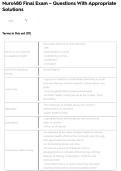
Nurs480 Final Exam – Questions With Appropriate
Solutions
Save
Terms in this set (111)
(from least effective to most effective)
-PPE
hierarchy of control for -administrative controls
occupational health -engineering controls
-substitution
-elimination
control of hazardous lockout/tagout
energy
-a group or collection of individuals interacting in social
units and sharing common interests, cultural values, and
goals
community
-it can be geopolitical or phenomenological
-(in public health nursing) serves as the context, client,
and setting
-the subgroups of a larger group with common
aggregate characteristics or concerns
-public health nursing
-a geographically-defined group, such as a county,
populations state, or country
-OR an at-risk group
-an extension of the realm of public health to include
organized health efforts at the community level through
both government and private efforts
-ex: AHA and american red cross
-focuses on a group of individuals within a
community health nursing
geographically or culturally defined group, with key
features of it being collaboration, initiatives, and
empowerment
-interventions focus on mainly improving education,
reducing employment, and incorporating SDOH
, -the art and science of preventing disease, prolonging
life, and promoting health through organized
community efforts to benefit each citizen
public health -its mission is social justice
-entitles all people to basic necessities such as
adequate income & health protection and accepts
collective burdens to make it possible
-focuses on population health through surveillance and
assessment of multiple determinants of health, with
intention to promote health and wellness, prevent
disease, disability, and premature health, and identify,
public health nursing implement, and evaluate evidence-based programs and
services
-prevention is key
-emphasizes primary prevention with the goal of
achieving health equity
A)primary prevention
-the prevention of health problems before they occur,
such as immunization
B)secondary prevention
-the early detection and intervention of health
levels of prevention
problems, such as screening for diseases
C)tertiary prevention
-the correction and prevention of deterioration of a
disease state, such as teaching insulin administration in
the home
-the prevention of health problems before they occur,
primary prevention
such as immunization
-the early detection and intervention of health
secondary prevention
problems, such as screening for diseases
-the correction and prevention of deterioration of a
tertiary prevention disease state, such as teaching insulin administration in
the home
, A)surveillance
B)disease and other health event investigation
C)outreach
D)screening
E)case finding
F)referral & followup
G)case management
H)delegated functions
levels of intervention I)health teaching
J)counseling
K)consultation
L)collaboration
M)coalition building
N)community organizing
O)advocacy
P)social marketing
Q)policy development & enforcement
-focus on improving community conditions through the
tactics of laws, policies, and regulations that create
community conditions supporting health for all people
upstream thinking -#1 shared characteristic b/w community & population
health is that they both enhance disease prevention
through the use of upstream health promotion
strategies
-the differences in health, or differences in important
influences on health, that are systematically associated
with being socially disadvantaged, such as being poor,
being a member of a disadvantaged racial/ethnic group,
or being female, and that put already disadvantaged
groups at further disadvantage; they could be
health inequality
avoidable by reasonable means
-the uneven distributions of health and health resources
as a result of genetic or other factors or a lack of
resources
-typically unavoidable differences in health and are not
the product of human behaviors
-the population-specific differences in the presence of
health disparities
disease, health outcomes, or access to healthcare
Solutions
Save
Terms in this set (111)
(from least effective to most effective)
-PPE
hierarchy of control for -administrative controls
occupational health -engineering controls
-substitution
-elimination
control of hazardous lockout/tagout
energy
-a group or collection of individuals interacting in social
units and sharing common interests, cultural values, and
goals
community
-it can be geopolitical or phenomenological
-(in public health nursing) serves as the context, client,
and setting
-the subgroups of a larger group with common
aggregate characteristics or concerns
-public health nursing
-a geographically-defined group, such as a county,
populations state, or country
-OR an at-risk group
-an extension of the realm of public health to include
organized health efforts at the community level through
both government and private efforts
-ex: AHA and american red cross
-focuses on a group of individuals within a
community health nursing
geographically or culturally defined group, with key
features of it being collaboration, initiatives, and
empowerment
-interventions focus on mainly improving education,
reducing employment, and incorporating SDOH
, -the art and science of preventing disease, prolonging
life, and promoting health through organized
community efforts to benefit each citizen
public health -its mission is social justice
-entitles all people to basic necessities such as
adequate income & health protection and accepts
collective burdens to make it possible
-focuses on population health through surveillance and
assessment of multiple determinants of health, with
intention to promote health and wellness, prevent
disease, disability, and premature health, and identify,
public health nursing implement, and evaluate evidence-based programs and
services
-prevention is key
-emphasizes primary prevention with the goal of
achieving health equity
A)primary prevention
-the prevention of health problems before they occur,
such as immunization
B)secondary prevention
-the early detection and intervention of health
levels of prevention
problems, such as screening for diseases
C)tertiary prevention
-the correction and prevention of deterioration of a
disease state, such as teaching insulin administration in
the home
-the prevention of health problems before they occur,
primary prevention
such as immunization
-the early detection and intervention of health
secondary prevention
problems, such as screening for diseases
-the correction and prevention of deterioration of a
tertiary prevention disease state, such as teaching insulin administration in
the home
, A)surveillance
B)disease and other health event investigation
C)outreach
D)screening
E)case finding
F)referral & followup
G)case management
H)delegated functions
levels of intervention I)health teaching
J)counseling
K)consultation
L)collaboration
M)coalition building
N)community organizing
O)advocacy
P)social marketing
Q)policy development & enforcement
-focus on improving community conditions through the
tactics of laws, policies, and regulations that create
community conditions supporting health for all people
upstream thinking -#1 shared characteristic b/w community & population
health is that they both enhance disease prevention
through the use of upstream health promotion
strategies
-the differences in health, or differences in important
influences on health, that are systematically associated
with being socially disadvantaged, such as being poor,
being a member of a disadvantaged racial/ethnic group,
or being female, and that put already disadvantaged
groups at further disadvantage; they could be
health inequality
avoidable by reasonable means
-the uneven distributions of health and health resources
as a result of genetic or other factors or a lack of
resources
-typically unavoidable differences in health and are not
the product of human behaviors
-the population-specific differences in the presence of
health disparities
disease, health outcomes, or access to healthcare